

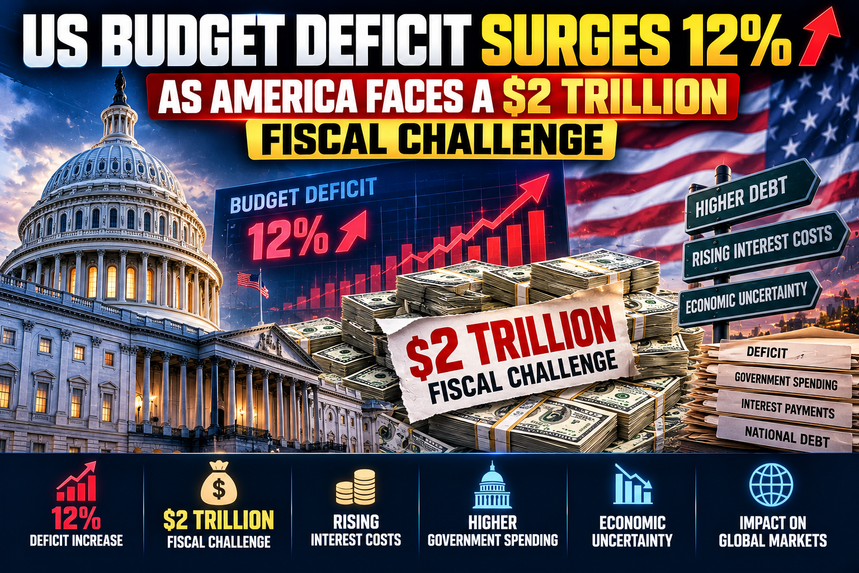
The United States is facing renewed pressure on its public finances as its federal budget deficit climbs, highlighting the growing gap between government spending and revenue. The deficit has become a major economic concern because it increases the amount the government must borrow, adds to the national debt and can influence interest rates, financial markets and future economic policy.

The reported 12% increase in the US budget deficit has renewed attention on Washington’s fiscal position, with the annual shortfall approaching the $2 trillion mark. A deficit of this size illustrates the challenge facing policymakers as they attempt to fund major government programmes, manage debt-servicing costs and maintain economic growth without allowing borrowing to rise indefinitely.
However, the exact meaning of the 12% increase depends on the reporting period and the comparison being used. A monthly deficit, a fiscal-year-to-date figure and a full-year projection can tell different stories. The $2 trillion figure should therefore be understood in the context of the relevant budget period rather than automatically treated as the final deficit for the current fiscal year.
Why Is the US Budget Deficit Increasing?
A federal budget deficit occurs when the government spends more money than it collects through taxes and other revenues during a given period. To cover the difference, the Treasury generally borrows by issuing government securities, including Treasury bills, notes and bonds.
One important factor behind the United States’ persistent deficits is the rising cost of mandatory spending. Programmes such as Social Security, Medicare and Medicaid account for a substantial portion of federal expenditure. These programmes provide retirement benefits, healthcare coverage and assistance to eligible Americans, making them important parts of the country’s social safety net.
Interest payments on existing federal debt are another significant pressure. As the national debt grows and government securities mature, the Treasury must continue servicing outstanding obligations. When interest rates are elevated, refinancing debt can become more expensive, leaving the government with less room in its budget for other priorities.
Defence spending, infrastructure programmes, other government operations and discretionary spending also contribute to the overall spending total. At the same time, tax receipts can fluctuate with economic growth, employment, corporate profitability and changes in tax policy.
When spending rises faster than revenue, the deficit can widen. The scale of the increase in any particular reporting period, however, depends on the balance of these factors and the timing of government receipts and payments.
How Does a $2 Trillion Deficit Affect the US Economy?
A deficit approaching $2 trillion represents a substantial financing requirement for the federal government. It does not mean the United States has run out of money or is automatically unable to meet its obligations. Instead, it means the government must borrow to cover the gap between its expenditure and income.
Large borrowing requirements can affect financial markets. When the Treasury issues more securities, investors must decide how much of their money to allocate to government debt compared with corporate bonds, equities and other assets. Depending on demand, inflation expectations and Federal Reserve policy, increased Treasury issuance can contribute to upward pressure on longer-term interest rates.
Higher borrowing costs can affect households and businesses. Mortgage rates, car loans, business financing and other forms of credit are influenced by broader interest-rate conditions. If government borrowing contributes to higher market rates, private borrowers may face more expensive financing.
The impact is not automatic, however. Treasury securities are also widely regarded as important safe assets in global financial markets. Demand from domestic and international investors, economic conditions and expectations about future monetary policy all influence Treasury yields.
A large deficit can also reduce the government’s fiscal flexibility. If a recession, natural disaster or international crisis requires additional spending, policymakers may face more difficult choices when debt and interest costs are already high.
Why Rising Debt-Servicing Costs Matter
The federal budget deficit adds to the government’s borrowing requirements, while the national debt represents the accumulated stock of outstanding federal obligations. These are related but different measures.
As the debt increases, interest payments can consume a larger share of federal revenue. Unlike spending that directly provides services or finances new infrastructure, interest payments largely reflect obligations created by earlier borrowing.
This can create a difficult cycle: larger deficits require more borrowing, a higher debt stock can generate greater interest costs, and higher interest costs can contribute to future deficits.
The speed at which this happens depends on interest rates, economic growth, inflation, tax revenue and the maturity structure of government debt. Strong economic growth can improve revenue and make debt easier to manage relative to the size of the economy, while weak growth and high borrowing costs can make the situation more challenging.
What Could the US Government Do Next?
Policymakers have several broad options for addressing persistent deficits. They can seek to increase government revenue, restrain spending growth, reform major entitlement programmes or combine these approaches. Measures that encourage productivity and economic growth may also improve the government’s long-term revenue outlook.
Each option involves trade-offs. Tax increases can raise revenue but may affect households, businesses and investment decisions. Spending reductions can improve the budget balance but may affect public services, benefits or government investment. Changes to major entitlement programmes can have significant consequences for retirees, patients and future beneficiaries.
Congress and the administration must also consider the timing of any fiscal adjustments. Rapid spending cuts or tax increases can weaken demand if implemented during a fragile economic period, while delaying difficult decisions can allow debt and interest costs to grow.
A credible long-term fiscal strategy would aim to stabilise debt relative to the size of the economy while preserving the government’s ability to respond to economic shocks and fund essential priorities.
What the Growing Deficit Means for Investors
Investors will monitor the deficit because it can influence Treasury issuance, bond yields, the dollar and expectations for future fiscal policy. Bond-market movements will depend not only on the size of the deficit but also on inflation, economic growth, investor demand and the Federal Reserve’s interest-rate decisions.
Stock markets may respond differently across sectors. Higher interest rates can place pressure on companies whose valuations depend heavily on future earnings, while financial institutions and other businesses may experience different effects depending on their funding structures and economic exposure.
International markets can also be affected because US Treasury securities play a central role in global finance. Changes in US borrowing costs and the dollar can influence capital flows, emerging-market currencies and the cost of financing for governments and businesses around the world, including in India.
Nevertheless, a 12% increase in the deficit does not by itself predict a market crash, a recession or a specific movement in the dollar. Investors need to consider the underlying data and the wider economic environment.
Conclusion
The rise in the US budget deficit highlights the growing challenge of balancing government spending, revenue and debt-servicing costs. A shortfall approaching $2 trillion would represent a major borrowing requirement, while continued increases could narrow Washington’s room to respond to future economic challenges.
The key issue is not simply the headline deficit figure but whether government revenue and economic growth can keep pace with spending and interest obligations over time. The future path will depend on fiscal policy, borrowing costs, economic performance and the willingness of policymakers to make difficult budget decisions.
For financial markets, the deficit remains an important indicator to watch, but its consequences will depend on how it develops relative to the size of the US economy and how investors respond to the government’s financing needs.
About The Author