

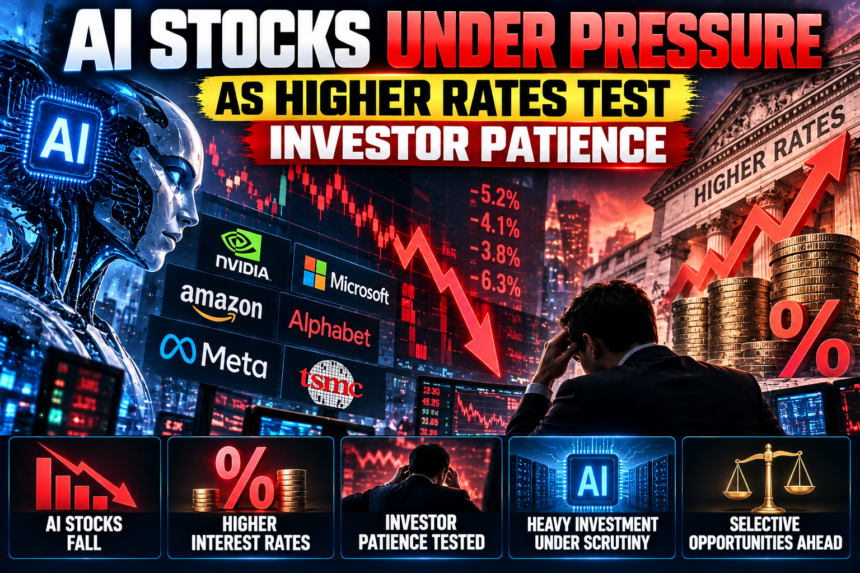
Artificial intelligence(AI) has become one of the most powerful forces shaping the global stock market, attracting billions of dollars in investment and driving the valuations of major technology companies. However, the sector faces a growing challenge as higher interest rates test investor confidence and raise questions about how much investors should pay for future growth.

AI-related stocks have benefited from strong demand for advanced chips, cloud computing, data centres and AI-powered software. Companies developing the infrastructure behind artificial intelligence have attracted considerable attention because of their potential to benefit from the rapid adoption of the technology. Yet, even businesses with promising long-term prospects can experience market pressure when borrowing costs remain high and investors become more selective.
The central question facing the market is whether the expected growth from artificial intelligence can justify the substantial investments and elevated valuations associated with the industry.
Why Higher Interest Rates Put Pressure on AI Stocks
Interest rates play an important role in determining how investors value companies, particularly businesses whose earnings are expected to grow significantly in the future.
When interest rates rise or remain elevated, investors can earn more from relatively lower-risk assets, such as government bonds. This makes expensive growth stocks less attractive by comparison. Investors may demand stronger earnings potential before paying premium prices for technology companies.
Higher interest rates also reduce the present value of future profits. Many AI businesses are valued partly on the expectation that their revenue and earnings will expand substantially over the coming years. When the discount rate used to value those future earnings increases, the estimated value of those profits falls.
This does not necessarily mean that AI demand is weakening. Instead, it means the financial conditions used to evaluate AI companies have become more demanding.
Companies with high valuations, limited current profitability or substantial capital requirements can be particularly vulnerable when investors reassess their expectations.
Chipmakers and Data Centre Companies Under Scrutiny
The AI investment boom has created opportunities for semiconductor manufacturers, server suppliers, networking companies and data centre operators. These businesses provide the computing power required to train and operate increasingly sophisticated AI models.
Chipmakers have benefited from demand for high-performance processors and specialised accelerators. Meanwhile, cloud providers and data centre operators are investing heavily in computing capacity, electricity infrastructure, cooling systems and networking equipment.
However, higher interest rates can complicate this expansion. Building AI infrastructure requires substantial upfront spending, and some projects depend on financing that becomes more expensive when borrowing costs rise.
Investors are therefore examining whether the anticipated demand will translate into sustainable revenue growth, strong profit margins and attractive returns on invested capital.
The market may increasingly distinguish between companies with established customer demand and strong cash generation and businesses whose future success depends on uncertain revenue projections.
Big Tech Faces Growing Pressure to Prove AI Returns
Major technology companies have committed enormous resources to developing AI models, expanding cloud infrastructure and integrating artificial intelligence into existing products. Their investments reflect the belief that AI could transform productivity, advertising, software development, online search and enterprise computing.
Nevertheless, investors are becoming increasingly attentive to the financial results of these investments.
Building AI infrastructure can increase capital expenditure long before the resulting products generate enough revenue to cover the cost. Companies must also account for electricity consumption, specialised hardware, research and development, talent acquisition and ongoing operating expenses.
If AI adoption grows rapidly and customers are willing to pay for advanced services, these investments could support substantial long-term profits. But if monetisation progresses more slowly than expected, investors could question whether spending levels are sustainable.
Higher interest rates intensify this scrutiny because capital becomes more expensive and the opportunity cost of large investments increases.
Consequently, quarterly earnings reports, capital expenditure forecasts, cloud revenue growth and management guidance may play an increasingly important role in determining which AI stocks outperform.
Valuations Become a Major Concern
One of the biggest risks for AI investors is the possibility that market prices already reflect exceptionally optimistic expectations.
When investors anticipate rapid revenue growth, expanding profit margins and dominant market positions, even strong business results may not be enough to push share prices higher. Companies must often exceed expectations to justify premium valuations.
If growth falls short of forecasts, the resulting adjustment can be significant. A stock can decline even when its underlying business continues to expand because the market had expected an even stronger performance.
This creates a challenging environment for investors attempting to distinguish between temporary volatility and a more fundamental reassessment of the sector.
Not every AI company faces the same risks. Established businesses with diversified revenue streams, strong balance sheets and consistent free cash flow may be better positioned to withstand tighter financial conditions. Companies that rely heavily on external financing or speculative future demand may face greater pressure.
Could AI Stocks Recover if Interest Rates Fall?
A decline in interest rates could provide support to growth-oriented technology stocks by reducing financing costs and increasing the present value of expected future earnings. It could also encourage investors to take on more risk.
However, lower rates alone would not guarantee a sustained recovery. AI companies would still need to demonstrate that their products solve meaningful problems, attract paying customers and generate sufficient returns to justify continued investment.
The direction of monetary policy also depends on economic conditions, inflation and central bank assessments. Investors should therefore avoid assuming that interest rates will fall on a particular timetable or that every AI stock will benefit equally.
In the long run, business fundamentals are likely to remain crucial. Revenue growth, profit margins, cash generation, competitive advantages and disciplined capital allocation will help determine which companies can turn the AI boom into lasting shareholder value.
What Investors Should Watch Next
Investors following AI stocks should pay close attention to several developments: central bank interest-rate decisions, inflation data, corporate earnings, AI-related capital expenditure and evidence that businesses are generating meaningful revenue from AI services.
It is also important to monitor whether demand for advanced chips and computing infrastructure continues to justify the industry’s substantial spending plans. Changes in competition, energy costs, regulation and technology could influence profitability even if overall AI adoption remains strong.
Diversification and careful valuation analysis can help investors manage the risks associated with a rapidly evolving sector. Rather than assuming that every company associated with artificial intelligence will succeed, investors can evaluate individual businesses based on their financial strength, competitive position and ability to generate sustainable returns.
Conclusion
AI stocks remain connected to one of the most important technological shifts of the modern economy, but higher interest rates are testing investor patience and raising the standard for acceptable returns. Expensive financing, elevated valuations and uncertainty over AI monetisation are encouraging investors to scrutinise the sector more closely.
The long-term outlook for artificial intelligence may remain promising, but that does not eliminate the possibility of short-term volatility or significant differences in performance between companies. The next phase of the AI investment story may depend less on excitement alone and more on earnings, cash flow and evidence that massive investments can produce lasting profits.
For investors, the key challenge is to separate genuine long-term opportunities from valuations that leave little room for disappointment.
About The Author