

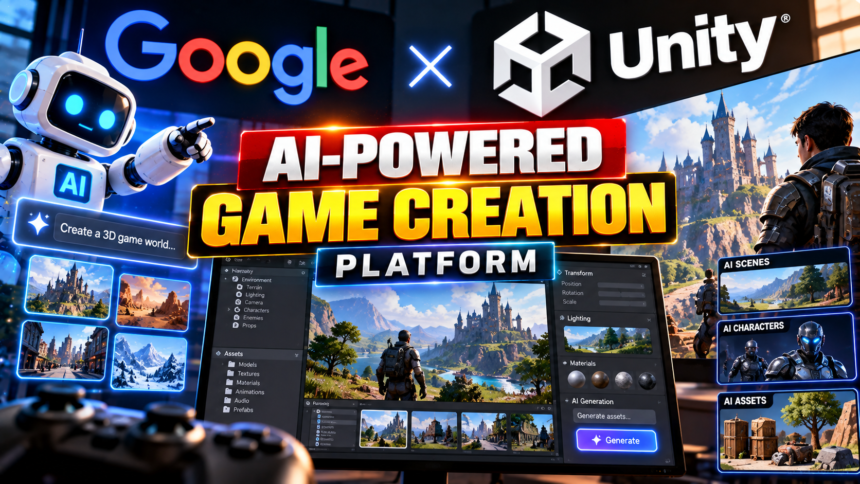
Google and Unity announced a major partnership on October 7, 2026, aimed at making video game creation accessible to a much wider audience through artificial intelligence. The initiative introduces Playground, an experimental platform that allows users to create, customise, play and share games simply by describing their ideas in everyday language. The announcement marks another step in the growing use of generative AI in the gaming industry, where technology is increasingly helping people turn creative concepts into playable experiences without requiring advanced programming skills.
The platform is designed for people who want to experiment with game development, including beginners, gaming enthusiasts and aspiring creators. Instead of learning a programming language or building an entire project from scratch, users can describe the kind of game they want and then refine it through further instructions. Google says creators can adjust gameplay rules, character designs, physics and environments through its conversational interface. The service is experimental, and the company intends to develop it further as users test its capabilities and provide feedback.
How Google’s Playground Platform Works
Playground uses a conversational approach to game development. Users can begin with a blank project, adapt a starter idea or follow guided prompts to create a game. They can describe the genre, gameplay mechanics, visual appearance and other features they want to include. The AI then helps turn those instructions into a playable browser-based experience.
For example, a user could request a racing game with multiple tracks, obstacles, speed boosts and a points system. Another creator might ask for a puzzle game in which players solve challenges to unlock new levels. Users can then request changes to the rules, environment or characters rather than rebuilding the entire project manually.
The platform also supports the use of uploaded visuals, which can be adapted into game assets that fit the intended art style. Once a project is ready, it can be tested directly in the browser. Games can be kept private, shared through links or published to Playground’s Explore gallery, where other people can discover and play them.
Google has also highlighted community features, including leaderboards and multiplayer matchmaking for supported experiences. Published games undergo safety screening, and users can report content that violates the platform’s guidelines.
Unity Spark Could Bring More Advanced 3D Gaming Features
Alongside Playground, Google and Unity announced plans for an expanded creation experience called Unity Spark. The companies say this product is intended to provide more advanced capabilities for creators who want to move beyond simple experimental games.
Unity is widely known for its game-development engine, which is used to build games for mobile devices, computers, consoles and other platforms. Integrating Unity technology with AI-assisted creation could allow users to begin with a basic idea and gradually develop more sophisticated projects.
According to the companies, Unity Spark is expected to support professional-level mechanics, higher-fidelity 3D graphics and the flexibility of the Unity runtime. It is currently in testing, with a closed beta planned for later in 2026. These capabilities are planned features, not a guarantee that every advanced game can already be created automatically.
The broader idea is to create a pathway from beginner-friendly experimentation to more advanced development. A creator could start by generating a simple playable prototype, test whether the concept works, and then use more powerful tools to improve its mechanics, visuals and overall presentation.
Availability, Access and Pricing
Google launched Playground on October 7, 2026, initially for users aged 18 and older in the United States. The platform is available through its website, and the company has indicated that it plans to expand access over time.
Browsing and playing games in the platform’s catalogue is free. Creating games uses a weekly token system, with limited access available on the free tier and higher usage limits for eligible Google AI subscription users. The exact experience and available features may change as Playground develops.
For users outside the United States, including India, availability is an important consideration. The initial launch does not establish that the complete creation service is accessible in every country. Interested users can check the official website for the latest regional eligibility and access information.
Official website: Google Playground
What This Means for the Gaming Industry
The partnership could lower the barrier to entry for independent game creators. In traditional development, even a relatively small game can require programming, artwork, animation, sound design, testing and considerable time. AI-assisted tools may help beginners produce early prototypes more quickly and give experienced developers a faster way to experiment with ideas.
However, generating a playable game is not the same as producing a polished commercial release. High-quality games still require thoughtful level design, balanced mechanics, performance optimisation, testing and original creative direction. Developers may also need to review intellectual-property rights, asset licences and the terms governing the distribution or monetisation of AI-generated content.
The development also increases competition among platforms that allow users to create their own games. Services such as Roblox have already built large communities around user-generated experiences. Google’s partnership with Unity could attract creators interested in browser-based projects and eventually more advanced 3D games, although its long-term impact will depend on the quality of its tools and the size of its community.
Conclusion
Google and Unity’s new initiative represents a significant development in AI-assisted gaming. Playground is designed to let users create and share playable games using text prompts, while the planned Unity Spark integration aims to offer a more advanced route into 3D development and sophisticated gameplay.
The platform does not eliminate the need for creativity, testing or technical expertise in professional game development. Instead, it offers a new way to begin projects and experiment with ideas. Its future success will depend on how well it translates user instructions into engaging games, how widely it becomes available and whether creators can use it to build experiences that keep players coming back.
Sources: Google’s official announcement | Unity’s official announcement | TechCrunch
About The Author