

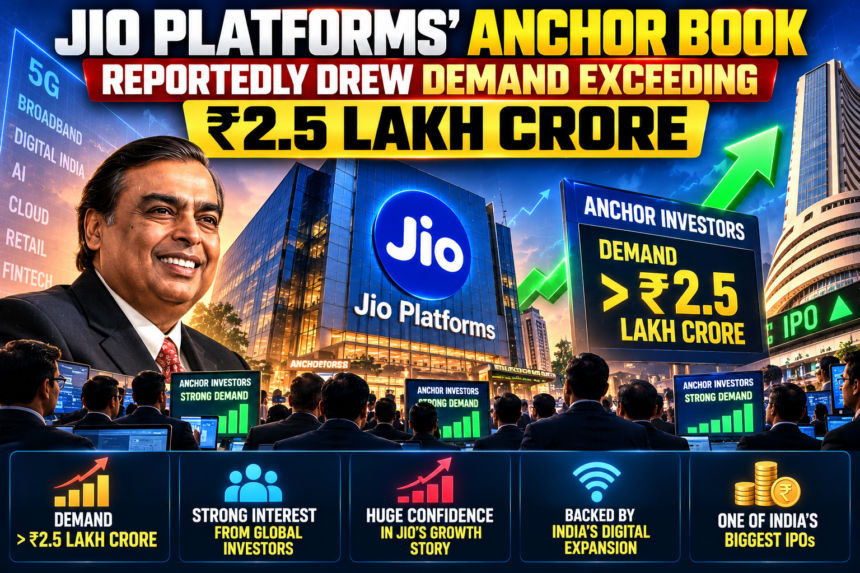
Jio Platforms’ much-anticipated initial public offering (IPO) is attracting significant attention from investors, with reports suggesting that demand for its anchor book has exceeded ₹2.5 lakh crore. If confirmed, the strong interest would underline the scale of investor expectations surrounding the potential stock-market debut of Reliance Industries’ digital and telecommunications business.

The reported demand comes as investors look for opportunities in India’s expanding digital economy, including telecommunications, cloud computing, digital payments and artificial intelligence infrastructure. Jio Platforms has established itself as one of the country’s most influential digital businesses, supported by its telecommunications subsidiary, Reliance Jio Infocomm, and a growing collection of technology-related services.
However, the reported ₹2.5 lakh crore figure represents investor demand, not the amount Jio Platforms will necessarily raise through the IPO. Anchor-book demand can exceed the shares available for allocation by a substantial margin. The final amount raised will depend on the offer size, pricing, allocation and terms formally disclosed by the company.
What Is the Jio Platforms Anchor Book?
An anchor book is a portion of an IPO reserved for eligible institutional investors before the broader public subscription process begins. These investors may include mutual funds, insurance companies, pension funds and other qualifying domestic or international institutions.
Anchor investors are typically offered shares at the IPO price determined under the applicable process. Their participation can help establish early institutional interest and provide an indication of how large investors view the company’s valuation and business prospects.
If reports of more than ₹2.5 lakh crore in demand are accurate, the interest would be substantial relative to the size of a large Indian public offering. Nevertheless, the demand figure needs to be distinguished from confirmed allocations. Investors may express interest in quantities of shares greater than the number they ultimately receive.
The final anchor allocation, investor list and price will be important indicators for assessing the level of institutional participation.
Why Are Investors Interested in Jio Platforms?
Jio Platforms occupies a central position in India’s digital economy. Its telecommunications business has built a large customer base by offering mobile connectivity, high-speed internet and digital services across the country.
The company’s wider ecosystem includes digital applications, entertainment services, cloud-related offerings and technology platforms. This gives investors exposure to several parts of the digital economy through a single corporate group.
One of the biggest attractions is the potential for continued data consumption growth. As more Indians use video streaming, digital payments, online shopping and AI-powered services, demand for reliable connectivity and computing infrastructure is likely to remain important.
Jio’s existing customer relationships and network infrastructure could also help it introduce new services, improve customer engagement and generate additional revenue. However, these opportunities will depend on competition, pricing, investment requirements and the company’s ability to convert usage growth into sustainable profits.
The Role of 5G and Artificial Intelligence
Telecommunications infrastructure is becoming increasingly important as businesses and consumers adopt more data-intensive services. Jio’s 5G network provides a platform for higher-speed connectivity, enterprise applications and new digital services.
Artificial intelligence could create another potential growth opportunity. AI applications require computing capacity, connectivity and data-centre infrastructure, all of which are becoming strategically important as companies expand their digital operations.
Jio Platforms could benefit from the adoption of AI-enabled services and enterprise technology offerings. However, investors will need to evaluate the actual revenue contribution of these businesses rather than relying solely on the size of the overall AI market.
Developing and operating advanced infrastructure can also require substantial capital expenditure. The long-term financial benefit will depend on whether additional investment generates adequate returns.
What Could the IPO Mean for Reliance Industries?
A public listing of Jio Platforms would give investors a direct route to owning shares in a business that is currently part of Reliance Industries’ wider corporate structure.
For Reliance Industries, the IPO could provide a market-based valuation of the digital business and potentially create greater visibility into its financial performance. A listing could also broaden Jio Platforms’ shareholder base and establish a framework for direct participation by public-market investors.
The actual financial impact on Reliance Industries would depend on the structure of the offering. A fresh issue would bring proceeds into Jio Platforms, whereas an offer for sale would allow existing shareholders to sell some of their holdings. The two structures have different implications for the company’s balance sheet and existing shareholders.
Investors should therefore examine the final offer documents to determine how much money the company itself will receive and whether the transaction will involve dilution of existing ownership.
How Could Strong Demand Affect the IPO Valuation?
Heavy institutional interest can improve confidence in an IPO, but it does not automatically guarantee a successful listing or continued share-price gains.
The valuation will depend on factors such as revenue growth, profitability, cash flow, debt, capital expenditure and the future outlook for telecommunications and digital services. Investors will also compare Jio Platforms with other listed telecommunications and technology companies, while accounting for differences in business models and growth prospects.
If the IPO is priced aggressively, even a company with strong demand could face volatility after listing. Conversely, a valuation that investors consider reasonable relative to the company’s growth prospects may support demand from a wider range of buyers.
The final subscription figures, allocation details and listing performance will provide a clearer picture of market sentiment.
What Should Investors Watch Next?
The most important developments will be the formal IPO timetable, price band, issue size, valuation, anchor allocation and the opening and closing dates for public subscription. Investors should also review the company’s financial statements, risk disclosures, use of proceeds and shareholding structure before making a decision.
It is particularly important to distinguish reported investor interest from confirmed regulatory disclosures. An anchor-book demand figure does not guarantee that the entire IPO will be oversubscribed, nor does it establish the price at which the shares will trade after listing.
Conclusion
The reported demand of more than ₹2.5 lakh crore for Jio Platforms’ anchor book highlights the considerable attention surrounding a potential listing of one of India’s largest digital businesses. Its telecommunications scale, digital ecosystem and exposure to future technology growth could make the IPO a closely watched event in the Indian capital market.
However, the headline demand figure should be treated as a reported indication of institutional interest until confirmed by official allocation disclosures. The IPO’s eventual success will depend on its valuation, financial fundamentals, offer structure and the willingness of investors to hold the shares beyond the initial listing.
For investors, the key question is not simply how much demand the IPO attracts, but whether Jio Platforms’ long-term earnings potential justifies the valuation at which its shares are offered.
About The Author