

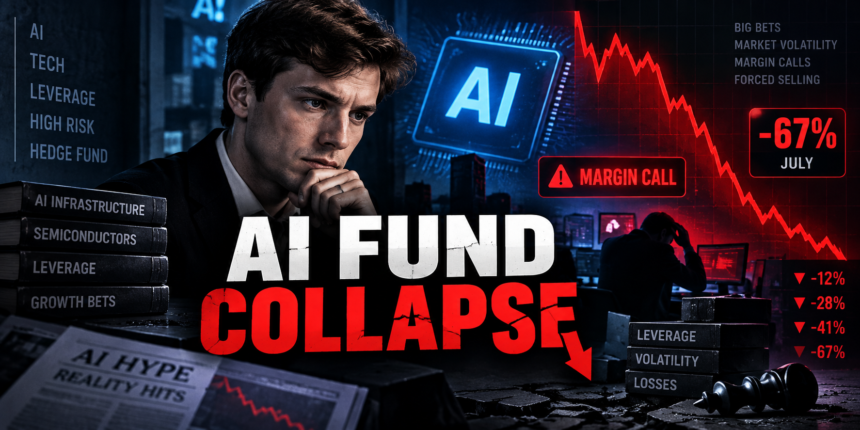
Leopold Aschenbrenner’s AI-focused hedge fund Situational Awareness suffered a dramatic collapse in July 2026 after a concentrated bet on the artificial-intelligence boom turned sharply against it. The fund’s portfolio value fell by about 67% in July, according to a letter sent to investors, after AI-related stocks experienced a severe sell-off and leveraged positions amplified the losses.

The collapse is particularly striking because Situational Awareness had been one of the most successful AI-focused investment stories of the year. The fund reportedly grew to roughly $45 billion at its peak in early July, while its returns had been extraordinary. But the same high-conviction strategy that generated huge gains also exposed the fund to enormous downside when the AI trade reversed.
The Fund Was Built Around a Huge AI Bet
Aschenbrenner became well known after publishing his 2024 essay Situational Awareness, in which he argued that increasingly powerful AI systems could arrive much sooner than many investors expected.
His investment thesis followed a straightforward chain: if AI capabilities accelerate rapidly, demand for the infrastructure needed to build and operate those systems should also explode.
That meant investing heavily in companies involved in semiconductors, memory, data centres, computing infrastructure and electricity.
Among the fund’s major public-market positions were companies such as Nebius, SanDisk, Micron, CoreWeave and SK Hynix. It also held private investments, including a major position in AI company Anthropic. At the same time, the fund reportedly shorted some software companies that Aschenbrenner believed could eventually be disrupted by AI.
For much of 2026, this strategy worked extremely well.
But it created an important weakness: the portfolio was heavily concentrated around one broad economic theme. When investors started questioning AI valuations and semiconductor demand, several of the fund’s largest positions fell simultaneously.
Leverage Turned a Stock-Market Correction Into a Crisis
The most important reason the losses became so large was leverage.
Leverage means borrowing money to increase the size of an investment position. It can dramatically increase profits when markets move in the investor’s favour, but it can also magnify losses when prices move in the opposite direction.
Reports indicated that Situational Awareness had used very high leverage, with some accounts describing exposure as high as several times the fund’s capital. The Economic Times reported that leverage had reached as much as 400% on a concentrated portfolio.
Consider a simplified example: if an investor has ₹100 and borrows another ₹300 to invest ₹400, a 25% decline in the investment wipes out the entire original ₹100.
That is essentially the danger Aschenbrenner’s fund encountered.
When AI-related stocks began falling sharply, the losses were not simply absorbed as a normal decline in portfolio value. The borrowed positions created additional pressure because lenders and prime brokers require investors to maintain sufficient collateral.
As the value of the securities fell, the fund faced margin calls, requiring it to provide additional cash or reduce positions.
AI Stocks Fell at Exactly the Wrong Time
The timing of the sell-off made the situation even worse.
The fund’s largest US-listed holdings reportedly suffered declines of more than 35% during July, while other semiconductor and AI-infrastructure stocks also came under heavy selling pressure.
This was particularly damaging because these were not small positions. The fund had built substantial exposure to companies expected to benefit from rapidly increasing AI spending.
As investors became concerned about the enormous amounts being spent on AI infrastructure, the market began reassessing whether the expected returns would justify those investments.
That caused a reversal in some of the most crowded AI trades.
The problem was then compounded by the fund’s short positions.
Aschenbrenner had also bet against certain software companies that he expected AI to disrupt. But some of those stocks rose instead of falling.
That meant both sides of the strategy were moving against him simultaneously: the stocks he owned were falling while some stocks he had shorted were rising.
Normally, a long-short strategy is designed so gains on one side can offset losses on the other. In this case, the opposite happened.
Falling Liquidity Made Everything Worse
Another major problem was liquidity.
As markets moved rapidly, it became increasingly difficult for the fund to adjust positions without causing additional losses. Aschenbrenner told investors that positions were moving rapidly against the fund while market liquidity was drying up.
This created what he described as a situation resembling a bank run: falling asset prices increased the fund’s vulnerability, which encouraged further selling and increased the pressure.
Once lenders demanded additional collateral, the fund could no longer simply wait for its long-term AI thesis to play out.
That is an important distinction.
Aschenbrenner could still believe that AI infrastructure companies would eventually become extremely valuable. But a leveraged investor can be forced to sell before the long-term thesis has time to work.
The Fund Was Forced to Sell Most of Its Public Portfolio
The crisis ultimately forced Situational Awareness to unwind most of its public-equity holdings.
The bulk of the fund’s public stock portfolio was sold to Citadel, the investment firm led by billionaire Ken Griffin, in a major block transaction. Reuters reported that the fund had effectively unwound most of its public-equity portfolio after the July losses.
Aschenbrenner acknowledged the severity of the situation in his letter to investors, saying the fund had come closer to permanent capital impairment than was acceptable.
He also said that the firm had removed leverage from the portfolio.
Despite the collapse, the fund was still reportedly up around 80% for 2026 at the end of July because of its enormous gains earlier in the year.
That illustrates how extreme the fund’s performance had been in both directions.
Why JPMorgan Stopped Lending
The consequences have continued beyond the July crash.
On September 11, JPMorgan Chase stopped lending to Situational Awareness following the fund’s losses, according to Reuters. The bank had been involved through its prime-brokerage business, which provides financing and other services to hedge funds.
The decision highlights the importance of leverage in the collapse. Prime brokers are not simply trading partners; they also provide financing that allows hedge funds to build positions larger than their own capital.
Other major financial institutions, including Goldman Sachs, Citigroup and Bank of America, remain involved with the fund as brokers, according to Reuters.
Situational Awareness has also been working with Clear Street as it rebuilds its portfolio.
Aschenbrenner Is Betting on AI Again
Perhaps the most surprising development is that Aschenbrenner has not abandoned his AI investment thesis.
Recent reports indicate that Situational Awareness has returned to AI-related investments, including call options linked to companies such as AMD, CoreWeave, SK Hynix and SanDisk.
The difference is the structure of the trades.
Using fully paid-for options can limit the maximum loss to the premium paid for the option, unlike highly leveraged stock positions that can create much larger collateral requirements.
This suggests that Aschenbrenner still believes the underlying AI infrastructure opportunity is intact, but has recognised that the portfolio needs a different risk structure.
What the Collapse Says About the AI Boom
The Situational Awareness collapse does not necessarily prove that the AI boom is over.
Instead, it demonstrates the difference between being right about a technology and being right about its stock prices at a particular moment.
AI could continue transforming computing, software and the global economy while individual AI-related stocks still fall sharply.
A company can have strong long-term prospects and nevertheless become a poor investment if its valuation becomes too high, if investors become overly crowded into the trade or if the investor holding it uses excessive leverage.
That is arguably the biggest lesson from Aschenbrenner’s experience.
His original AI thesis may still prove correct. But leverage, concentration and liquidity risk can overwhelm even a fundamentally strong investment thesis.
The collapse therefore serves as a warning for the wider AI investment boom: the future of artificial intelligence may remain extraordinarily promising, but betting on that future with borrowed money can turn a temporary market correction into a catastrophic loss.
For Aschenbrenner, the strategy now appears to be about surviving long enough to see whether his long-term AI prediction comes true—without allowing another short-term market shock to force him out of the trade.
About The Author