

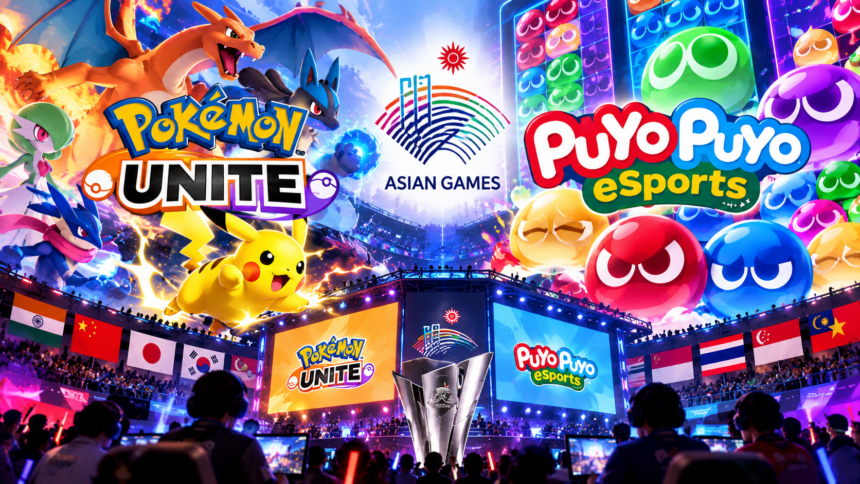
Esports Expands Its Role at the Asian Games
Esports is taking another major step into mainstream international sport at the Aichi-Nagoya 2026 Asian Games, with competitive gaming returning as an official medal discipline. The tournament, being held in Japan from September 19 to October 4, has expanded the esports programme, with competitions taking place at Aichi Sky Expo between September 23 and October 2. The Olympic Council of Asia has confirmed 11 esports medal events, including Pokémon UNITE and Puyo Puyo Champions.

The inclusion of these two games is particularly notable because they represent very different sides of competitive gaming. Pokémon UNITE is a team-based multiplayer battle arena title requiring coordination, strategy and rapid decision-making, while Puyo Puyo Champions is a competitive puzzle game where speed, pattern recognition and precise execution are critical.
Both games also have an Indian connection this year. India has been approved to compete in four esports titles at Aichi-Nagoya — League of Legends, Pokémon UNITE, eFootball and Puyo Puyo Champions — as part of a 15-member esports contingent.
Pokémon UNITE Makes Its Asian Games Appearance
Pokémon UNITE brings one of the world’s most recognizable gaming franchises into a serious international esports environment. Unlike traditional Pokémon games, UNITE is built around five-player team battles, with teams competing to score points while defeating opponents and controlling objectives on the battlefield.
For the 2026 Asian Games, 11 National Olympic Committees are participating in the Pokémon UNITE event. The competition is scheduled for September 27, with the knockout stages continuing into September 28 according to the published esports schedule.
India’s six-player Pokémon UNITE squad consists of Adnan Mohammed Badshah, Reuben Godfrey Fernandes, Sai Krishna Nalluri, Dipjyoti Laxman Nath, Rudra Narayan Nayak and Deepkumar Vipulbhai Patel. Adnan Mohammed Badshah is the designated captain. The players come from different parts of India, including Madhya Pradesh, Maharashtra, Andhra Pradesh, Odisha and Gujarat.
The six-player roster gives India both its playing lineup and additional flexibility during a long tournament. In a team-based title such as Pokémon UNITE, communication, role coordination and adaptation to an opponent’s strategy can be just as important as individual mechanical skill.
Why Pokémon UNITE Is Different From Traditional Asian Games Esports
Pokémon UNITE also demonstrates how esports at the Asian Games is becoming more diverse. Earlier Asian Games esports programmes were strongly associated with major PC and mobile competitive titles, but the Aichi-Nagoya programme includes games spanning racing, football, fighting games, multiplayer battle arenas and puzzle competition.
The OCA’s official programme includes Pokémon UNITE alongside games such as League of Legends, Honor of Kings, Mobile Legends: Bang Bang, PUBG Mobile, Identity V, Naraka: Bladepoint, Gran Turismo 7 and eFootball.
That variety is important because it allows different types of esports athletes to compete on the same continental sporting stage. Pokémon UNITE places particular emphasis on coordinated team play, while other events test racing precision, tactical decision-making, fighting-game execution or individual puzzle skills.
Puyo Puyo Champions Brings Puzzle Esports to the Games
Puyo Puyo Champions provides an entirely different competitive experience.
The classic Japanese puzzle franchise is built around matching and clearing groups of Puyos. At professional level, however, the game becomes considerably more complex. Players must build combinations quickly, manage the board under pressure and anticipate the opponent’s moves while maintaining their own attack patterns.
For Aichi-Nagoya 2026, the Puyo Puyo Champions competition features 12 participating National Olympic Committees according to the OCA’s official participation announcement.
The competition format is also designed specifically for high-level head-to-head play. According to the Japanese esports schedule, the preliminary stage was held on September 24 using a round-robin format divided into two groups, with matches decided by a best-of-five structure. The final-stage competition is being held on September 26, with the quarterfinals and later rounds using longer match formats.
India’s representative in Puyo Puyo Champions is Paritosh, who is part of the country’s approved 15-member esports contingent.
India’s Puyo Puyo Campaign Draws Attention
India’s participation in Puyo Puyo has already produced a notable storyline at the Games. Karl Gonzalvo of the Philippines reached the quarterfinals, demonstrating the intensity of the competition as players from different Asian esports communities faced each other.
The event has also highlighted the international nature of competitive puzzle gaming. Countries and territories participating in the Puyo Puyo competition include India, Japan, Hong Kong, Kazakhstan, South Korea, Mongolia, the Philippines, Singapore, Thailand and Chinese Taipei.
India’s Wider Esports Campaign
India’s participation in Pokémon UNITE and Puyo Puyo Champions forms part of a broader esports campaign at the Asian Games. The country’s 15-member contingent is competing across four titles, with six players assigned to Pokémon UNITE, one to Puyo Puyo Champions, two to eFootball and six to League of Legends.
This is also an expansion of India’s involvement compared with the previous Asian Games. At Hangzhou, India sent a 19-member esports contingent, while the League of Legends team finished fifth.
The 2026 Games therefore provide another opportunity for Indian esports athletes to compete under a national banner and gain experience in a multi-sport event environment.
A Bigger Moment for Esports in Asia
The significance of Pokémon UNITE and Puyo Puyo at Aichi-Nagoya goes beyond the individual games. Esports first appeared at the Asian Games as a demonstration sport at Jakarta-Palembang in 2018 before becoming a full medal discipline at Hangzhou in 2023. Aichi-Nagoya now continues that progression with an expanded programme.
The decision to include both a globally recognized Pokémon title and a traditional Japanese puzzle franchise also reflects the broad range of competitive gaming. One relies heavily on team communication and tactical play; the other rewards individual speed, calculation and consistency.
With Pokémon UNITE and Puyo Puyo Champions now part of the Asian Games medal programme, competitive gaming is gaining another major platform in front of an international sporting audience. For India, participation in both events adds another chapter to the country’s developing esports presence and gives its players an opportunity to compete on one of Asia’s biggest sporting stages.
About The Author