

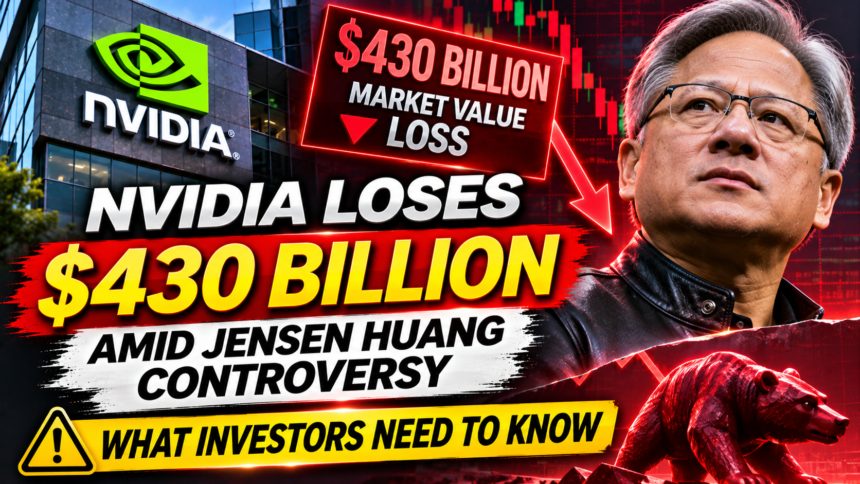
Nvidia, the world’s leading artificial intelligence chipmaker, is facing one of the most serious crises in its recent history after losing approximately $430 billion in market value over just two trading sessions. The dramatic decline followed reports concerning CEO Jensen Huang’s alleged relationship with a Chinese businesswoman suspected by US intelligence officials of having links to Beijing.
The controversy has raised questions about corporate governance, national security, semiconductor exports to China and Nvidia’s dependence on its long-time chief executive. Investors are increasingly concerned that the situation could develop into a much larger regulatory and political issue for the company.
According to Reuters reporting on November 10, Nvidia shares fell approximately 9.5% over two sessions, wiping out around $430 billion in market capitalisation. The stock declined 4.3% on Monday and another 5.5% on Tuesday, briefly allowing Microsoft to overtake Nvidia as the world’s second-most valuable company.
The situation is particularly significant because Nvidia has become one of the most important companies in the global AI industry. Its processors power data centres, advanced AI models and cloud computing infrastructure used by some of the world’s largest technology businesses.
BOX 1: What Happened to Nvidia?
The controversy began after reports emerged concerning Jensen Huang’s alleged relationship with Alice Huang, also known as Huang Le, a Chinese businesswoman who is not related to the Nvidia CEO.
US intelligence agencies reportedly suspected that Alice Huang had connections to Chinese intelligence. The allegations attracted additional attention after reports suggested that her business network had obtained access to large quantities of Nvidia processors and helped move restricted chips into China.
The reports also raised questions about whether Huang’s personal relationship could have created potential national security risks or exposed the company to pressure from foreign intelligence operations.
The FBI is examining whether Jensen Huang himself was targeted by a foreign intelligence operation.
Importantly, these are allegations and intelligence-related claims, not established findings of wrongdoing by Huang. Nvidia has said its board has no reason to believe that US national security or company secrets were compromised.
The controversy has nevertheless created considerable uncertainty among investors because of Nvidia’s strategic importance to the American technology industry.
BOX 2: How Nvidia Lost $430 Billion in Market Value
Nvidia’s shares experienced two consecutive sessions of significant selling.
| Trading session | Share-price movement |
|---|---|
| Monday, November 9 | Down approximately 4.3% |
| Tuesday, November 10 | Down approximately 5.5% |
| Total two-session decline | Approximately 9.5% |
| Market value erased | Approximately $430 billion |
Nvidia’s shares closed at approximately $168.89 on Tuesday, November 10, according to Yahoo Finance.
The decline was particularly significant because Nvidia had been one of the biggest beneficiaries of the artificial intelligence investment boom.
The company had attracted enormous investor interest as demand for its graphics processing units increased among technology companies building AI data centres.
However, the latest controversy introduced a different kind of risk. Investors were no longer focusing exclusively on chip demand and earnings growth. They were also examining whether political investigations, export restrictions and leadership uncertainty could affect Nvidia’s future.
BOX 3: Who Is Alice Huang and Why Is She Important?
Alice Huang, also known as Huang Le, is a Chinese businesswoman whose business connections have become central to the controversy.
According to reports published by The Information and Reuters, she and her family established a network of companies operating across China and Singapore to acquire Nvidia processors.
She previously held senior positions at an investment firm in Shanghai before becoming the controlling shareholder of Singapore-based cloud computing company Megaspeed International.
The company was linked to Century Litong, a China-based business that reportedly received preferred cloud partner status from Nvidia in 2023.
This relationship allegedly provided priority access to Nvidia processors.
The reports claim that Alice Huang used her connections and business network to help secure restricted semiconductor supplies when certain orders were delayed.
The allegations suggest that approximately 240,000 Nvidia H100, H200 and some A100 processors, collectively worth at least $7.5 billion, were moved into China through the network.
Some of these processors reportedly reached major Chinese technology companies, including Alibaba, Tencent and smaller AI research organisations.
However, Reuters stated that it could not independently verify all the reported details. There has also been no public finding establishing that Jensen Huang knowingly participated in illegal chip shipments.
BOX 4: Why the $7.5 Billion Chip Shipment Allegations Matter
The United States has introduced restrictions on exports of certain advanced AI processors to China because of concerns about their potential military and strategic applications.
These restrictions are intended to limit China’s access to some of the most powerful computing technologies developed by American companies.
Nvidia has therefore faced significant challenges in selling its advanced products to Chinese customers.
If restricted processors were transferred to China through intermediary businesses, it could attract investigations involving export-control compliance, distributors and companies participating in the supply chain.
The reported movement of approximately 240,000 chips has therefore become an important part of the controversy.
For Nvidia, the issue goes beyond potential lost revenue. It could lead to additional government scrutiny, stricter licensing requirements and greater restrictions on international sales.
The company may also face pressure to strengthen its customer verification systems and monitor how its processors are ultimately used.
BOX 5: Nvidia Board Launches an Independent Investigation
On November 8, Nvidia’s board of directors announced that it was initiating an independent investigation into reports that Jensen Huang had been targeted by a foreign intelligence operation.
The investigation will be supervised by independent directors and supported by external legal counsel.
The board appointed Joon Kim, a partner at Wachtell Lipton and former acting US Attorney for the Southern District of New York, to lead the investigation.
His professional experience includes corporate investigations and white-collar defence.
Nvidia stated that it had no reason to believe that national security or confidential company information had been compromised.
The company also confirmed that Huang supports the review and has committed to cooperating with investigators.
The investigation will be important in determining whether the controversy involved any actual compromise of corporate information, business decisions or security procedures.
BOX 6: Political Pressure in Washington Intensifies
The controversy has expanded beyond Nvidia’s boardroom and attracted attention from senior American politicians.
Republican Senator Kevin Cramer called on Jensen Huang to step down, arguing that the potential national security implications required stronger action.
Democratic Senate Leader Chuck Schumer demanded answers from the Trump administration and called for tighter restrictions on American chip exports to China.
Other lawmakers have also raised questions about whether Huang shared confidential information with Alice Huang and whether the relationship influenced Nvidia’s position on export restrictions.
The situation has also attracted attention because of reports that Secretary of State Marco Rubio briefed President Donald Trump about intelligence concerning the alleged relationship.
Trump said he had spoken with Jensen Huang and asked whether he knew that the woman was allegedly a Chinese spy. According to Trump, Huang said he had absolutely no idea.
The White House disputed aspects of reporting about when the president received intelligence briefings.
The political debate could eventually influence proposed legislation covering semiconductor exports, chip security and foreign access to advanced AI infrastructure.
BOX 7: Could Jensen Huang Be Forced to Leave Nvidia?
One of the biggest questions facing investors is whether Jensen Huang could leave his position as CEO.
Huang has led Nvidia for more than three decades and played a central role in transforming it from a graphics-chip manufacturer into a global AI computing powerhouse.
His public appearances, strategic decisions and relationships with major technology companies have made him one of the most recognisable leaders in the semiconductor industry.
He also owns approximately 3.6% of Nvidia, representing a substantial personal investment in the company.
Some political figures have called for his resignation, while other market participants believe the company should wait for the independent investigation to establish the facts.
Nvidia’s board has publicly expressed confidence in Huang and his leadership team.
There is currently no confirmed announcement that he will resign or be removed.
Nevertheless, leadership uncertainty itself can affect investor sentiment, especially when a company’s success is closely associated with one individual.
BOX 8: Why Nvidia’s Problems Could Affect the Entire AI Industry
Nvidia is not simply another semiconductor company. It is a central supplier to the global AI infrastructure industry.
Microsoft, Amazon, Google, Meta and numerous AI developers rely on advanced Nvidia processors to train and operate artificial intelligence models.
If Nvidia faces additional export restrictions or significant supply-chain disruptions, the consequences could extend beyond its own financial performance.
Potential effects include:
- AI data centres: Technology companies could face delays in obtaining advanced processors.
- Cloud computing: Restrictions could increase the cost of expanding AI computing capacity.
- Semiconductor suppliers: Companies connected to Nvidia’s production ecosystem could experience uncertainty.
- AI developers: Higher computing costs could affect the economics of developing advanced models.
- Investors: Greater regulatory uncertainty could put pressure on valuations across the semiconductor sector.
However, Nvidia’s underlying technology demand remains an important factor. The controversy does not automatically mean that customers will stop purchasing its processors or that the global AI expansion will end.
BOX 9: Microsoft Briefly Overtakes Nvidia in Market Value
Another major development during the sell-off was Microsoft’s brief rise above Nvidia in market capitalisation.
Nvidia had previously become one of the world’s most valuable companies because of the enormous demand for AI processors.
However, the two-day decline reduced its market value by approximately $430 billion.
Microsoft briefly overtook Nvidia during Tuesday’s trading session, although Nvidia finished the day ahead of Microsoft.
At Tuesday’s close, Microsoft had a market value of approximately $3.96 trillion, compared with Nvidia’s $4.07 trillion, according to Dow Jones Market Data.
This demonstrates how quickly the rankings of the world’s largest companies can change when investors reassess their expectations.
BOX 10: What Investors Should Watch Next
The next few weeks could be particularly important for Nvidia.
Investors will closely monitor several developments:
- Board investigation: Whether the independent investigation identifies any compromise of company information or business procedures.
- FBI investigation: Whether authorities establish that Jensen Huang was targeted by a foreign intelligence operation.
- US export restrictions: Whether Washington introduces additional restrictions on advanced AI chip shipments to China.
- Megaspeed investigation: Whether the Singapore-based company faces further government scrutiny or potential trade restrictions.
- Leadership developments: Whether Nvidia’s board continues to support Huang or considers changes to its leadership structure.
- Quarterly earnings: Nvidia’s upcoming financial results will provide information about AI chip demand, revenue growth and future guidance.
Nvidia is scheduled to report its next quarterly earnings on November 17, making the announcement particularly important for investors assessing the company’s financial outlook.
BOX 11: What Happens Next for Nvidia?
Nvidia is facing a difficult combination of corporate governance questions, political scrutiny and concerns about its dependence on Jensen Huang’s leadership.
The company’s enormous position in the AI semiconductor market remains a major strength, but the latest controversy has demonstrated that even the most successful technology businesses can face unexpected risks.
The reported $430 billion loss in market value reflects investors’ concerns about the possible consequences of the allegations rather than a confirmed $430 billion financial loss for the company.
The independent investigation, potential government action and Nvidia’s next earnings announcement will help determine whether the crisis becomes a temporary market disruption or develops into a longer-term challenge.
For investors, the most important distinction is between allegations, confirmed facts and actual financial consequences. Nvidia has not announced that its confidential information or national security systems were compromised.
The coming weeks will reveal whether the company can resolve the controversy, maintain confidence in its leadership and continue benefiting from the worldwide expansion of artificial intelligence.
Nvidia’s biggest challenge is now not only maintaining its dominance in AI chips but also protecting the trust of investors, regulators and customers during one of the most sensitive periods in its history.
About The Author