
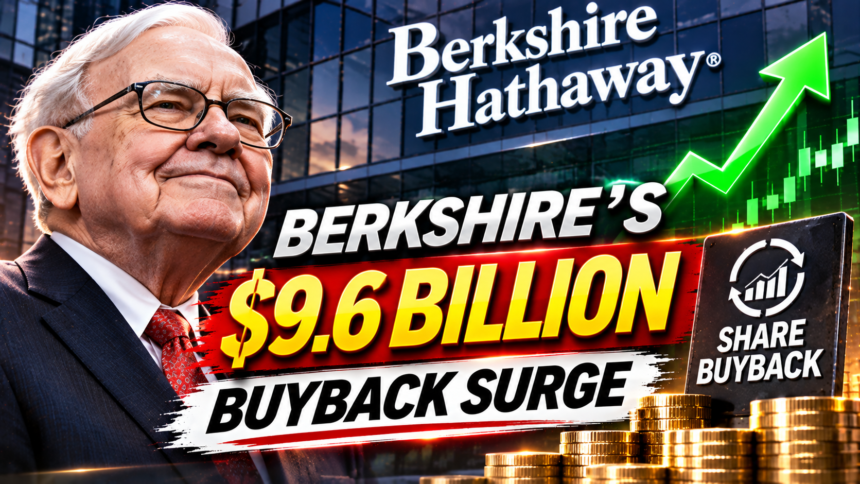
Berkshire Hathaway has made a major move in the stock market, spending approximately $9.6 billion to buy back its own shares during the third quarter of 2026. The massive repurchase programme represents a significant development for the investment conglomerate, particularly because the company had spent much of the previous year holding enormous cash reserves rather than aggressively purchasing its own stock.
The decision also highlights a change in capital allocation under new CEO Greg Abel, who took over the company’s leadership from legendary investor Warren Buffett at the beginning of 2026. Abel appears more willing to deploy Berkshire’s capital through share repurchases when management believes the company’s stock is trading below its estimated intrinsic value.
According to Berkshire’s November 7 financial announcement, the company repurchased $9.6 billion of its shares between July and September. This came on top of approximately $4.8 billion in buybacks during the first half of 2026. Berkshire also purchased approximately $2 billion more shares during the first four weeks of October.
The development has attracted considerable attention because Berkshire remains one of the world’s largest publicly traded companies, with a portfolio spanning insurance, railways, energy, manufacturing, retail and major stock investments.
Berkshire’s $9.6 Billion Buyback Marks a Major Change
Share buybacks occur when a company uses its own money to purchase shares from existing shareholders. These shares are generally retired or held as treasury stock, reducing the number of shares outstanding.
When the number of outstanding shares declines, each remaining share represents a slightly larger ownership percentage of the company. This can also increase earnings per share if profits remain unchanged.
Berkshire’s latest $9.6 billion repurchase is particularly important because the company had been relatively inactive in the buyback market for an extended period.
During Warren Buffett’s final years as CEO, Berkshire accumulated enormous cash reserves as the company struggled to find investments that met its valuation requirements. Buffett repeatedly emphasised that Berkshire would only repurchase its shares when management believed the market price was below their conservatively estimated intrinsic value.
The renewed buying activity suggests that Greg Abel was prepared to use that policy more actively during the third quarter.
However, the company has not announced a permanent commitment to purchase shares at the same pace. Buybacks depend on market prices, available capital and management’s assessment of Berkshire’s underlying value.
Greg Abel’s First Major Capital Allocation Decisions
Greg Abel became Berkshire Hathaway’s CEO at the beginning of 2026, ending Warren Buffett’s approximately six-decade period as the company’s chief executive.
Although Buffett remains an important figure in Berkshire’s history and serves as chairman emeritus, Abel is now responsible for managing the company’s enormous collection of businesses and investments.
His early decisions are attracting attention from investors who want to understand whether Berkshire will maintain Buffett’s conservative investment philosophy or adopt a more active approach to deploying capital.
The $9.6 billion buyback suggests that Abel is willing to return capital to shareholders when he believes the company’s own stock offers an attractive opportunity.
At the same time, Berkshire has continued making investments outside its traditional businesses.
The company has reportedly invested in technology-related opportunities, including a major commitment involving Alphabet, Google’s parent company. It has also made substantial acquisitions, including the purchase of Occidental Petroleum’s chemicals business for approximately $9.4 billion and a reported $6.8 billion investment in homebuilder Taylor Morrison.
These moves suggest that Berkshire is exploring different ways to deploy its enormous financial resources while maintaining its traditional focus on long-term value.
Berkshire Still Holds More Than $350 Billion in Cash
Despite spending billions on share repurchases and acquisitions, Berkshire continues to maintain an extraordinary amount of liquidity.
At the end of September 2026, the company reported approximately $377.4 billion in cash, cash equivalents and US Treasury bills before accounting for unsettled purchases. After adjusting for approximately $20.5 billion in unsettled Treasury bill transactions, its cash position was around $357 billion.
This remains one of the largest corporate cash reserves in the world.
The cash position provides Berkshire with considerable financial flexibility. It allows the company to make acquisitions, purchase stocks, support its insurance operations and respond to unexpected economic opportunities.
It also means Berkshire does not need to sell its existing investments simply to finance new purchases.
However, holding such a large amount of cash has a financial trade-off. If attractive investment opportunities are limited, substantial reserves may generate lower long-term returns than investments in productive businesses or equities.
The recent buybacks indicate that management is beginning to deploy more of this capital, although Berkshire still has enormous resources available.
Why Berkshire Buys Back Its Own Shares
Berkshire’s buyback policy is closely connected to its approach to intrinsic value.
Intrinsic value represents management’s estimate of what a business is actually worth based on its expected future cash flows, assets and earning potential.
If Berkshire believes its shares are trading below that estimated value, purchasing its own stock can be an attractive investment.
For example, imagine a company has 100 shares outstanding and earns $1,000 in annual profit. Its earnings per share would be $10.
If the company repurchases 10 shares and its profit remains unchanged, earnings per share would increase to approximately $11.11.
This does not automatically create additional operating profit, but it increases the ownership percentage and earnings attributable to each remaining share.
For a company such as Berkshire, which has a large portfolio of operating businesses and investments, buybacks can be an efficient way to return capital without paying regular dividends.
However, the strategy only makes financial sense when shares are purchased at an attractive price. Buying back overvalued shares can destroy shareholder value instead of creating it.
Berkshire’s Profits Decline Despite Record Buybacks
The company’s aggressive share repurchases came during a mixed financial quarter.
Berkshire reported third-quarter operating earnings of approximately $12.71 billion, down 6% from $13.49 billion in the same period of 2025.
Net earnings attributable to shareholders declined approximately 28% to $22.11 billion, compared with $30.8 billion a year earlier.
The difference between operating earnings and net earnings is important. Net earnings include investment gains and losses, which can fluctuate significantly depending on stock-market movements. Berkshire has repeatedly advised investors to focus more closely on operating earnings when evaluating its underlying business performance.
The insurance division was a major source of weakness.
Insurance underwriting profit declined approximately 43%, while insurance investment income also faced pressure. Geico, Berkshire’s major automobile insurance business, reported weaker underwriting results as claims costs and operating expenses increased.
Geico’s underwriting profit fell to approximately $1.35 billion, compared with $2.37 billion in the previous year’s quarter.
However, other divisions performed better. BNSF Railway reported stronger earnings, while Berkshire Hathaway Energy and several manufacturing businesses also contributed positively.
Overall company revenue increased approximately 11% to $105.65 billion.
Warren Buffett’s Investment Philosophy Remains Important
Although Greg Abel is now leading Berkshire, Warren Buffett’s investment philosophy continues to influence the company’s strategy.
Buffett built Berkshire into a global investment powerhouse by purchasing businesses with strong competitive advantages, dependable management and the potential to generate substantial long-term cash flows.
He also maintained a disciplined approach to valuation, avoiding investments simply because cash was available.
Berkshire’s buyback policy reflects this philosophy. The company does not promise to repurchase a fixed number of shares every quarter. Instead, it purchases stock when management believes the price offers sufficient value.
The company also maintains a minimum liquidity requirement. Its repurchase programme does not allow buybacks that would reduce consolidated cash, cash equivalents and US Treasury bill holdings below $30 billion.
This ensures that Berkshire retains a substantial financial cushion even when it is actively purchasing its own shares.
What the $9.6 Billion Buyback Means for Investors
The latest buyback is an important signal about how Berkshire’s leadership is approaching capital allocation after Buffett’s departure as CEO.
It demonstrates that the company is prepared to use its enormous financial resources when management sees attractive opportunities in its own shares.
However, investors should not interpret the buyback as proof that Berkshire’s stock is guaranteed to rise. Share repurchases can support earnings per share and shareholder ownership, but they do not eliminate risks associated with the company’s businesses, insurance operations or investment portfolio.
Another important development is that Berkshire’s purchases slowed as its share price climbed during October. This suggests that management’s willingness to repurchase shares remains dependent on valuation rather than a fixed spending target.
For investors, the coming quarters will reveal whether Abel continues the buyback programme or redirects more capital towards acquisitions, stocks and private investments.
What Comes Next for Berkshire Hathaway?
Berkshire enters the next phase of its leadership transition with a huge cash reserve, a diversified portfolio and a more active share repurchase strategy.
Greg Abel must balance several priorities: maintaining financial strength, improving business performance, identifying attractive investments and deciding when returning capital to shareholders makes the most sense.
The $9.6 billion buyback represents one of his most significant early decisions as CEO. It also shows that Berkshire’s enormous cash reserves are not simply being held indefinitely.
Nevertheless, the company’s declining insurance profits demonstrate that even a financially powerful conglomerate faces operational challenges.
The biggest question for investors is whether Abel can preserve Berkshire’s disciplined investment culture while finding new opportunities to generate growth.
With more than $350 billion in available cash and substantial ownership of established businesses, Berkshire still has considerable financial power. Its future performance will depend on how effectively its new leadership deploys that capital in the years ahead.
About The Author