
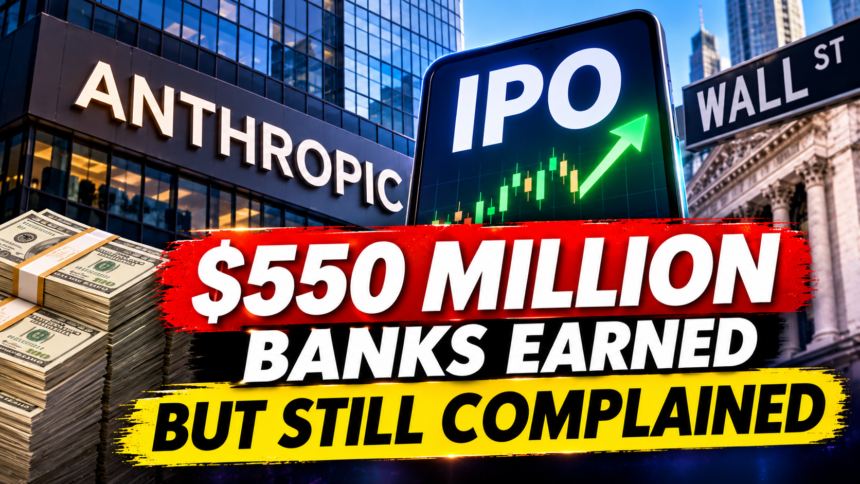
Anthropic has demonstrated that even the biggest Wall Street investment banks may have to follow a technology company’s rules when the opportunity is too valuable to ignore. The artificial intelligence company generated approximately $550 million in underwriting fees for the banks involved in its blockbuster initial public offering (IPO). Yet, behind the enormous payday, some bankers reportedly complained privately about the company’s unusually strict conditions, compressed deadlines and tight control over confidential information.
The IPO, internally known as Project Lantern, became one of the year’s biggest financial events. Anthropic’s offering raised approximately $81.34 billion, attracting enormous investor demand and involving 22 underwriting banks. However, the process reportedly left several financial professionals frustrated, raising questions about how much control powerful technology companies can now exercise over Wall Street.
Anthropic’s $550 Million IPO Payday for Wall Street
Anthropic’s IPO generated approximately $550 million in underwriting fees for the 22 banks involved in managing the offering. According to the company’s final prospectus, Anthropic paid approximately $536.7 million, while selling shareholders contributed the remaining $13.3 million.
Goldman Sachs and Morgan Stanley, the two lead underwriters, received the largest individual shares of the fee pool. Each was entitled to approximately 20.5% of the underwriting fees, or around $113 million.
The other 20 banks shared the remaining amount.
Despite the enormous headline figure, the fees represented less than 1% of the total IPO value. The banks were willing to accept the arrangement because the deal offered more than immediate revenue. Working on a landmark listing also provides prestige, strengthens relationships with major investors and can create opportunities for future trading, lending and financial services business.
Why Were Bankers Reportedly Frustrated?
The biggest source of frustration was Anthropic’s approach to managing the IPO. Instead of allowing the underwriting banks to operate through a conventional process, the company reportedly imposed strict requirements on how they could work.
One unusual condition involved the size of the teams assigned to the deal. Anthropic instructed some of its 22 underwriters to limit the number of bankers working on the transaction to just four, with a preference for senior staff.
The restriction was reportedly intended to reduce the possibility of confidential information leaking outside the transaction.
For large investment banks, which typically rely on teams of specialists to manage complex IPOs, such restrictions created additional operational challenges.
The company also reportedly required certain senior bank officers to sign six-month restrictions preventing key members of the transaction teams from working with rival AI companies, including OpenAI, Cursor, DeepSeek and Hugging Face.
Bankers and lawyers considered the restrictions unusually broad, particularly because they applied to individual professionals rather than simply managing conflicts between financial institutions.
Strict Information Controls and an Unusual Document System
Anthropic also introduced strict controls over how banks accessed IPO documents.
Rather than distributing ordinary PDF files to most underwriters, the company used a platform called NetRoadshow. The system recorded who accessed documents and which pages they viewed. Individual bankers’ names were also placed as watermarks on documents.
The platform reportedly prevented bankers from downloading and saving copies, making it more difficult for them to work with the information using their usual processes.
These restrictions came amid concerns about confidential information reaching the media before the official public filing. Reuters had reported details from a draft IPO filing almost four weeks before the company’s Form S-1 became public.
The incident appears to have contributed to Anthropic’s cautious approach to information sharing.
Bankers Were Given Only Hours to Approve Important Documents
Another major complaint involved the compressed timeline.
The company had planned to file an updated registration document, known as Form S-1A, on November 10. This filing contained important information, including the proposed share price range, and was necessary for the next stage of the IPO marketing process.
However, the document approval process reportedly became chaotic.
A law firm working on the deal initially sent banks a PDF containing incorrect price-range and share information related to the sale of shares in Canada. The firm subsequently sent another email instructing recipients to disregard the earlier document.
The corrected version was then shared through NetRoadshow at approximately 2 a.m. New York time. Banks were reportedly given only several hours to review and approve it before submission to the US Securities and Exchange Commission.
The combination of late changes, delayed financial projections and rushed approvals made the process particularly demanding for the underwriting teams.
Why Did Banks Accept These Conditions?
The obvious question is why major financial institutions agreed to such demanding requirements when they could have walked away.
The answer lies in the enormous commercial value of the opportunity.
Anthropic was one of the most closely watched AI companies in the world, and demand for its shares was extremely strong. Its IPO order book was heavily oversubscribed, meaning investor demand significantly exceeded the number of shares available.
For banks, participating in such a high-profile transaction offered substantial financial rewards and valuable exposure in the global investment banking industry.
The deal also highlighted a changing balance of power. Traditionally, major investment banks played a central role in determining how companies prepared for public listings. However, companies with highly sought-after shares can increasingly dictate terms because banks compete aggressively to secure their business.
Anthropic’s IPO Success Does Not Guarantee a Rising Stock
Although the offering initially attracted strong demand, its stock-market performance also demonstrated that a successful IPO does not guarantee continued share-price growth.
Anthropic shares recorded an approximately 17% gain on their first trading day. However, the stock subsequently closed 8.5% lower on Friday, November 20, amid a broader decline in AI-related stocks.
This movement showed that investor enthusiasm around an IPO can change quickly, particularly when wider market conditions become uncertain.
The company’s long-term performance will depend on its ability to grow revenue, manage the enormous costs of AI development and compete in an increasingly crowded market.
A New Power Balance Between AI Companies and Wall Street
Anthropic’s IPO has become an example of how influential technology companies can reshape traditional financial practices. Its strict conditions reportedly frustrated some bankers, but the institutions involved still participated in a transaction that generated approximately $550 million in fees.
The development also follows a similar pattern at SpaceX’s June 2026 IPO, where bankers reportedly expressed frustration with the company’s tight control over the offering process.
Together, these transactions suggest that Wall Street’s biggest institutions may have to adapt when dealing with companies whose shares attract extraordinary global demand.
For Anthropic, the message is clear: its importance in the AI industry has given it significant negotiating power, even when dealing with some of the world’s most powerful investment banks.
About The Author