

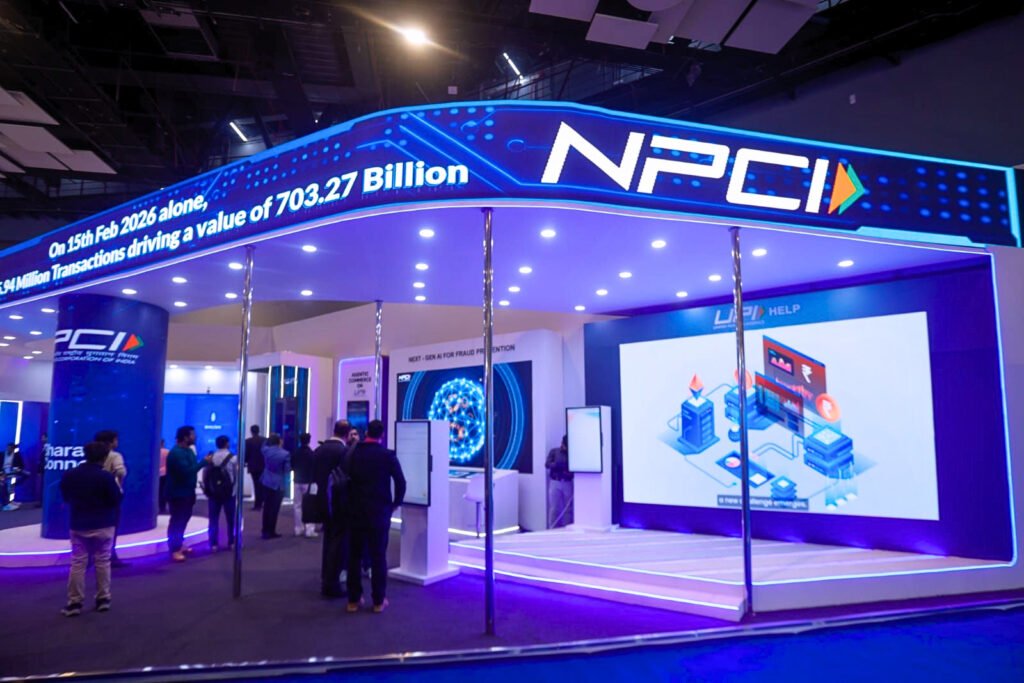
The National Payments Corporation of India (NPCI) has unveiled FiMI Banking, a sovereign artificial intelligence model designed specifically for India’s retail banking ecosystem, marking another major step in the country’s push to build homegrown AI systems for financial services.
The model was announced at the Global Fintech Festival 2026 in Mumbai and is designed to go beyond conventional AI chatbots. Instead of simply answering banking-related questions, FiMI Banking is being developed to reason through complex financial tasks, interact with banking tools and carry out actions within predefined rules and safeguards. NPCI is collaborating with HDFC Bank to further develop the model for practical banking applications.
The launch comes as India’s banking sector moves from experimenting with AI to deploying it across core operations, including lending, fraud detection, customer service, collections, compliance and product development.
A Banking AI Built Specifically for India
FiMI Banking is based on Gemma, Google’s family of open AI models, but has been further trained by NPCI for Indian retail banking scenarios. This domain-specific approach is intended to address a problem with general-purpose AI models: they may be capable of understanding language but do not necessarily understand the detailed rules, processes and constraints involved in financial services.
According to NPCI’s research paper, FiMI Banking was developed using vetted banking documents, structured ground-truth information, synthetic customer profiles and banking tools. The system was then evaluated on its ability to safely handle multi-turn conversations and banking actions.
This is particularly important in banking, where an AI system cannot simply provide a plausible answer. It needs to provide information based on authorised sources, follow institutional rules and avoid taking actions outside its permitted scope.
NPCI’s research found that preference optimisation increased the model’s rate of refusing out-of-scope requests from 52% to 80%. Reinforcement learning with verifiable rewards also improved performance on difficult edge cases, while reducing the number of generated tokens required.
From Chatbots to Agentic Banking
One of the most significant aspects of FiMI Banking is its focus on agentic AI.
Traditional banking chatbots generally answer questions such as how to reset a PIN, check an account-related issue or understand a financial product. An agentic banking system can potentially go further: it can reason through a request, interact with approved banking tools and complete a sequence of actions while operating within predefined controls.
This could eventually allow customers to interact with banks through more natural conversations rather than navigating complicated menus and multiple screens.
For example, an AI banking agent could potentially understand a customer’s request, determine which banking service is required, retrieve authorised information and initiate the appropriate workflow. The important distinction is that the AI would operate inside the bank’s infrastructure and rules rather than having unrestricted control.
NPCI and HDFC Bank are now working together to strengthen FiMI Banking for such use cases.
NPCI Opens Up New Benchmarks for Banking AI
NPCI has also released an evaluation framework designed to make the performance of banking AI agents easier to measure.
One of the benchmarks, IndicBank Bench, contains 799 scripted, multi-turn test cases across six retail banking domains. It evaluates areas including safety, the ability to perform actions correctly and the appropriateness of responses.
A second benchmark, the Tau² Agentic Banking Benchmark, contains 1,000 tasks covering 50 scenario families. It uses a dual-control simulation in which another model acts as the customer, allowing AI banking agents to be tested through dynamic conversations rather than only predetermined questions.
NPCI said the benchmark data is synthetic and does not contain real customer, account or institutional information. The organisation is also making the benchmarks, technical report and evaluation sets available so that banks, fintech companies, developers and researchers can test their own AI systems against standardised Indian banking scenarios.
FiMI Builds on NPCI’s Earlier AI Push
FiMI Banking is not NPCI’s first move into financial AI.
In February 2026, NPCI announced FiMI — Finance Model for India, a domain-specific language model developed for India’s payments ecosystem. The model currently powers NPCI’s UPI Help Assistant, which was designed to help users with payment-related queries, grievance redressal and mandate management.
The original FiMI model was trained around Indian payment systems and supported areas such as UPI transaction disputes, mandate management and regulatory queries. NPCI said the system was designed for high-volume payment environments where accuracy and reliability are critical.
The organisation has therefore been gradually moving from payments-focused AI toward a broader vision for financial AI.
Why Sovereign AI Matters for India’s Financial Sector
The development of FiMI Banking also reflects India’s wider push for sovereign and India-specific AI infrastructure.
India’s digital finance ecosystem already provides enormous scale for AI development. UPI processed 24.509 billion transactions in August 2026, while 741 banks were live on the platform in July, according to government data.
This infrastructure gives Indian technology companies and financial institutions an environment in which AI can be developed around local regulations, languages, financial products and customer behaviour.
The government is pursuing similar initiatives elsewhere in banking. The RBI and Digital India BHASHINI Division are developing Banking BHASHINI, a domain-specific language model intended to incorporate banking terminology, regulatory guidelines and industry applications while improving access to financial services in India’s many languages.
The broader goal is to make AI useful not only for India’s largest banks and urban customers, but also for new-to-credit borrowers, MSMEs, rural customers and people who face language or accessibility barriers.
FiMI Banking therefore represents more than another banking chatbot. It is part of India’s attempt to build an AI layer specifically designed for the country’s financial infrastructure — one that can understand local banking requirements, operate within strict controls and eventually perform useful financial tasks.
If the technology can demonstrate reliability and safety at scale, FiMI Banking could become an important building block in India’s next phase of digital finance, following the transformation that UPI brought to payments.
About The Author