

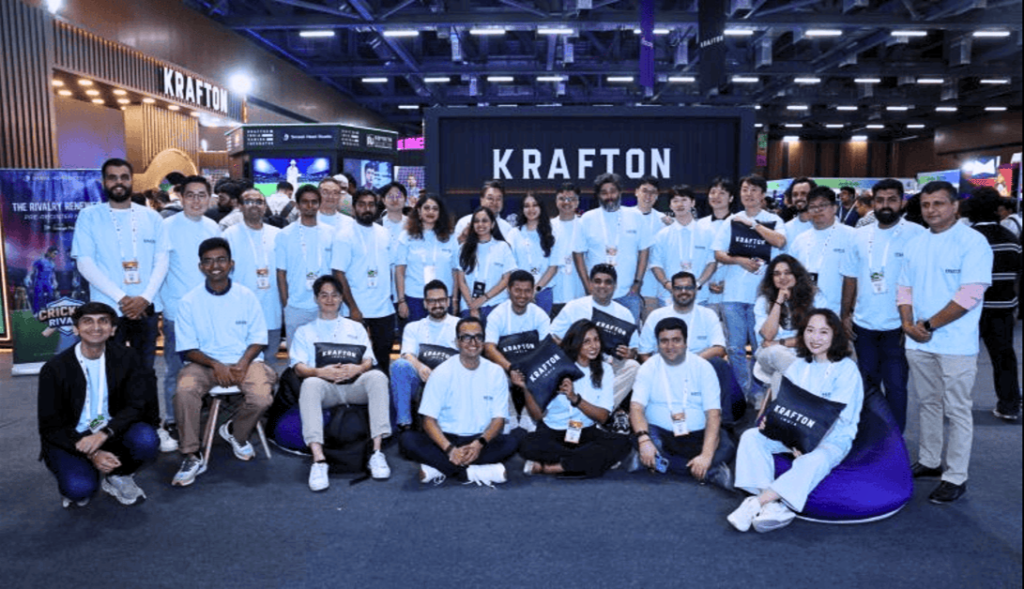
KRAFTON India has partnered with the Indian Institute of Technology Madras (IIT Madras) to launch KIGI Academy, a new industry-academia programme aimed at developing the next generation of game developers, designers and creators in India. The six-month initiative will give students practical experience across the complete game-development process, from coding and game design to UI/UX, art and product development.
The programme begins with an initial cohort of 30 students and is fully funded by KRAFTON. The company says the initiative is designed to address a key challenge facing India’s rapidly expanding gaming industry: while the country has a large pool of programmers and gamers, many aspiring developers lack experience working on a game from concept through production.
Six months of classroom and studio experience
KIGI Academy will combine academic training at IIT Madras with practical industry exposure at KRAFTON India’s Bengaluru headquarters.
The first phase will run for 16 weeks at IIT Madras, where students will build their fundamental game-development skills using the Unity engine. Training will focus particularly on mobile game development, reflecting India’s mobile-first gaming market.
Students will participate in labs, code reviews and collaborative weekly builds. The curriculum is expected to cover areas including game architecture, multiplayer networking, 3D systems, game logic and other technical aspects of creating a modern game.
After the IIT Madras phase, selected students will move to KRAFTON India’s Bengaluru headquarters for an eight-week residential programme. During this stage, participants will work in teams and take a game idea from an early concept towards a polished, playable vertical slice.
A vertical slice is essentially a representative playable section of a game that demonstrates its core mechanics, visual direction and overall experience. This gives students exposure to the type of development workflow used in professional game studios rather than limiting their learning to individual coding assignments.
KRAFTON wants to close India’s experience gap
KRAFTON’s decision to launch the programme comes as India’s gaming industry continues to grow. The company believes the country’s challenge is not simply a shortage of technically skilled people, but a lack of developers with practical experience in taking games from an initial idea to a finished product.
The programme therefore goes beyond programming. Students will learn about game design, user experience, UI/UX, art and product development, helping them understand how different disciplines come together to create a complete gaming product.
KRAFTON also wants students to understand the specific requirements of India’s market. Because mobile gaming remains particularly important in the country, participants will learn how to develop and optimise games for a wide range of devices, including lower-end smartphones.
The company has said that the programme is not intended simply to produce programmers. The broader goal is to create professionals who understand the complete gaming ecosystem and can potentially contribute to India’s game-development industry or eventually create their own studios.
Top students could get KRAFTON job opportunities
The programme could also become a pathway into the gaming industry for some participants.
Although the initial cohort will contain 30 students, only 10 students will progress to the Bengaluru residency phase after the selection process. KRAFTON has indicated that students who perform strongly may receive opportunities for full-time positions at the company.
The academy is partly inspired by KRAFTON’s KRAFTON Jungle training programme in South Korea, which has already trained more than 1,000 developers. The company plans to use experience from that programme while adapting the model to India’s gaming ecosystem.
KRAFTON has also invested heavily in India’s broader gaming and technology ecosystem. According to Moneycontrol, the company has invested more than $250 million in Indian startups across gaming, interactive entertainment, esports and technology since 2021. Its India-focused gaming incubator, KIGI, has also supported multiple startups.
A potential boost for India’s game-development industry
The partnership comes at a time when India’s gaming market is becoming increasingly important. According to data cited by Moneycontrol, India’s video-game market crossed $1.5 billion in 2025 and is projected to reach around $3.2 billion by 2030.
For IIT Madras students, KIGI Academy provides an opportunity to gain experience that is difficult to obtain through traditional engineering education alone. For KRAFTON, it offers a way to identify and develop promising talent at an early stage.
The company has indicated that the initiative could eventually expand beyond IIT Madras and reach more colleges over the next few years. The longer-term ambition is not simply to train more developers, but to help establish game development as a viable career path in India and encourage more original games to be created domestically.
With KRAFTON bringing industry expertise and IIT Madras providing an academic environment, KIGI Academy could become an important experiment in how India builds a professional game-development talent pipeline. If the model succeeds, it could help bridge the gap between India’s large technology talent pool and the specialised skills required to build globally competitive games.
About The Author