

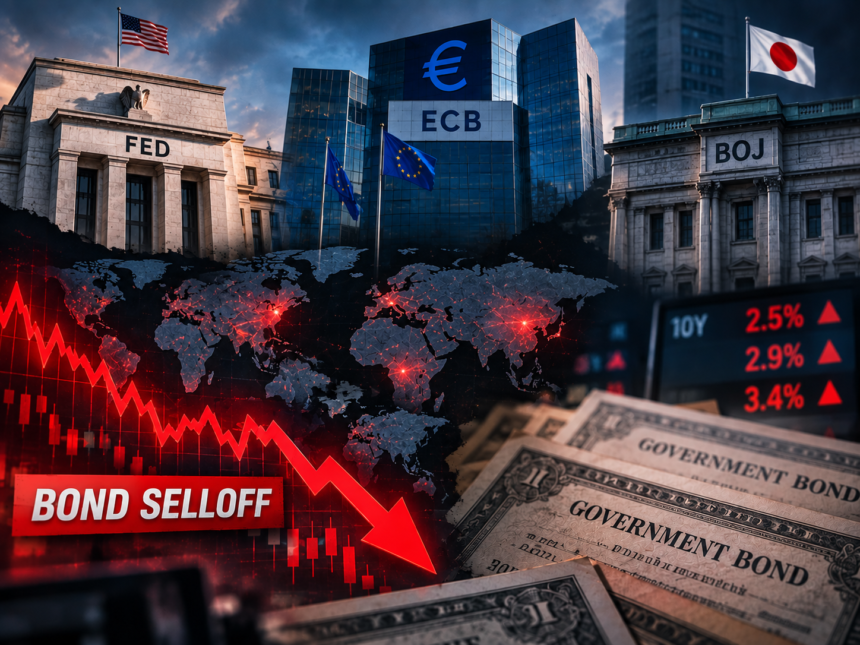

The latest global bond sell-off is putting central banks in an increasingly difficult position. Government bond yields have climbed sharply across the United States, Japan, Europe and the UK as investors demand higher compensation for inflation, rising government debt and the possibility of further interest-rate increases.
The move has become particularly intense in long-dated bonds. Japan’s 10-year government bond yield recently crossed 3% for the first time since 1996, while US 10-year Treasury yields have approached 4.8%. UK and European government borrowing costs have also moved to multi-year or multi-decade highs.
The bond rout is being driven by a combination of higher energy prices following renewed Middle East tensions, stronger-than-expected economic data, elevated inflation expectations and concerns about the huge amount of government and corporate debt entering the market. Central banks are therefore being forced to balance inflation control against the risk that higher borrowing costs could weaken economic growth and put additional pressure on government finances.
Federal Reserve faces pressure to keep rates higher
The US Federal Reserve is at the centre of the global bond-market turbulence.
The latest US employment data has strengthened expectations that the Fed could raise interest rates at its September 15–16 meeting. Markets are currently pricing roughly a 60% probability of a hike, although the final decision will depend heavily on upcoming inflation data.
Fed Chair Kevin Warsh has also taken a more hawkish approach to inflation. He has warned that the central bank will have more work to do if it becomes clear that inflation is not returning sustainably to its 2% target.
That messaging is important for the bond market because investors had previously hoped that monetary policy could become easier. Instead, stronger growth and rising energy prices are forcing markets to consider the possibility that interest rates could remain elevated or even rise further.
At the same time, the Fed must be careful not to overreact to an energy-driven inflation shock. Higher rates can reduce demand, but they cannot directly increase oil supply or resolve geopolitical disruptions.
US Treasury is using buybacks rather than relying on the Fed
The US government’s response has so far focused more on debt-management measures than direct central-bank intervention.
The US Treasury has announced plans to at least double the size of its longer-dated bond buyback operations. The objective is to improve liquidity and reduce some pressure at the long end of the Treasury market. The first operation under the expanded programme is scheduled for this week.
However, Treasury buybacks are different from quantitative easing. The government is managing the composition of its outstanding debt rather than asking the Federal Reserve to create money and purchase bonds.
That distinction is important because the Fed is unlikely to aggressively buy bonds simply to push yields lower while inflation remains above target.
ECB is moving towards another rate hike
The European Central Bank faces a similar but even more complicated situation.
Eurozone inflation has moved back above 3%, while rising energy prices caused by the Middle East conflict are creating additional inflationary pressure. The ECB is widely expected to raise its policy rate by 25 basis points at its September meeting.
The ECB’s challenge is that higher bond yields are already tightening financial conditions.
Government borrowing costs have risen substantially, meaning businesses and households are also facing higher financing costs. If the ECB raises rates again, it could add to those pressures. But leaving policy unchanged while energy prices push inflation higher could allow inflation expectations to become entrenched.
ECB President Christine Lagarde’s comments following the decision will therefore be closely watched. Investors want to know whether September’s expected hike is a one-off response to the inflation shock or the beginning of another tightening cycle.
The ECB also has a potential tool for dealing with disorderly bond-market fragmentation: its Transmission Protection Instrument. The facility allows the central bank to purchase government bonds under specific conditions if unjustified market stress threatens the transmission of monetary policy.
However, there is currently no indication that the ECB is preparing an emergency bond-buying programme.
Bank of Japan faces the biggest structural change
Japan is arguably at the centre of the current bond-market transformation.
The 10-year Japanese government bond yield has moved above 3%, something not seen since the mid-1990s. This is particularly significant because Japanese government bonds spent decades acting as an anchor for global borrowing costs.
The Bank of Japan has already moved away from its ultra-loose monetary policy framework, and markets are increasingly expecting another rate hike. The yen’s recent appreciation has strengthened those expectations, with investors pricing the possibility of a 25-basis-point increase to 1.25% at the September 17–18 meeting.
Higher Japanese yields could have global consequences beyond Japan.
Japanese investors hold enormous amounts of overseas bonds. If domestic Japanese yields become more attractive, some investors could repatriate money from US, European and Australian markets. That could reduce foreign demand for overseas government debt and push international yields even higher.
The shift is therefore being watched closely by global bond investors.
Bank of England faces fiscal and inflation pressure
The UK is also under significant pressure.
The 10-year gilt yield has moved above 5%, while the 30-year yield has reached levels not seen in decades. Investors are concerned about both inflation and the government’s fiscal position.
The Bank of England therefore has limited room to respond by rapidly cutting rates. Doing so could weaken the pound and potentially worsen imported inflation.
At the same time, maintaining restrictive monetary policy for too long could put additional pressure on households and businesses that are already facing elevated borrowing costs.
The UK’s situation demonstrates the broader problem facing central banks: bond yields are increasingly being influenced by government debt supply and fiscal credibility, not just short-term monetary policy.
Central banks are reluctant to rescue bond markets
One of the most important features of the current sell-off is that central banks have not rushed to intervene directly.
During previous periods of severe financial stress, central banks have purchased large quantities of government bonds to stabilise markets. The Bank of England, for example, intervened during the 2022 UK gilt crisis.
The current situation is different.
The bond-market sell-off is largely being driven by inflation concerns, higher expected interest rates and fiscal worries. If central banks responded by aggressively purchasing bonds, they could risk sending the opposite message to markets and undermining their fight against inflation.
As a result, policymakers appear more comfortable allowing yields to rise as long as the market remains orderly.
Oil prices are making the policy dilemma worse
Energy prices are an important part of the current problem.
Brent crude has moved close to $100 a barrel as Middle East tensions raise concerns about disruptions to global energy supplies. Higher oil prices feed directly into headline inflation and can eventually affect transportation, manufacturing and consumer prices.
This creates a difficult situation for central banks because monetary policy cannot directly solve an oil shortage.
If policymakers raise rates to combat the inflation caused by energy prices, they could weaken economic activity without addressing the underlying supply shock. But if they ignore the inflationary impact, expectations could become harder to control.
That is why upcoming inflation data in the US and Europe is so important.
Bond-market pressure could eventually force stronger action
For now, policymakers appear to be treating the sell-off as a significant but manageable adjustment rather than a financial crisis.
The US Treasury is using buybacks, the ECB has tools available if market fragmentation becomes disorderly, the BOJ is preparing markets for further normalisation and the Fed is watching inflation and employment data before deciding its next move.
But the risks are increasing.
Higher bond yields raise government debt-servicing costs, increase mortgage and corporate borrowing rates and can reduce the attractiveness of equities. They also create pressure on highly leveraged companies, including technology firms that are issuing large amounts of debt to finance artificial-intelligence infrastructure. Five major AI hyperscalers have already issued about $220 billion of debt in 2026, more than twice last year’s pace.
If yields continue rising, central banks may eventually face a choice between tolerating tighter financial conditions and intervening to prevent disorderly market conditions.
The global bond market is entering a different era
The latest sell-off suggests that the world may be moving further away from the ultra-low-interest-rate environment that dominated the years following the global financial crisis.
Investors are now demanding higher returns to compensate for inflation, fiscal deficits, geopolitical uncertainty and the enormous amount of debt being issued by governments and corporations.
For central banks, that means controlling short-term interest rates may no longer be enough to determine long-term borrowing costs.
The immediate focus will be on the US CPI report, the Federal Reserve meeting, the ECB’s rate decision and the BOJ’s September meeting. Together, these events could determine whether the bond sell-off begins to stabilise or develops into a deeper repricing of global interest rates.
For now, central banks appear unwilling to fight the bond market directly. Instead, they are allowing yields to reflect the new reality of higher inflation risks, heavier government borrowing and a potentially more expensive global cost of capital.
About The Author