

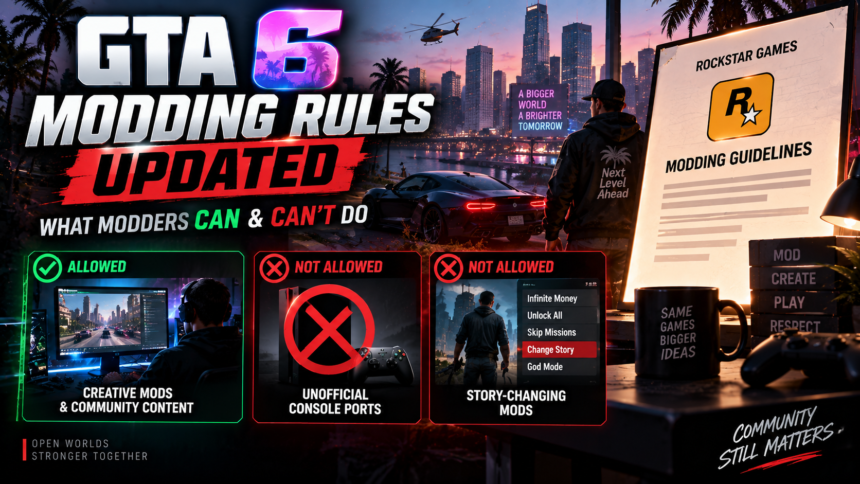
Rockstar Games has reportedly published a new, more detailed set of modding guidelines, giving the Grand Theft Auto community a clearer picture of what kinds of modifications will and will not be allowed as the company prepares for the arrival of Grand Theft Auto VI. The timing of the update has attracted particular attention because GTA 6 is scheduled to launch on November 19, 2026, with the PC version expected later.
The new guidance does not appear to completely ban traditional single-player modding. Instead, it establishes much clearer boundaries around story modifications, unofficial multiplayer projects, intellectual property, monetization, cryptocurrency, gambling and unofficial ports. Rockstar’s existing support documentation already directs users toward its single-player mod policy, Creator Platform License Agreement and Mod Guidelines.
Rockstar Makes Its Modding Rules More Explicit
For years, Rockstar’s relationship with the GTA modding community has been complicated. Single-player modifications have generally been tolerated under certain conditions, while unauthorized multiplayer modifications and projects that interfere with Rockstar’s online services have faced much stricter treatment.
The newly published guidance appears to bring many of those previously scattered restrictions into one place. According to reports examining the new rules, Rockstar is effectively establishing a framework under which creators can continue developing modifications, but only if those projects remain within specific boundaries.
This distinction could become particularly important once GTA 6 eventually arrives on PC. GTA V developed one of the world’s largest modding communities, and many creators will naturally want to transfer that experience to the next generation of Grand Theft Auto.
Story Mods Face New Restrictions
One of the biggest changes highlighted in reports is the restriction on modifications that expand or alter Rockstar’s official story continuity.
Under the published guidelines, creators should not modify official storylines, plots, missions, characters or other established elements of Rockstar’s continuity. Mods also cannot combine maps, locations, characters, storylines or other intellectual property from different Rockstar titles.
That could affect some of the more ambitious projects traditionally associated with the GTA modding community.
For example, a project attempting to combine GTA 5’s Los Santos with another GTA game’s map or characters could fall outside Rockstar’s stated guidelines. Similarly, a modification designed to create unofficial expansions of Rockstar’s established storylines could face restrictions.
The rules therefore appear to preserve room for customization while drawing a line around Rockstar’s official fictional universe.
Unofficial GTA Ports Could Be Targeted
Another particularly important rule concerns unofficial ports.
Rockstar’s new guidelines reportedly prohibit modifying its games so that they operate on consoles, hardware devices or platforms where the game has not officially been released.
This could affect community projects attempting to bring GTA games to unsupported platforms.
The issue has become especially relevant as modders have increasingly experimented with unofficial versions of Rockstar games on devices and platforms that did not originally receive official releases. The new guidance gives Rockstar a clearer basis for saying that such projects are outside its permitted modding framework.
However, the publication of the rules does not automatically mean that every affected project will immediately receive a takedown notice. The guidelines establish Rockstar’s position and its ability to enforce its intellectual-property rights; actual enforcement can vary from project to project.
Multiplayer Modding Is Being Pushed Toward Creator Platform
Perhaps the biggest change for the GTA roleplay community concerns multiplayer.
Rockstar’s guidelines reportedly state that multiplayer modding is limited to Rockstar’s official licensed Creator Platform unless Rockstar separately authorizes it.
This is significant because GTA V multiplayer roleplay became a massive phenomenon through FiveM, allowing independent communities to build custom servers with their own maps, economies, jobs, vehicles and gameplay systems.
Rockstar eventually acquired Cfx.re, the team behind FiveM and RedM, bringing the technology and community closer to its official ecosystem.
The current Creator Platform License Agreement confirms that Rockstar provides Creator Services that enable users to create, distribute and operate customized or modified versions of certain Rockstar games and assets, including FiveM and RedM.
That suggests Rockstar is not necessarily abandoning user-created multiplayer content. Instead, it is seeking to move that activity into an environment where the company can establish rules, moderate content and control how creators monetize their work.
Paid Mods and Monetization Face Strict Limits
Another major part of the reported guidelines involves money.
Creators are reportedly permitted to monetize mods only through digital storefront providers approved by Rockstar and in accordance with the applicable rules. Other forms of commercial exploitation are prohibited.
This is particularly significant because GTA V’s modding ecosystem has developed its own economy. Developers have sold scripts, vehicles, maps, server assets and other content through third-party platforms.
Under Rockstar’s new framework, creators would need to follow Rockstar’s approved monetization structure rather than freely selling Rockstar-based modifications through any platform they choose.
The policy also reportedly prohibits creators from monetizing Rockstar-created assets such as official missions, DLC or in-game assets.
Cryptocurrency, NFTs and Gambling Are Not Allowed
Rockstar’s updated rules also draw a clear line around financial mechanics inside mods.
The guidelines reportedly prohibit modifications involving cryptocurrency, NFTs, tokens, memecoins and stablecoins. They also prohibit real-money gambling, loot boxes and similar chance-based mechanics involving real money.
This could become increasingly important as gaming communities experiment with digital economies.
Rockstar is effectively preventing creators from turning its intellectual property into an unofficial financial ecosystem involving speculative digital assets or gambling-style mechanics.
The rules also reportedly restrict mods that use third-party advertisements, product placements or sponsored content.
Real-World Brands and Personal Likenesses Also Face Restrictions
The new guidelines reportedly include restrictions on third-party intellectual property.
Creators cannot freely use protected elements belonging to other companies or individuals, including characters, music, photographs, advertisements, brands and logos. The rules also reportedly prohibit the unauthorized use of real people’s voices, images or likenesses.
This could have implications for GTA mods that recreate celebrities, commercial brands or real-world products.
For years, modders have used GTA as a platform for recreating real-world vehicles, celebrities and brands. Rockstar’s more explicit rules could make such projects more complicated, particularly when they are distributed or monetized publicly.
Cheat Menus and Online Interference Remain Off Limits
Rockstar is also maintaining a strict position against modifications that interfere with its official multiplayer services.
The published GTA 6 terms prohibit unauthorized mods, hacks, scripts, bots and mod menus that interfere with the services or provide unfair advantages. They also prohibit software that exploits vulnerabilities or bypasses technical protections.
This distinction is important because Rockstar’s rules treat creative modifications differently from tools designed to interfere with competitive online gameplay.
A cosmetic or gameplay modification for an authorized environment is fundamentally different from a cheat designed to provide an unfair advantage in official multiplayer.
GTA 6 Could Enter a Very Different Modding Era
The timing of the new rules is what makes the development particularly interesting.
GTA V’s enormous lifespan was helped by an enormous unofficial modding community. Players created graphical overhauls, new vehicles, missions, maps and multiplayer experiences that kept the game relevant more than a decade after its original release.
GTA 6 is approaching with Rockstar taking a much more structured approach to user-generated content.
Rockstar now owns the technology behind FiveM, operates an official Creator Platform and has established clearer rules governing what creators can do. The company’s current Creator Platform agreement explicitly provides a framework for customized versions of Rockstar games and game assets.
That could mean the future of GTA 6 modding will be less decentralized than GTA V’s.
What This Means for GTA 6 Players
For ordinary players, the new rules are unlikely to change much immediately. GTA 6 itself will continue to operate under Rockstar’s official terms and services.
For modders, however, the guidelines provide a much clearer set of boundaries.
Single-player creativity remains possible within Rockstar’s rules, but creators cannot freely alter official story continuity, combine intellectual property from different Rockstar games, create unauthorized ports or commercially exploit Rockstar’s content outside approved channels.
For multiplayer creators, the direction is even clearer: Rockstar wants customized multiplayer experiences to operate through its official Creator Platform or another specifically licensed arrangement.
The GTA Modding Community Is Entering a New Era
Rockstar’s updated modding guidelines represent an important moment for the Grand Theft Auto community. Rather than simply banning mods, the company appears to be establishing a more controlled ecosystem in which certain forms of creativity are permitted while others are explicitly restricted.
The biggest changes concern story expansions, cross-game projects, unofficial ports, multiplayer modifications and monetization. Cryptocurrency, real-money gambling, unauthorized advertising and certain forms of third-party intellectual property are also restricted.
For GTA 6, these rules could become the foundation for the next generation of modding.
The big question now is how Rockstar will balance its desire to protect its intellectual property with the creativity that made GTA V one of the most heavily modded games in history. With GTA 6 approaching its November 2026 launch, the company’s new rules give creators their clearest indication yet of where Rockstar intends to draw that line.
About The Author