

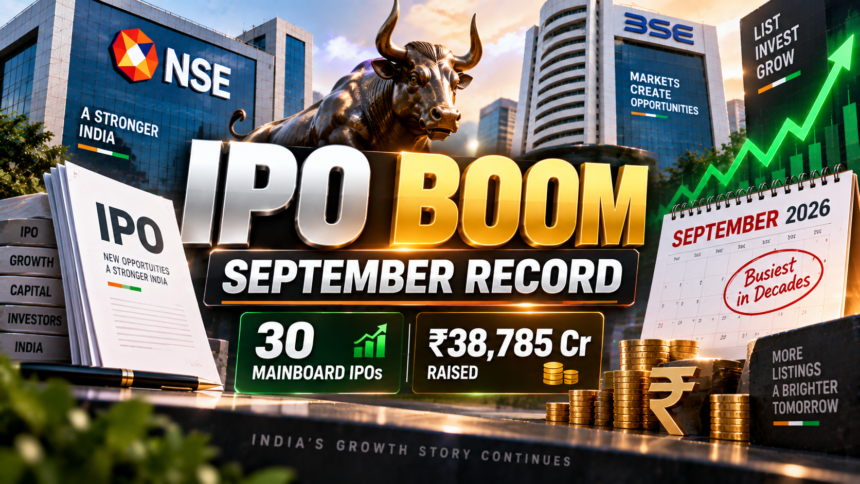

India’s primary market has entered a historic phase, with September 2026 emerging as the busiest month for mainboard initial public offerings (IPOs) in nearly three decades. As of September 23, as many as 30 mainboard companies have launched IPOs during the month, the highest monthly number since December 1996, when 33 issues came to the market.
The surge has also been accompanied by a substantial flow of capital. Mainboard IPOs launched in September have raised approximately ₹38,785 crore, making the month one of the strongest fundraising periods for India’s primary market in recent years. The unprecedented rush has brought a wide range of companies to investors, from financial and technology businesses to manufacturing, automotive and consumer-focused companies.
A Record IPO Rush Returns After Nearly 30 Years
The scale of September’s IPO activity is particularly notable because India has not seen this many mainboard issues in a single month since the mid-1990s.
Economic Times reported that September’s 30 mainboard IPOs have surpassed the monthly issue count seen in most recent market cycles. The previous comparable peak was in December 1996, when 33 mainboard IPOs were launched.
The development reflects how dramatically India’s primary market has expanded. Companies today have access to a much larger pool of domestic institutional investors, retail investors and digital investment platforms than they did three decades ago.
The number of companies entering the market has also increased as businesses seek capital for expansion, acquisitions, debt reduction and other corporate purposes.
₹38,785 Crore Raised in September
The record number of IPOs has translated into a major fundraising opportunity for Indian companies.
According to Economic Times, mainboard IPOs launched during September have raised approximately ₹38,785 crore so far. This is the largest monthly fundraising total since October last year, when 10 issues collectively raised around ₹45,188 crore.
The September figure is particularly significant because the fundraising has been distributed across a large number of companies rather than being driven by just one or two offerings.
The arrival of large issues such as the National Stock Exchange (NSE) IPO, alongside several mid-sized offerings, has helped push the month’s total higher.
NSE IPO Adds a Mega-Issue to the September Calendar
One of the biggest events in the September IPO rush has been the public offering of the National Stock Exchange of India.
NSE’s IPO was a major contributor to the month’s overall fundraising because of its approximately ₹22,569-crore issue size. The issue attracted strong institutional demand and was subscribed 5.71 times overall by the time bidding closed.
The QIB portion was subscribed 12.68 times, while the non-institutional category was subscribed 6.55 times. The retail portion recorded a comparatively lower subscription of 1.39 times.
The scale of the NSE offering demonstrates why September’s fundraising total has been substantially higher than a typical month, even as the number of individual IPOs has reached a historic level.
Why So Many Companies Are Launching IPOs Now
The September IPO rush did not happen entirely by chance. A significant factor is the expiration of regulatory approvals for several companies.
Earlier this year, the Securities and Exchange Board of India (Sebi) provided a one-time extension for certain IPO approvals that were due to expire between April and September 2026. The extension allowed companies affected by market volatility to use their existing approvals until September 30.
Prime Database data cited by Economic Times showed that approvals for 35 companies were originally scheduled to expire on September 30. Companies that failed to launch their offerings could potentially have had to seek fresh regulatory clearance.
That deadline created a strong incentive for companies with ready-to-launch IPOs to enter the market before the end of September.
A Release of Pent-Up IPO Supply
The current boom also follows a relatively cautious first half of 2026.
Market conditions earlier in the year were affected by volatility, geopolitical uncertainty, foreign investor outflows and concerns about valuations. Several companies therefore delayed their offerings while waiting for more favourable conditions.
By July and August, market activity began to improve, encouraging companies that had postponed their IPO plans to return to the primary market.
The Indian Express reported that the improvement in market conditions and the release of pent-up IPO supply were important factors behind the acceleration in IPO activity during the second half of the year.
The Economic Times similarly reported that August had already become the busiest IPO month in nearly a year, with more than 20 companies raising over ₹21,000 crore. September then accelerated the trend dramatically.
Six IPOs Opening on a Single Day
The intensity of the IPO rush was also visible earlier in September when six mainboard IPOs opened on the same day.
Business Standard reported that six IPOs were scheduled to open on September 9, marking the first time in around 30 years that exactly six offers were set to open on a single day. Historical data from Prime Database showed that the previous comparable instance was October 14, 1996.
The concentration of IPO launches illustrates the pressure on companies to complete fundraising plans before regulatory deadlines and the willingness of issuers to tap investors while market conditions remain supportive.
Investors Face a Crowded Primary Market
For investors, the September boom has created both a larger selection of IPOs and a more crowded decision-making environment.
Rather than evaluating one or two major issues at a time, investors have had to compare companies across multiple sectors, business models, valuations and issue structures.
The month has included large companies as well as smaller offerings, meaning subscription levels and listing performance have varied considerably.
Economic Times reported that among 16 IPOs that had listed by September 23, five had opened below their issue price and one listed flat, while the remaining issues delivered positive listing gains. However, post-listing performance has also differed significantly between individual companies.
This highlights an important distinction between IPO demand and longer-term stock performance: heavy subscription does not automatically determine how a company will trade after listing.
IPO Performance Keeps Investor Interest High
Recent listing performance has also helped maintain investor interest in new issues.
Economic Times reported that September’s IPO market had generally produced positive listing outcomes, with several newly listed stocks trading above their issue prices. Some issues, however, have performed very differently from the broader group.
The performance of ESDS Software Solution has been particularly notable. According to Business Standard, the stock had risen more than 300% from its September 4 debut by September 23, making it one of the strongest-performing recent listings.
Such gains can increase investor interest in upcoming IPOs, although individual company fundamentals and valuations remain important factors when assessing each issue.
More IPOs Could Still Arrive Before September Ends
The IPO rush is not necessarily finished.
Economic Times reported that around 23 companies collectively seeking approximately ₹40,775 crore still faced a September 30 deadline for their IPO approvals. Companies that fail to launch within the applicable period could need to refile their documents and potentially go through another regulatory process.
That creates the possibility of continued primary-market activity during the final week of September.
However, the number of companies ultimately launching will depend on market conditions, regulatory requirements and individual issuer decisions.
September Marks a New Era for India’s Primary Market
September 2026 has already established itself as an exceptional month for India’s IPO market. With 30 mainboard issues, approximately ₹38,785 crore raised, a record six IPOs opening on a single day earlier in the month and the massive NSE offering adding significant fundraising volume, the month stands out as the busiest mainboard IPO period in nearly three decades.
The rush also reflects a broader transformation in India’s capital markets. Strong domestic participation, a large pipeline of companies seeking public capital and improved market conditions have created an environment in which multiple businesses can access investors within a short period.
As September moves toward its final days, attention will now turn to the remaining IPOs, upcoming listings and whether companies waiting on the sidelines will complete their offerings before the September 30 regulatory deadline.
About The Author