

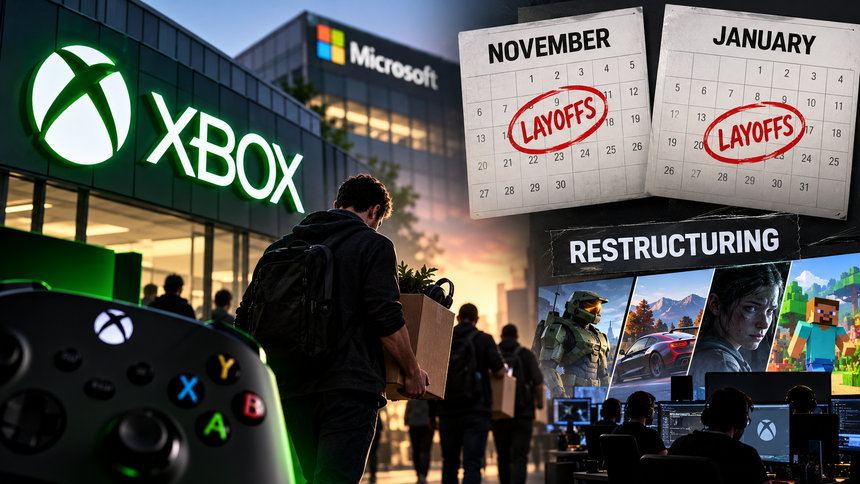
Microsoft’s Xbox gaming division is facing renewed uncertainty as reports indicate that additional job cuts could take place in October, November 2026 and January 2027. The reported plans form part of a broader restructuring led by Xbox chief executive Asha Sharma, who is attempting to reorganise the business, reduce operating costs and improve its financial performance.
The potential layoffs come after Microsoft announced plans in July 2026 to eliminate approximately 3,200 roles across its gaming division during the 2027 financial year. Around 1,600 positions were affected immediately, followed by additional reductions in September. Microsoft subsequently confirmed that another 268 roles would be eliminated as part of its ongoing restructuring.
According to reports published on October 20 and 21, further rounds of cuts are being considered as Xbox continues its organisational reset. However, Microsoft has not publicly confirmed the proposed November and January rounds, and the exact number of employees who could be affected remains unknown.
The developments have raised concerns among employees, developers and gaming communities about the future structure of Xbox Game Studios and the teams responsible for some of the industry’s most recognisable franchises.
Why Is Xbox Considering More Job Cuts?
The reported layoffs are connected to a wider effort to make Microsoft’s gaming operations more efficient and financially sustainable.
In July, Sharma described the restructuring as one of the most significant organisational changes in Xbox’s history. The company said its existing structure had become too complicated, with excessive management layers, overlapping responsibilities and teams operating without sufficient coordination.
Microsoft also acknowledged that its gaming business had not consistently generated the returns expected from its investments. In its restructuring announcement, the company said that it had lost approximately 64 cents for every dollar invested in a typical year under the previous operating model.
The company is now attempting to simplify decision-making, reduce administrative expenses and concentrate resources on projects it believes have stronger commercial prospects.
The strategy reflects a difficult challenge for a business that owns numerous studios, publishes games across multiple platforms and operates subscription services, cloud gaming infrastructure and console hardware.
Reducing expenses may improve profitability, but workforce reductions can also disrupt development schedules, weaken employee morale and remove experienced personnel from projects that require years of specialised work.
For employees, the possibility of additional layoffs means that uncertainty could continue well into early 2027.
Xbox Is Restructuring Its Game Development Studios
The changes extend beyond job cuts. Microsoft is also reorganising the way its studios operate and deciding which businesses should remain under its direct management.
In September, Xbox announced changes affecting several major development groups. The next Halo project was moved under Activision, where a dedicated team would develop the franchise separately from Call of Duty. The Grounded franchise was also moved within Microsoft’s publishing structure.
Turn 10 Studios and Playground Games, both associated with the Forza racing franchise, were brought together under a combined structure. Microsoft Casual Games was moved under King, the company behind Candy Crush.
These changes are intended to reduce duplication and bring related operations closer together. In theory, combining publishing expertise and aligning teams could improve coordination, reduce costs and allow developers to share resources more effectively.
However, restructuring also introduces risks. Different studios have their own creative cultures, production processes and technical requirements. Combining teams does not automatically produce better games, and organisational changes can create confusion if responsibilities are not clearly defined.
The ultimate test will be whether the new structure helps Microsoft deliver successful releases more consistently without weakening the creative independence that makes individual studios distinctive.
Independent Studios and the Uncertain Future of Ninja Theory
Another important element of the restructuring involves Microsoft’s decision to separate certain studios from Xbox’s internal structure.
Double Fine Productions and Compulsion Games have been allowed to return to independent operations under arrangements intended to give them greater control over their future projects. Undead Labs has also transitioned towards independent ownership, with plans for State of Decay 3 to remain connected to Game Pass through a new publishing arrangement.
These changes demonstrate that Microsoft’s strategy is not limited to closing studios or dismissing employees. In some cases, it is exploring alternative ownership structures that could reduce the direct financial burden on Xbox while allowing developers to continue creating games.
Nevertheless, uncertainty remains around other studios. Ninja Theory, the developer behind the Hellblade series, has been mentioned in reports discussing possible further changes, including concerns about its future.
No closure should be treated as confirmed without an official announcement. The distinction matters because speculation about a studio’s future can quickly spread through gaming communities before the company has made a final decision.
For developers, the broader concern is whether Microsoft’s new operating model will provide sufficient long-term stability for ambitious, story-driven games that may require substantial development time.
Is Microsoft Losing Confidence in Xbox?
The restructuring raises questions about Microsoft’s long-term approach to gaming, but it does not establish that the company intends to abandon Xbox.
Microsoft has invested heavily in gaming through acquisitions, including its $68.7 billion purchase of Activision Blizzard in 2023. That acquisition brought major franchises and businesses into its portfolio, significantly expanding the company’s presence across console, PC and mobile gaming.
However, owning more studios and intellectual property also creates substantial operating expenses. Microsoft must determine how to use those assets effectively while competing for players’ time and spending against Sony, Nintendo, mobile gaming companies and other entertainment platforms.
Xbox is therefore attempting to balance several priorities: producing successful games, growing subscription revenue, maintaining its console business and reaching players across multiple platforms.
The restructuring suggests that Microsoft wants a more focused operating model. It does not, by itself, prove that Xbox will be sold or discontinued.
What Could This Mean for Players?
For players, the most important question is whether the changes will affect the games they expect to play.
Microsoft stated during its July restructuring announcement that its publicly announced first-party games and projects were not being cancelled as part of those reductions. However, that statement does not guarantee that every future project will remain unaffected by subsequent decisions.
If additional job cuts occur, players may see changes to development schedules, studio leadership, publishing arrangements or the long-term priorities of particular franchises.
On the other hand, Microsoft hopes that a simpler structure will allow teams to focus more effectively on making and releasing games. Better coordination could help some projects move forward with clearer objectives and fewer administrative obstacles.
The impact will vary from studio to studio, depending on its financial position, development pipeline and role within the wider Xbox organisation.
Conclusion
Xbox is entering another uncertain period as reports point to potential job cuts in November 2026 and January 2027, following an extensive restructuring already announced by Microsoft. The company is also reorganising its development studios, changing publishing responsibilities and allowing selected teams to operate independently.
The strategy is intended to reduce costs, simplify management and improve the financial performance of Microsoft’s gaming business. Yet, the human consequences are significant, and the long-term results remain uncertain.
For employees, the immediate concern is whether further layoffs will affect their positions. For developers, the challenge is adapting to a changing organisational structure while continuing to produce games. For players, the key question is whether these changes will ultimately lead to stronger releases or create further disruption.
Until Microsoft confirms the reported future rounds of layoffs, their timing and scale remain uncertain. What is clear is that Xbox is undergoing a substantial transformation, and the decisions made over the coming months could shape the future of its studios, franchises and gaming strategy for years to come.
About The Author