

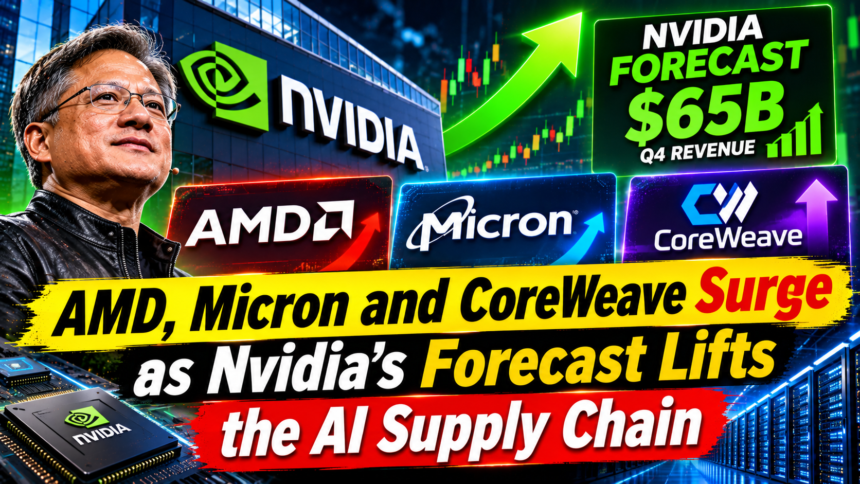
Shares of major artificial intelligence companies rallied on November 18, 2026, after Nvidia delivered a stronger-than-expected revenue forecast, renewing investor confidence in the global AI boom. AMD, Micron Technology and CoreWeave were among the companies benefiting as investors increased their exposure to businesses supplying the chips, memory and computing infrastructure needed to power artificial intelligence.
The market reaction followed Nvidia’s latest financial outlook, in which the world’s leading AI chipmaker projected fourth-quarter revenue of approximately $130 billion, plus or minus 3%. That figure was above the average analyst estimate of $125.25 billion, according to data compiled by LSEG.
Nvidia shares gained approximately 3.7% in premarket trading, while several other semiconductor and AI infrastructure companies also advanced. The rally suggests that investors are looking beyond Nvidia itself and focusing on the wider network of companies benefiting from rapidly expanding demand for AI computing.
Nvidia’s $130 Billion Revenue Forecast Reignites AI Optimism
Nvidia remains at the centre of the artificial intelligence infrastructure market because its graphics processing units (GPUs) are widely used to train and operate advanced AI models.
The company’s latest revenue forecast provided investors with fresh evidence that demand for AI computing infrastructure remains strong.
Nvidia expects fourth-quarter revenue to reach around $130 billion, with a possible variation of 3% in either direction. This is significantly higher than the $125.25 billion average estimate from analysts.
The forecast is important because investors have been questioning whether technology companies can continue spending enormous amounts on AI infrastructure and whether that investment will generate sufficient returns.
Nvidia’s outlook helped ease some of those concerns and supported a broader recovery across AI-related stocks.
The market response was particularly significant because uncertainty surrounding the company’s leadership had recently affected investor confidence. The company’s board also rejected calls to bring back former CEO Jensen Huang, while maintaining that its existing strategy remained on track.
AMD Shares Rise as Investors Look Beyond Nvidia
Advanced Micro Devices (AMD) was among the semiconductor companies benefiting from the positive market sentiment. Its shares rose approximately 3% in premarket trading on November 18, according to Reuters.
AMD is one of Nvidia’s most important competitors in the AI accelerator market. Its Instinct GPU products are designed to handle demanding AI workloads, while its EPYC processors are used in data centres and enterprise computing systems.
The company has also been expanding its ambitions beyond individual chips by developing complete AI computing systems.
AMD’s recent financial performance has strengthened its position in the market. For the third quarter of 2026, the company reported revenue of approximately $13.4 billion, representing 45% year-over-year growth.
Its data-centre segment generated a record $8.55 billion in revenue, nearly doubling compared with the same period last year.
CEO Lisa Su has also forecast that AMD’s overall revenue could grow by more than 80% in 2027.
These developments help explain why investors are paying attention to AMD whenever Nvidia delivers strong results. Continued growth in AI spending could create opportunities for multiple chipmakers rather than benefiting only one company.
Micron Gains as AI Memory Demand Becomes More Important
Micron Technology also participated in the November 18 rally, with its shares rising approximately 3.4% in premarket trading.
Unlike Nvidia and AMD, which are primarily associated with processors and AI accelerators, Micron supplies the memory technology required by advanced computing systems.
One particularly important product category is High Bandwidth Memory (HBM). AI accelerators require extremely fast access to large amounts of data, making HBM a critical component of modern AI infrastructure.
As companies build larger data centres and deploy more powerful AI systems, demand for advanced memory products is increasing.
Micron has already highlighted this opportunity through its financial outlook. In September 2026, the company reported that customer commitments under its long-term supply agreements had increased to approximately $32 billion.
This suggests that customers are making substantial commitments to secure future memory supplies.
The growing importance of memory also highlights a major challenge for the AI industry: building powerful processors is not enough. Companies must also secure the memory, networking and storage components required to operate them efficiently.
CoreWeave Jumps as AI Infrastructure Spending Expands
CoreWeave was another major beneficiary of the market recovery, with its shares gaining approximately 6.5% in premarket trading.
CoreWeave operates specialised cloud infrastructure designed for demanding computing workloads, particularly artificial intelligence.
Instead of relying exclusively on traditional cloud infrastructure, AI developers can use specialised GPU-powered computing capacity to train models, run applications and process large volumes of data.
CoreWeave has become an important player in this market because AI companies need access to powerful computing systems without necessarily building and operating every data centre themselves.
The company had already attracted investor attention after its November 11 financial results. Its stronger performance and improved revenue outlook helped ease some concerns about the cost of expanding AI infrastructure.
However, CoreWeave’s business also carries substantial financial risks. Building data centres requires enormous investment in servers, power, cooling systems and other equipment. The company must generate enough revenue from its computing contracts to justify these expenses and manage its financing obligations.
Nvidia’s latest forecast has strengthened the market’s expectations for AI computing demand, providing additional support to companies such as CoreWeave.
AI Rally Spreads Across the Technology Industry
The market reaction was not limited to three companies.
Other semiconductor businesses also moved higher during premarket trading on November 18. Broadcom gained approximately 2.5%, Micron rose 3.4%, Marvell advanced 4.4%, and several other technology companies recorded gains.
AI-focused cloud providers also benefited. CoreWeave and Nebius rose approximately 6.5% and 8.1%, respectively, while data-centre-related companies including IREN, Applied Digital and Core Scientific also advanced.
The movement demonstrates how interconnected the AI supply chain has become.
A single strong forecast from Nvidia can influence expectations for chip manufacturers, memory suppliers, networking companies, cloud providers and data-centre operators.
As AI adoption expands, each part of this infrastructure ecosystem could experience additional demand.
What Could Go Wrong for AI Stocks?
Despite the positive market reaction, the AI investment boom still faces several challenges.
The first concern is valuation. Many AI-related companies have already experienced substantial share-price increases, meaning investors may have high expectations for future earnings.
The second challenge is the enormous cost of infrastructure expansion. Data centres require large amounts of electricity, specialised equipment and capital. If AI demand grows more slowly than expected, some companies could struggle to generate sufficient returns on their investments.
Memory supply is another important factor. Shortages or higher component costs could affect the production and profitability of AI hardware companies.
Finally, competition is increasing. Nvidia faces growing challenges from AMD, custom-designed chips developed by major technology companies and other semiconductor manufacturers.
Strong demand does not automatically guarantee that every company in the AI supply chain will become profitable.
What Happens Next?
Investors will now watch whether Nvidia can convert its strong revenue outlook into sustained financial growth and whether demand for AI infrastructure continues to expand.
AMD’s ability to increase its share of the AI accelerator market, Micron’s capacity to supply advanced memory and CoreWeave’s ability to turn infrastructure investment into profitable computing contracts will be important developments.
For now, Nvidia’s $130 billion fourth-quarter revenue forecast has provided a major boost to the AI sector. The November 18 rally shows that the market is increasingly treating artificial intelligence as an opportunity extending far beyond the company producing the most widely recognised AI chips.
The next stage of the AI boom may depend not only on who builds the most powerful processors, but also on who can supply the memory, networking, electricity and computing infrastructure needed to make artificial intelligence work at global scale.
About The Author