

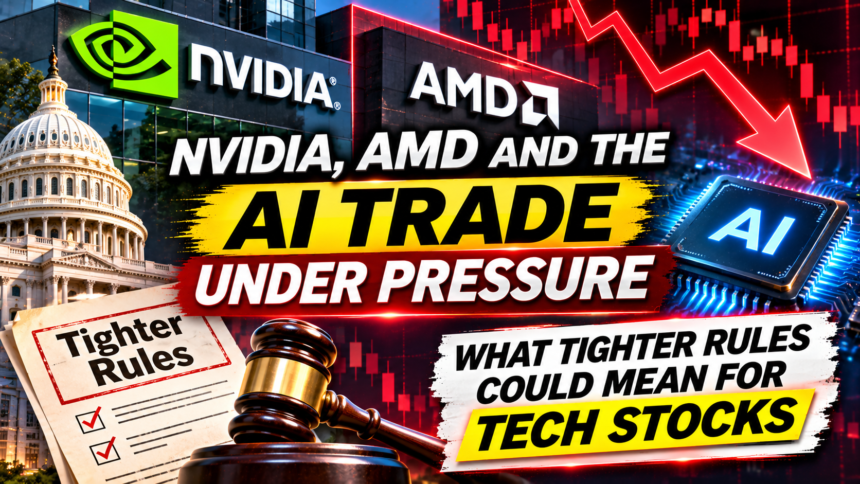
The artificial intelligence investment boom is facing a fresh challenge as concerns about tighter regulations send shockwaves through the US technology stock market. Nvidia and AMD, two of the biggest beneficiaries of the global AI revolution, have come under significant selling pressure as investors reassess the risks surrounding semiconductor exports, data-centre construction and government oversight.
The uncertainty intensified following the November 3, 2026, US midterm elections, in which Democrats secured control of both the House of Representatives and the Senate. Investors are concerned that the new political balance could lead to stricter oversight of artificial intelligence infrastructure, potentially slowing the construction of data centres that power advanced AI systems.
On November 5, the Nasdaq Composite suffered its biggest single-day decline in 19 months, falling 5.52%. Semiconductor stocks experienced even heavier selling, with the Philadelphia Semiconductor Index dropping more than 12%. Nvidia shares fell over 9%, while the broader sell-off erased approximately $3 trillion in market value from S&P 500 companies.
The market reaction demonstrates how sensitive technology valuations have become to changes in government policy. With billions of dollars flowing into artificial intelligence, even the possibility of additional regulatory restrictions is enough to create uncertainty among investors.
Why Nvidia and AMD Are Facing Selling Pressure
Nvidia and AMD occupy central positions in the global artificial intelligence industry.
Nvidia dominates the market for high-performance graphics processing units (GPUs), which are used to train and operate advanced AI models. Its processors are widely purchased by cloud computing companies, technology businesses and research organisations.
AMD is another major semiconductor supplier, competing through its Instinct accelerator products and EPYC server processors. The company is attempting to capture a larger share of the rapidly expanding AI data-centre market.
Both companies depend on the ability of customers to purchase and deploy their chips across international markets.
However, tighter export restrictions could limit which customers are allowed to purchase advanced processors, how many chips they can receive and where those products can be installed.
At the same time, stricter rules governing data-centre construction could delay infrastructure projects and reduce demand for new processors.
This creates two separate risks for semiconductor manufacturers: restrictions on selling chips internationally and restrictions that could slow the expansion of the facilities that use them.
How Tighter AI Regulations Could Affect Data Centres
One of the biggest concerns following the US election is the possibility of stricter regulations affecting large data-centre projects.
AI data centres require enormous amounts of electricity, water, land and specialised infrastructure. As technology companies build increasingly powerful computing facilities, communities and local authorities have raised concerns about electricity costs, environmental effects, water consumption and pressure on existing infrastructure.
In several US states, opposition to new data-centre developments has become an important political issue.
The Democratic victories in states where resistance to new data centres has grown strengthened investor concerns that local and federal authorities could introduce additional restrictions.
Potential measures could include stricter environmental reviews, electricity infrastructure requirements, water-use regulations and longer approval procedures.
Such measures would not necessarily stop AI development. However, they could increase construction costs and delay projects.
For companies such as Nvidia and AMD, delays in data-centre construction could affect future demand for GPUs, networking equipment and other semiconductor products.
The concern is particularly important because investors have already priced substantial future AI growth into many technology stocks.
US Export Controls Create Another Risk for Chipmakers
Apart from data-centre regulations, semiconductor export controls remain one of the biggest challenges facing Nvidia and AMD.
The US government has increasingly used export restrictions to control the international distribution of advanced computing technology, particularly products that could support military or strategic AI capabilities in countries such as China.
In March 2026, Reuters reported that US officials were considering a new framework that could require foreign buyers to obtain government approval before purchasing large quantities of advanced AI chips.
The proposed framework could require licences for certain installations, security assurances from foreign governments and monitoring arrangements for exported processors.
For example, foreign companies seeking to purchase large numbers of advanced chips could be required to provide information about their intended use and demonstrate that the products would not be diverted to restricted customers.
The proposal was still under discussion at the time of reporting and should not be treated as a fully implemented regulation.
Nevertheless, it illustrates the increasing importance of government approval in the international AI semiconductor business.
Nvidia and AMD could face additional administrative costs, shipment delays and uncertainty when selling products to overseas customers.
China Remains a Major Concern for Nvidia and AMD
China is one of the most important markets in the global semiconductor industry, but US export restrictions have complicated business opportunities for American chipmakers.
Advanced AI processors are considered strategically important because they can be used to train large language models, develop sophisticated computing systems and operate powerful AI infrastructure.
The US government has therefore introduced restrictions affecting certain semiconductor products and Chinese customers.
For Nvidia, restrictions can limit the company’s ability to sell some of its most advanced processors to Chinese businesses. This creates a risk of losing sales in a major technology market.
AMD faces similar challenges.
In its November 4, 2026, quarterly filing, AMD disclosed that its MI308 and MI325 products had been affected by US export licensing requirements. The company also explained that some approved shipments to Chinese customers were subject to additional inspection conditions.
The company warned that future restrictions could negatively affect revenue, increase compliance costs and encourage Chinese customers to purchase products from domestic competitors.
These developments demonstrate that export controls can affect not only immediate sales but also the long-term competitive position of American semiconductor companies.
The AI Investment Boom Could Face Delays
The broader technology industry has committed enormous amounts of capital to artificial intelligence.
Microsoft, Alphabet, Amazon and Meta are expanding their data-centre networks to support AI assistants, cloud computing services and advanced models.
These projects require billions of dollars in investment, with semiconductor manufacturers benefiting from demand for processors and networking equipment.
However, the business model depends on infrastructure being completed on schedule.
If new environmental reviews, electricity requirements or export licensing procedures delay projects, technology companies may postpone equipment purchases.
This could create a chain reaction throughout the AI supply chain.
Chip manufacturers could experience slower orders, data-centre developers could face higher construction costs, and cloud providers could take longer to expand their computing capacity.
For investors, this raises questions about whether the enormous capital expenditure planned by major technology companies will produce the expected returns.
Why the Nasdaq Experienced a Major Sell-Off
The market reaction on November 5 was not limited to Nvidia and AMD.
The Nasdaq Composite declined 5.52%, marking its biggest daily fall in 19 months and pushing the index into correction territory.
The S&P 500 dropped 4.36%, while the Dow Jones Industrial Average declined 3.44%.
Semiconductor companies experienced some of the heaviest losses because investors viewed them as particularly exposed to potential restrictions on AI infrastructure and international chip sales.
Data-centre companies and AI-linked utilities also faced selling pressure.
The decline reflected several overlapping concerns, including tighter AI regulation, uncertainty about infrastructure spending and comments from Federal Reserve officials suggesting that future interest-rate increases could not be ruled out.
Higher interest rates can also affect technology valuations because investors place greater emphasis on the future profitability of companies when borrowing costs rise.
Consequently, the market decline was not caused by regulation fears alone. It reflected a broader reassessment of the risks surrounding highly valued technology businesses.
Could Tighter Rules Benefit Chinese Semiconductor Companies?
Another important question is whether stricter American regulations could create opportunities for Chinese chipmakers.
When US companies face restrictions on selling advanced processors to certain markets, customers may increasingly explore domestic alternatives.
Chinese semiconductor manufacturers are investing heavily in developing processors, manufacturing capabilities and AI computing systems.
Companies such as Huawei and other domestic technology businesses are attempting to reduce dependence on American semiconductor suppliers.
Although developing competitive advanced chips remains technically challenging, restrictions could encourage Chinese customers to accelerate investments in local alternatives.
For Nvidia and AMD, this represents a long-term competitive risk beyond the immediate financial impact of lost sales.
The companies could face increasing competition in markets where their products become difficult to obtain because of government restrictions.
What Investors Should Watch Next
The future direction of Nvidia, AMD and the broader AI stock market will depend on how the regulatory environment develops.
Investors will be watching several important developments:
- Data-centre regulations: Whether federal, state and local authorities introduce stricter construction, electricity and environmental requirements.
- Export controls: Whether the US government expands licensing requirements for advanced AI processors.
- China sales: Whether Nvidia and AMD receive additional approvals to sell selected products to Chinese customers.
- AI infrastructure spending: Whether Microsoft, Amazon, Alphabet and Meta maintain their aggressive investment plans.
- Chip demand: Whether semiconductor orders continue growing despite the uncertainty surrounding regulations.
It is also important to distinguish proposed restrictions from laws that have already been implemented. Not every political discussion will become a regulation, and the final impact will depend on the details of any approved measures.
What Comes Next for Nvidia, AMD and AI Stocks?
The recent sell-off represents a major change in investor sentiment towards the artificial intelligence industry.
For much of 2026, investors rewarded companies that were closely connected to AI development and infrastructure expansion. However, the market is now paying greater attention to the risks that could prevent those companies from achieving their growth targets.
Nvidia and AMD remain important suppliers of AI computing technology, and global demand for advanced processors has not disappeared. Nevertheless, their future performance will depend on more than technological innovation.
Government policies, international trade restrictions, data-centre approvals and infrastructure costs could all influence their growth.
For investors, the central question is whether AI companies can continue expanding quickly enough to justify their valuations while managing an increasingly complicated regulatory environment.
The November market correction has demonstrated that the AI boom is entering a more uncertain phase. The technology still offers enormous opportunities, but the next stage of growth may depend as much on government policy and infrastructure availability as on the development of more powerful AI chips.
About The Author