
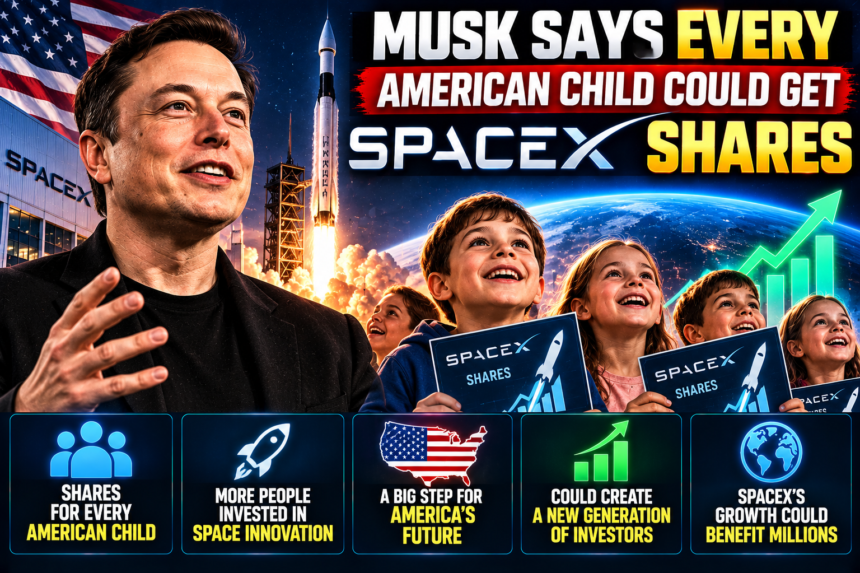
Elon Musk has announced plans to give one share of SpaceX to every child in the United States next year, potentially creating one of the largest direct stock-gifting initiatives ever proposed by a private individual. The announcement, made on October 19, 2026, has attracted widespread attention because of its enormous estimated value and its unusual approach to distributing wealth.
Musk, the billionaire entrepreneur behind SpaceX, Tesla and several artificial intelligence ventures, said that he intended to give a share of his space company to every American child in 2027. He described the initiative as the first of many such gifts, suggesting that the plan could form part of a broader effort to distribute ownership of successful technology businesses more widely.
Based on an estimated 72 million children under the age of 18 in the United States and a recent SpaceX share price of approximately $146, the proposed giveaway could be worth more than $10.5 billion. Depending on the share price and the number of eligible recipients when the distribution takes place, the final value could be higher or lower.
However, an important distinction remains: Musk has announced his intention, but the detailed distribution mechanism, eligibility rules and timetable have not yet been fully explained. The proposal should therefore be understood as a pledge rather than a completed transfer of shares.
Why Musk Wants to Give SpaceX Shares Directly to Children
The announcement followed a public discussion about how technology companies and their founders could share some of the wealth generated by artificial intelligence and other advanced technologies.
On October 18, Anthropic, the company behind the Claude AI chatbot, announced plans to allocate 5% of its equity to a new public-benefit fund, subject to the necessary approvals. The proposed fund is intended to support public-benefit activities through donations and other forms of assistance.
Musk responded by arguing that shares should be distributed directly to members of the public rather than being channelled exclusively through an intermediary organisation. He subsequently announced his plan to give SpaceX shares to American children.
His proposal reflects an idea sometimes described as universal basic capital. Under this concept, individuals receive ownership of financial assets that may appreciate over time, allowing them to participate more directly in economic growth.
Supporters argue that distributing shares could help more people build wealth instead of concentrating the financial benefits of technological progress among company founders, executives and existing investors.
The idea has become increasingly relevant as businesses invest heavily in artificial intelligence, automation and advanced computing. These technologies could create substantial economic value, but they have also raised concerns about employment, wage inequality and the distribution of future wealth.
How Much Could Every Child Receive?
The estimated financial scale of Musk’s proposal is enormous.
If approximately 72 million American children each received one SpaceX share valued at $146, the calculation would look like this:
- Estimated eligible children: 72 million
- Shares per child: One
- Illustrative value per share: $146
- Estimated total value: $10.512 billion
This calculation represents a valuation based on a particular share price, not a guaranteed cash payment.
The value of an individual child’s holding could rise or fall depending on SpaceX’s future financial performance and stock-market valuation. If the share price doubled, for example, a child’s single share would be worth approximately $292. If the price fell by half, its value would decline to about $73.
Children would therefore receive an investment asset rather than a fixed amount of money. The eventual benefit would depend on the company’s performance, the terms governing the shares and whether recipients could sell them.
The proposal also leaves an important question unanswered: whether eligibility will cover every child physically living in the United States, only American citizens, or a more narrowly defined group. Musk has not yet provided a complete set of eligibility rules.
What Is SpaceX, and Why Are Its Shares Valuable?
SpaceX is a major aerospace company known for developing reusable rockets, launching satellites and transporting cargo and astronauts. Its business includes the Falcon launch vehicle family, the Dragon spacecraft and Starlink, its satellite-based internet service.
The company has also pursued ambitious projects involving the Starship launch system and technologies intended to support future missions to the Moon and Mars.
SpaceX’s commercial appeal comes from its position in several strategically important markets. Satellite communications can generate recurring revenue, while launch services support commercial customers, governments and scientific organisations. Its reusable rocket technology has also helped reshape the economics of space transportation.
The company’s expansion into artificial intelligence and computing infrastructure has further increased investor interest in its long-term prospects.
Nevertheless, the value of SpaceX shares is not guaranteed. Aerospace development requires substantial investment, and the company faces technological, operational, regulatory and competitive risks. Its future valuation will depend on business results and investor expectations rather than the announcement of a stock giveaway alone.
How Could the Shares Reach Millions of Children?
The distribution process remains one of the most important unresolved parts of the announcement.
One possibility being discussed is the use of custodial investment accounts, which allow financial assets to be held for minors until they reach the applicable age for control of the account. The federal Trump Accounts programme has also been mentioned as a possible route because it provides investment accounts for eligible children and permits certain stock contributions.
However, Musk has not confirmed the final mechanism, and it would be incorrect to state that every child will automatically receive a share through this programme.
A distribution on this scale would require detailed arrangements for identifying eligible recipients, transferring ownership, maintaining records and handling taxes and other legal requirements. It would also need to address what happens when children become adults, move abroad or are otherwise unable to receive shares under the final rules.
The distinction between receiving a share and being able to sell it immediately is also important. Depending on the structure used, minors may have restrictions on accessing, transferring or disposing of their holdings.
Until the official arrangements are announced, families should not assume that they need to register for a particular programme or provide personal information to websites claiming to offer early access.
What Could the Giveaway Mean for Wealth Inequality?
If implemented as described, the initiative could provide millions of children with an investment asset before they enter adulthood.
Even a single share could become financially meaningful if SpaceX continues to grow over many years. Children who retain their holdings could potentially benefit from increases in the company’s value, although there is no guarantee of positive returns.
The initiative could also introduce more young people to investing and financial markets. Holding a share may encourage families to learn about business ownership, valuation, risk and the difference between an asset’s market price and its underlying economic value.
However, one share would not eliminate wealth inequality or guarantee financial security. A child’s overall financial circumstances would still depend on family income, education, housing, employment opportunities and access to other assets.
Critics may also question whether a company-specific stock gift is the most effective way to distribute wealth. A single-company investment exposes recipients to the risks of that business, whereas a diversified investment portfolio spreads risk across multiple companies.
The broader debate is therefore not simply about generosity. It concerns how the benefits of technological innovation can be distributed fairly, sustainably and transparently.
Conclusion
Elon Musk’s proposal to give one SpaceX share to every American child in 2027 could represent a stock giveaway worth approximately $10.5 billion at recent share prices. The announcement has brought renewed attention to universal basic capital and the question of how the public might participate more directly in the wealth created by technology companies.
For millions of children, the proposal could offer an early introduction to investment ownership and the possibility of long-term financial growth. Yet its actual impact will depend on the final eligibility rules, the distribution process, the legal structure and the future value of SpaceX shares.
For now, the plan remains a pledge awaiting further details. If Musk follows through, it could become a significant experiment in distributing corporate ownership beyond traditional investors and wealthy shareholders.
About The Author