

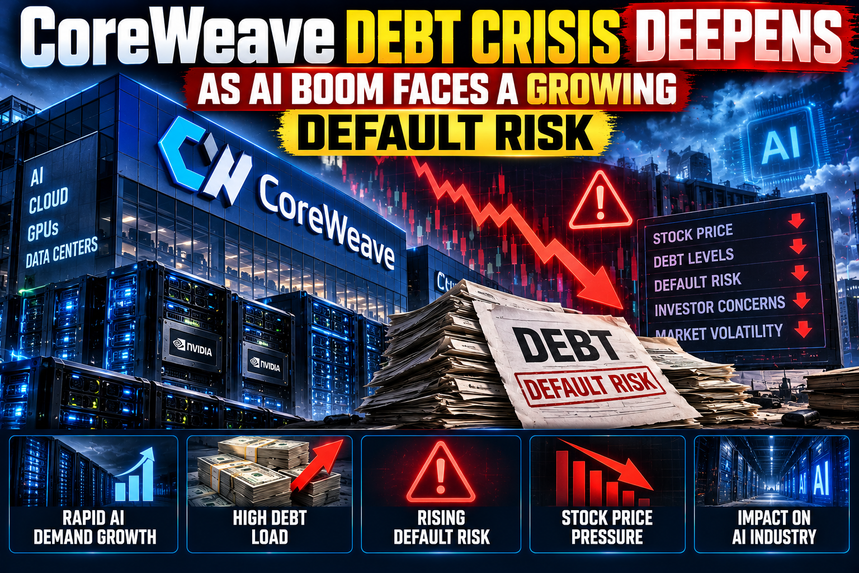
The artificial intelligence industry is facing renewed financial scrutiny as CoreWeave, a major AI cloud-computing company backed by Nvidia, comes under pressure from investors worried about its mounting debt and the sustainability of the AI infrastructure boom. In October 2026, the company’s shares and bonds suffered a sharp sell-off, while the cost of insuring its debt against default climbed to record levels. The developments have raised questions about whether companies investing billions of dollars in AI data centres can generate sufficient revenue to justify their borrowing.
CoreWeave has built its business around providing high-performance computing capacity to companies developing and operating artificial intelligence systems. Its rapid expansion has attracted major customers and substantial financing, but it has also left the company exposed to rising interest costs, infrastructure delays and changes in investor confidence. Although markets are increasingly pricing in significant credit risk, this does not mean CoreWeave has officially defaulted or is certain to fail.
Why Is CoreWeave Facing a Debt Crisis?
CoreWeave operates in the rapidly growing AI cloud-computing market, sometimes described as the “neocloud” sector. Instead of building their own complete computing infrastructure, AI developers can rent access to powerful graphics processing units (GPUs), servers and data-centre capacity from providers such as CoreWeave.
The business requires enormous upfront investment. Companies must purchase expensive AI chips, secure land, construct data centres, arrange electricity supplies and install cooling systems before they can generate revenue from the computing capacity.
To finance this expansion, CoreWeave has relied heavily on borrowing alongside customer contracts and other sources of capital. By October 2026, market data indicated that its debt and other liabilities had reached a very substantial level, with reported debt estimates around $50 billion. The company’s rapid spending has increased its exposure to changes in interest rates and financing conditions.
Investors became increasingly concerned after major technology companies signalled delays in some data-centre projects and challenges involving electricity, components and construction. These issues could delay the point at which new infrastructure starts generating revenue, while interest and other costs continue accumulating.
Default Risk Surges as Bond Yields Rise
One of the clearest warning signals has come from the credit markets. CoreWeave’s bonds have fallen in value, pushing yields on some issues into the 15%–16% range. Such high yields indicate that investors are demanding substantial compensation for the risks associated with lending to the company.
The cost of credit-default swaps (CDS), financial contracts used to protect against credit events, has also surged. Five-year CDS spreads reportedly climbed above 1,100 basis points during the October sell-off, with some market measures approaching 1,200 basis points.
Some market models have interpreted these prices as implying a default probability of roughly 60% or more over five years. This is a market-implied estimate, not a confirmed prediction. CDS pricing reflects investor expectations, risk premiums, liquidity conditions and the terms of the contracts. It does not establish that a default will occur.
Nevertheless, the sharp rise in borrowing costs creates a practical problem. If CoreWeave needs to raise additional money or refinance debt while investors remain concerned, it may have to accept more expensive financing or stricter lending conditions.
Strong AI Demand Has Not Eliminated Financial Risks
Despite the market pressure, CoreWeave has pointed to substantial demand for its services. At the end of the second quarter of 2026, the company reported a revenue backlog of approximately $104.2 billion, followed by more than $25 billion in additional customer commitments early in the third quarter.
A backlog represents contracted or otherwise committed future revenue expected to be recognised over time. It is not the same as cash already received, and converting it into revenue depends on delivering computing capacity, meeting contractual requirements and maintaining customer relationships.
Microsoft has been a particularly important customer, while OpenAI, Meta and other major technology companies have also signed substantial commitments. This demand provides a potential foundation for future growth.
However, a large backlog cannot automatically solve a liquidity problem. CoreWeave must build and operate the infrastructure needed to fulfil its agreements. Construction delays, rising financing costs, equipment constraints or changes in customer requirements could affect the timing and profitability of those contracts.
The central question for investors is therefore not simply whether customers want AI computing. It is whether CoreWeave can finance the infrastructure, deliver it on time and earn sufficient returns to cover its operating expenses and debt obligations.
Nvidia’s Role in CoreWeave’s Future
Nvidia has played an important role in CoreWeave’s expansion by supplying the advanced processors required for AI workloads and supporting the company’s growth. Nvidia has also agreed to purchase certain unused CoreWeave computing capacity through April 2032, providing a potential backstop for capacity that is not sold to other customers under the agreement’s terms.
This arrangement can reduce some demand uncertainty, but it does not eliminate every financial risk. CoreWeave must still build the required infrastructure, manage its expenses and meet its contractual obligations.
Nvidia’s support also illustrates how interconnected the AI ecosystem has become. Chipmakers, cloud providers, data-centre operators, lenders and AI developers all depend on continued investment and growing demand. If one part of the system faces financial pressure, the effects can spread through financing markets and business relationships.
Could CoreWeave’s Problems Spread Across the AI Industry?
CoreWeave’s difficulties have prompted investors to question whether the wider AI infrastructure boom is being financed too aggressively. Major technology companies are committing enormous sums to data centres and computing capacity, while specialised cloud providers are often using substantial debt to fund their expansion.
If lenders become more cautious, AI infrastructure companies could face higher borrowing costs, stricter loan conditions and greater difficulty obtaining new financing. Projects that depend on continued access to inexpensive capital could be delayed or scaled back.
Such a development could affect data-centre construction, demand for AI chips and the companies supplying power, cooling equipment and networking systems. It could also place pressure on technology stocks if investors begin to doubt whether expected AI revenues will justify the industry’s investment spending.
However, CoreWeave’s financial situation should not be treated as proof that the entire AI industry is in a bubble. Large technology companies differ significantly in their cash flows, balance sheets, customer bases and ability to finance investment internally. A financing crisis at one specialised provider would not automatically produce a wider financial crisis.
What Happens Next?
Investors will closely monitor CoreWeave’s quarterly results, cash flow, debt maturities, financing arrangements and progress in bringing new data-centre capacity online. The company’s ability to turn contracted demand into actual revenue while controlling capital expenditure will be particularly important.
A sustained recovery in customer demand, successful project delivery and improved access to financing could help stabilise confidence. Conversely, prolonged delays, persistently high borrowing costs or weaker-than-expected revenue could increase pressure on its balance sheet.
For investors, the episode is a reminder that rapid growth does not always translate into financial stability. Companies can have strong customer demand and substantial future contracts while still facing significant funding risks.
CoreWeave’s rising default-risk indicators have become a warning sign for the AI infrastructure market, but the outcome remains uncertain. The decisive factor will be whether the company can transform its large pipeline of AI contracts into dependable cash flow sufficient to fund its expansion and service its debt.
About The Author