

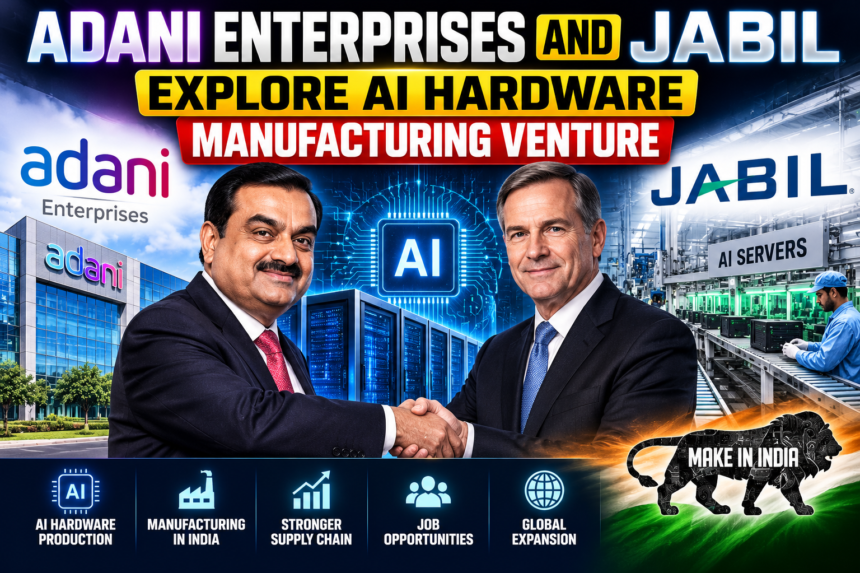
Adani Enterprises and US-based engineering and manufacturing company Jabil have signed a non-binding memorandum of understanding (MoU) to establish a proposed 50:50 joint venture for manufacturing and assembling artificial intelligence (AI) and data centre equipment in India. Announced on October 13, 2026, the agreement marks a significant step towards expanding India’s role in the rapidly growing global AI infrastructure market.
The proposed venture aims to manufacture critical equipment used to build and operate AI-powered data centres, including AI racks, servers, storage systems, networking hardware, power distribution equipment and liquid-cooling systems. The companies intend to serve India’s growing technology sector while also developing an export-oriented manufacturing platform for international customers.
However, the agreement is not yet a completed joint venture. The proposal remains subject to definitive agreements, relevant approvals and other customary conditions.
What Will the Adani–Jabil Venture Manufacture?
The proposed partnership will focus on the physical infrastructure required to run advanced AI applications. Although AI is often associated with software, chatbots and digital services, these technologies depend on powerful computing systems housed in specialised data centres.
The planned product range includes AI racks, servers, storage equipment and networking systems. AI racks organise and connect high-performance computing equipment, allowing large groups of processors to work together for demanding workloads such as training AI models and running AI services.
The venture also plans to manufacture equipment needed to distribute electricity and control temperatures inside data centres. This could include power distribution units, transformers and liquid-cooling systems. Such components are becoming increasingly important as AI hardware consumes substantial amounts of electricity and generates significant heat.
In addition to manufacturing and assembly, the proposed platform is expected to provide installation and commissioning services. The companies have outlined plans for multi-gigawatt manufacturing capacity, although detailed investment figures, production timelines and final facility locations have not yet been confirmed in the announcement.
Why Are Adani Enterprises and Jabil Joining Hands?
The partnership combines two different strengths. Adani brings experience in infrastructure, energy, logistics and data centre development, while Jabil contributes decades of engineering, electronics manufacturing and supply-chain expertise.
For Adani Enterprises, the venture represents an opportunity to expand beyond providing infrastructure and hosting digital workloads. By entering AI hardware manufacturing, the group could participate in more stages of the data centre value chain—from supplying infrastructure and energy to producing the equipment that makes AI computing possible.
For Jabil, the proposed partnership offers a route to expand its manufacturing presence in India and serve customers investing in AI infrastructure. Its experience in complex manufacturing could help translate demand from data centre operators and large technology companies into locally assembled systems.
The companies first announced their intention to develop a strategic alliance in June 2026. The October MoU advances that plan by outlining a proposed 50:50 joint venture structure.
India’s AI Data Centre Market Could Create a Major Opportunity
India’s demand for data centres is rising as businesses adopt cloud computing, AI applications and digital services. The companies project that India’s data centre capacity could reach between 5 gigawatts and 8 gigawatts by 2030. They also point to more than $50 billion in planned spending by large cloud and technology companies across India’s data centre, cloud and AI ecosystems.
These figures are industry projections and planned spending estimates, not guaranteed future investment or completed capacity. Nevertheless, they illustrate the scale of the opportunity that manufacturers and infrastructure providers are targeting.
The companies estimate that the global AI computing infrastructure market could represent an opportunity worth more than $3 trillion over the next seven years. This is their estimate of the wider market opportunity, rather than the expected revenue or valuation of the proposed Adani–Jabil venture.
If the project moves forward, locally manufacturing data centre equipment could help shorten supply chains, support domestic infrastructure projects and create opportunities to export products to international markets. It could also support skilled employment in engineering, electronics manufacturing, systems integration and technical services.
What It Could Mean for India’s Technology Manufacturing Sector
The proposed venture aligns with India’s broader ambition to strengthen domestic electronics manufacturing and reduce dependence on imported technology infrastructure. While India has expanded its digital services industry, manufacturing advanced data centre systems at scale could help it capture a larger share of the hardware investment supporting the AI economy.
The project could also complement Adani Group’s announced commitment to invest $100 billion in developing 5 GW of green-energy-powered, hyperscale AI-ready data centres by 2035. Manufacturing equipment locally could create potential connections between the group’s energy and data centre operations and its planned hardware business.
However, manufacturing AI racks and integrating complete data centre systems is different from producing advanced AI processors. The announced product scope focuses on equipment and systems surrounding high-performance computing. The MoU does not announce that the venture will manufacture leading-edge AI chips.
Success will depend on several factors, including the availability of components, reliable electricity, access to engineering talent, competitive production costs and demand from major data centre customers. International competition and rapid changes in AI hardware standards could also affect the project’s long-term prospects.
What Happens Next?
The next major step is for Adani Enterprises and Jabil to finalise binding agreements and satisfy the necessary approvals and other conditions. Further announcements should clarify the investment required, manufacturing locations, implementation schedule, production capacity and customer commitments.
Investors will also be watching for details about how the venture will be financed and how much it could contribute to each company’s future business. The announcement establishes a strategic direction, but it does not yet provide enough information to calculate the venture’s future revenue, profitability or financial impact.
If implemented successfully, the partnership could help India develop a stronger domestic base for AI and data centre hardware while giving both companies access to a fast-growing market. For now, the proposed 50:50 joint venture is an important development in India’s AI infrastructure ambitions, but its eventual impact will depend on execution and commercial demand.
About The Author