

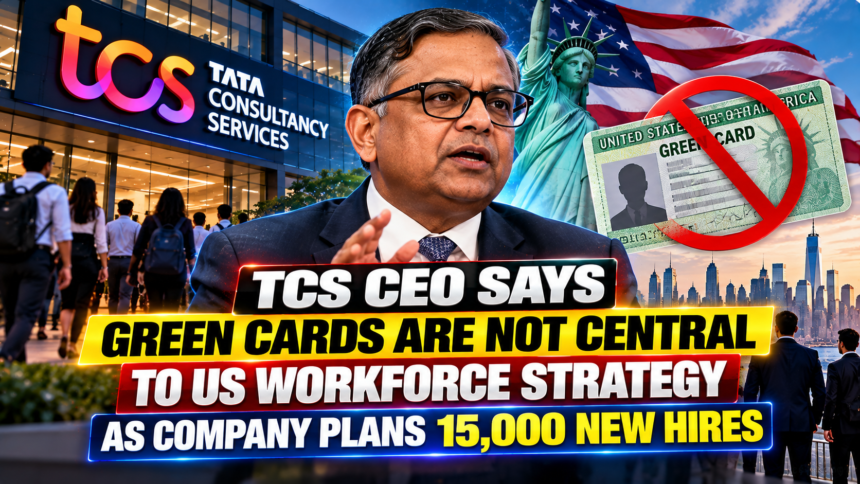
Tata Consultancy Services (TCS), one of India’s largest information technology services companies, has said that green cards are not a central part of its workforce strategy in the United States. CEO and Managing Director K. Krithivasan explained that the company has significantly reduced its applications for permanent residency for employees working in the US and is increasingly focusing on recruiting local talent.

The statement comes amid a major shift in US immigration policy. In October 2026, the US government suspended several technology companies, including TCS, from participating in the employment-based Permanent Labour Certification (PERM) programme, a process that can help eligible foreign workers obtain employment-based green cards.
Despite this development, TCS has maintained that its operations, hiring plans and customer engagements are not expected to face a significant impact. The company has also reiterated its intention to hire an additional 15,000 employees in the US over the next five years, highlighting its commitment to expanding its local workforce.
Why TCS Says Green Cards Are Not a Priority
Speaking about the company’s approach, Krithivasan indicated that permanent residency applications had become a very small part of its workforce planning. According to reporting by The Times of India on October 11, 2026, TCS had reduced its green card applications for H-1B employees to single-digit numbers in recent years.
The company has increasingly adopted a model in which employees travel from India to the US to work on client projects for a limited period, often two to three years, before returning to India. This arrangement allows TCS to deploy specialised skills where clients need them without making permanent US residency a central requirement for its workforce.
TCS has also expanded its recruitment of employees who are already based in the United States. Locally hired workers now account for approximately 50% of the company’s US workforce, according to the reported figures.
This approach reflects a broader change in how international IT service providers manage their employees. Rather than relying exclusively on transferring workers across borders, companies are building teams within the markets where their customers operate.
For TCS, the objective is to maintain access to skilled professionals while adapting to immigration requirements, customer expectations and the changing economics of international technology services.
US Green Card Programme Suspension: What Happened?
The issue gained prominence after the US government suspended eight technology companies from participating in the PERM programme in October 2026. The affected companies included TCS, Infosys, Wipro, HCLTech, Cognizant, Capgemini, Microsoft and Adobe.
The administration said the action was connected to concerns that the employment-based immigration process was disadvantaging American workers. The decision forms part of broader efforts to scrutinise skilled-worker immigration and how companies use employment-based visa programmes.
The PERM process is an important stage in many employment-based green card applications. Employers generally must obtain labour certification by demonstrating that the relevant hiring meets applicable US labour-market requirements before proceeding with certain employment-based immigration petitions.
However, a suspension of an employer’s participation in this process is not the same as cancelling every green card held by its employees or automatically ending their existing work authorisation. Its direct consequences depend on the applicable government directives and the circumstances of individual workers.
TCS said its applications under the programme had been in single digits over the preceding two years. Given this limited use, the company said it did not expect the suspension to affect its workforce strategy or customer engagements materially.
The distinction is important: while the policy change could create uncertainty for employees seeking permanent residency, TCS argues that its current business model is not heavily dependent on the programme.
TCS Plans to Hire 15,000 Employees in the US
Alongside its response to the immigration decision, TCS has reaffirmed plans to recruit another 15,000 people in the United States over the next five years.
The hiring target reinforces the company’s emphasis on building a stronger local talent base. TCS operates across a broad network of offices and delivery centres in the country, serving clients that require technology consulting, software development, digital transformation, cloud services and other IT solutions.
Local recruitment can help the company develop closer relationships with customers, reduce its dependence on international employee transfers and respond more effectively to local hiring requirements. Campus recruitment also gives TCS a way to identify and train new professionals for its business needs.
However, expanding local hiring does not mean immigration policy has become irrelevant. The company still operates internationally, and its ability to deploy particular specialists across borders can be affected by visa rules, labour regulations and administrative decisions.
Recruiting more US-based employees can also bring different costs and training requirements. The financial impact will depend on the mix of roles, employee experience, project demand and how effectively TCS integrates local staff with its global delivery network.
For job seekers in the US, the hiring commitment signals that the company intends to continue investing in its local operations. Nevertheless, the announcement does not guarantee that all 15,000 positions will be immediately available or that every role will be open to every applicant.
What the Development Means for Indian IT Companies and Workers
The TCS announcement highlights a growing challenge for Indian IT services companies: maintaining access to international markets while adjusting to stricter immigration policies.
For Indian professionals hoping to obtain US permanent residency through their employers, the suspension could create difficulties if their applications depend on the affected programme. Workers may need to review their individual immigration status and consult qualified immigration professionals about the implications for their circumstances.
At the same time, the immediate business impact may differ between companies. Firms that have reduced their use of the PERM process or expanded local hiring may be less directly exposed than businesses that rely more heavily on employer-sponsored permanent residency applications. The longer-term consequences will depend on how the US government implements the suspension and whether further restrictions follow.
For customers, TCS’s position is that existing services and client engagements should continue without a material disruption from this particular decision. The company’s ability to deliver projects will still depend on access to the right skills, regulatory compliance and changing customer demand.
Ultimately, TCS’s comments indicate that it has been moving towards a more locally staffed US operation for some time. The green card suspension has brought that strategy into sharper focus, but it does not remove the wider immigration challenges facing Indian technology workers.
The key issue to watch is whether TCS can deliver its planned 15,000 additional US hires while maintaining the cost efficiency and global talent mobility that underpin its international business model.
About The Author