
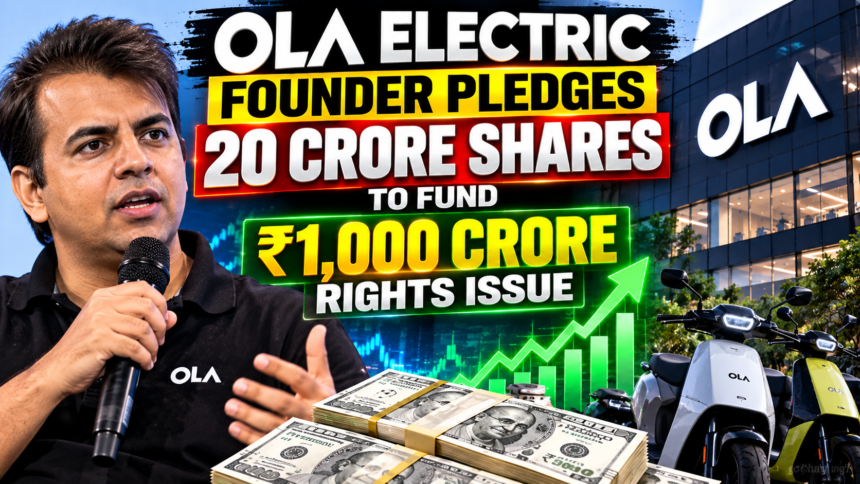
Ola Electric founder Bhavish Aggarwal has pledged 20 crore shares of the electric vehicle company to raise funds for his participation in its proposed ₹1,000 crore rights issue. The pledged shares represent around 4.32% of Ola Electric, making the move a significant financial commitment from the company’s founder at a time when the EV manufacturer is seeking additional capital.
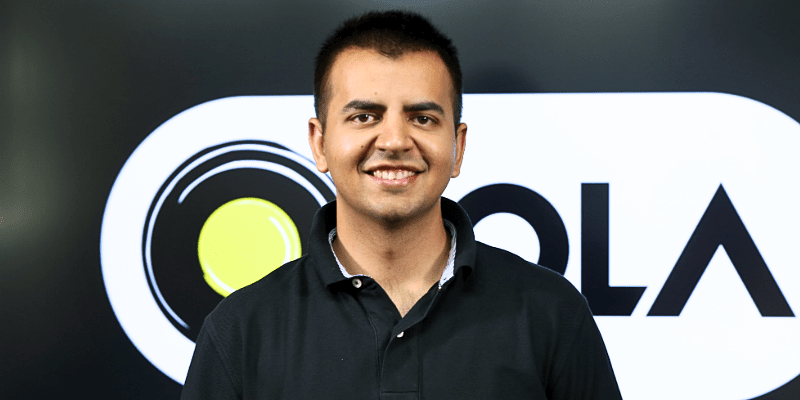
The arrangement allows Aggarwal to raise financing against his existing shares rather than immediately selling them in the open market. The funds will be used to support his participation in the rights issue, while the company seeks fresh money to strengthen its operations and pursue its growth plans.
Aggarwal Uses His Stake to Raise Funds
The 20 crore shares have been pledged against non-convertible debentures issued by Krutrim Data Centre Private Limited, a promoter-group entity associated with Aggarwal.
A share pledge is different from an outright sale. Aggarwal continues to hold the shares, but they are provided as collateral against the financing. The arrangement gives him access to funds while allowing him to maintain his ownership position in Ola Electric.
The development is important because it shows the founder is willing to use a substantial portion of his personal stake to participate in the company’s latest fundraising exercise.
The ₹1,000 Crore Rights Issue
Ola Electric’s board has approved a rights issue of partly paid-up equity shares worth up to ₹1,000 crore.
A rights issue allows existing shareholders to purchase newly issued shares, generally according to their existing ownership entitlement. Companies commonly use this method to raise additional capital while giving existing investors an opportunity to maintain their stake.
The final terms of the Ola Electric issue, including the issue price, number of shares, entitlement ratio, record date and payment schedule, are important details that investors will be watching.
The new capital is expected to provide Ola Electric with additional financial flexibility as it continues investing in electric vehicles, manufacturing, technology and other parts of its business.
Why Ola Electric Needs Fresh Capital
The electric vehicle industry is highly capital intensive. Companies need to spend heavily on manufacturing facilities, battery technology, research and development, software, supply chains and distribution networks.
Ola Electric has made significant investments in these areas while attempting to establish itself as one of India’s leading electric two-wheeler manufacturers.
However, the company is also operating in an increasingly competitive market. The need to invest while simultaneously improving financial performance makes access to additional capital particularly important.
The ₹1,000 crore rights issue can give Ola Electric more resources to manage these requirements, although the eventual success of the fundraising will depend on how effectively the company uses the money.
Competition Is Getting Stronger
Ola Electric’s position in India’s electric two-wheeler market has faced increasing competition from established automobile manufacturers and specialised EV companies.
TVS Motor, Bajaj Auto, Ather Energy and Hero MotoCorp have expanded their electric scooter offerings, giving consumers more choices.
Competition is no longer based only on price. Range, battery performance, charging capabilities, product quality, reliability, service networks and software features have all become important factors.
Ola Electric therefore needs to maintain its technology advantage while improving customer experience and controlling costs.
Aggarwal’s Participation Sends a Signal
Aggarwal’s decision to finance his participation in the rights issue can be viewed as a signal of his continued commitment to Ola Electric.
By using his existing shares as collateral, he is putting part of his personal investment behind the company’s fundraising effort without immediately disposing of the pledged shares.
For existing shareholders, promoter participation can be viewed positively because it demonstrates that the founder remains financially invested in the company’s future.
At the same time, pledged shares introduce an additional factor that investors need to monitor. A substantial decline in Ola Electric’s share price could affect the value of the collateral and the financing arrangement.
Ola Electric Has Raised Capital Before
The latest rights issue follows several earlier fundraising efforts.
Ola Electric raised ₹5,500 crore through its initial public offering in 2024 and subsequently pursued additional financing as it continued investing in its EV business.
The company also raised funds through a qualified institutional placement in 2026, demonstrating its continued reliance on external capital to support expansion and operations.
The repeated fundraising efforts underline the scale of investment required to build a competitive electric vehicle manufacturer.
What Investors Will Watch
Investors will now focus on the final structure of the ₹1,000 crore rights issue and the level of participation from existing shareholders.
The issue price will be particularly important because it will determine how many new shares Ola Electric needs to issue to raise the targeted amount.
Investors will also examine how the company plans to deploy the proceeds and whether the additional capital can improve its operating performance.
Sales growth, vehicle registrations, market share, margins, cash flow and losses will remain key indicators of whether the fundraising is producing meaningful results.
The Bigger Picture
Bhavish Aggarwal’s decision to pledge 20 crore Ola Electric shares highlights the importance of the company’s latest fundraising effort.
The arrangement allows him to raise financing against his existing stake and participate in the proposed ₹1,000 crore rights issue without immediately selling the pledged shares.
For Ola Electric, the fresh capital could provide greater financial flexibility as it attempts to strengthen its business and compete with increasingly powerful rivals in India’s electric two-wheeler market.
The real test, however, will be what the company does with the money. If Ola Electric can convert the fresh capital into stronger products, higher sales, improved market share and better financial performance, the rights issue could become an important step in its recovery and expansion.
If those improvements fail to materialise, investors may continue to question the company’s capital requirements and long-term path to profitability.
About The Author