
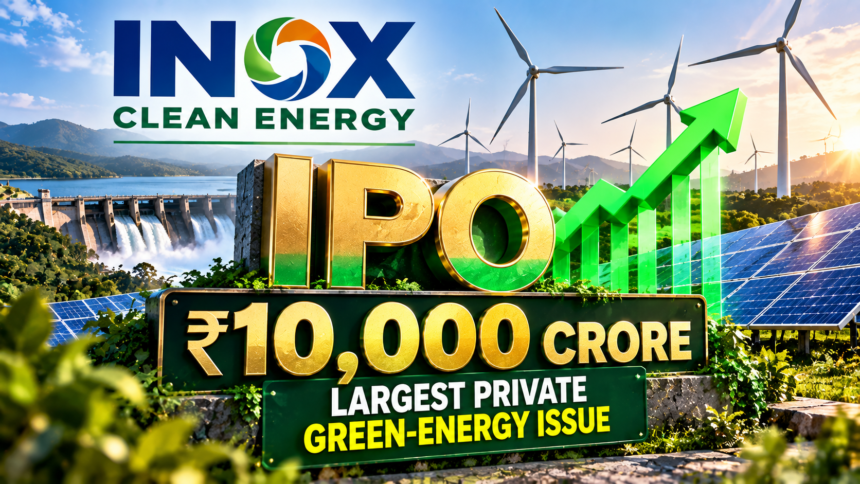
India’s renewable-energy sector is set for one of its biggest capital-market events after Inox Clean Energy, the renewable-energy arm of the INOXGFL Group, filed its Draft Red Herring Prospectus (DRHP) with the Securities and Exchange Board of India (SEBI) for an initial public offering of up to ₹10,000 crore.
The proposed offering would be the largest public issue by a private-sector renewable-energy company in India to date, according to the company and market reports. The IPO comes as India’s renewable-energy industry attracts significant investment amid the country’s long-term expansion of non-fossil-fuel electricity capacity.
The proposed IPO will have two components: a fresh issue of up to ₹8,000 crore and an offer for sale (OFS) of up to ₹2,000 crore. The fresh issue will bring new capital into Inox Clean Energy, while the OFS component represents shares being sold by existing shareholders. The company has not yet announced an IPO price band or final issue dates because the DRHP is still subject to the regulatory process.
₹8,000 Crore Fresh Issue: A Major Portion Will Go Toward Debt Reduction
One of the most important aspects of the proposed IPO is how the fresh capital will be deployed.
Inox Clean Energy plans to use ₹6,000 crore of the fresh-issue proceeds to repay or reduce outstanding borrowings of the company and its subsidiaries. The remaining amount is proposed to be used for general corporate purposes.
The debt-reduction component is significant because renewable-energy businesses generally require large amounts of capital to develop and acquire power-generating assets. Wind and solar projects require substantial upfront investment before they begin generating long-term electricity revenues.
Reducing debt could therefore change the company’s financial structure as it continues expanding its renewable portfolio. However, the eventual impact will depend on the company’s final capital requirements, operating cash flows, borrowing costs and future expansion plans.
Inox Clean Energy’s Renewable Portfolio Has Expanded Rapidly
Inox Clean Energy operates an integrated renewable-energy platform with two major business verticals: renewable power generation and solar manufacturing.
As of August 31, 2026, its renewable independent power producer (IPP) portfolio stood at 9.29 GW across India and Africa. This included approximately 2.37 GW of operational capacity, around 0.80 GW under construction, 2.99 GW of pipeline capacity and 3.13 GW of future capacity.
The company’s expansion has accelerated significantly through both organic development and acquisitions. Reuters reported that Inox Clean Energy acquired Vena Energy India’s 6-GW renewable-energy portfolio in June, substantially strengthening its operating platform and development pipeline.
The company has also set ambitious medium-term capacity objectives. It aims to reach approximately 10 GW of renewable power-generation capacity and 11 GW of solar-manufacturing capacity by FY2028.
Solar Manufacturing Adds Another Growth Engine
Unlike a pure renewable-power producer, Inox Clean Energy is building a business that combines electricity generation with solar photovoltaic manufacturing.
Its manufacturing operations give the company exposure to the solar-equipment side of the energy transition in addition to the recurring power-generation business. The company manufactures solar modules in India and the United States, according to Reuters.
The combination is important because renewable-power generation and solar manufacturing have different revenue and capital cycles. Power projects generate revenues through electricity sales over their operating lives, while manufacturing depends more directly on production capacity, module demand, pricing, technology and supply-chain conditions.
According to the CRISIL report cited in the company’s IPO disclosures, Inox Clean Energy is among India’s top 10 renewable IPP platforms and, on a fully commissioned basis, is also among the top 10 integrated solar PV module and cell manufacturing players.
IPO Structure and the ₹2,000 Crore OFS
The ₹10,000 crore headline size does not entirely represent new money entering Inox Clean Energy.
The proposed structure consists of:
| IPO component | Proposed amount |
|---|---|
| Fresh issue | Up to ₹8,000 crore |
| Offer for Sale | Up to ₹2,000 crore |
| Total IPO size | Up to ₹10,000 crore |
| Planned debt reduction | ₹6,000 crore |
The OFS component is separate from the fresh issue because the proceeds from shares sold by existing shareholders go to those selling shareholders rather than to the company.
The Economic Times reported that the OFS will involve existing shareholders including promoters Devansh Jain and Avarna Jain.
The company may also consider a pre-IPO placement of up to ₹1,600 crore. If such a placement takes place, the amount raised could reduce the size of the fresh issue, meaning the final IPO structure may differ from the current maximum ₹10,000 crore proposal.
Why the IPO Is Significant for India’s Renewable-Energy Market
The proposed offering comes at a time when India’s renewable-energy sector is attracting large amounts of capital for solar, wind, storage and related infrastructure.
Reuters reported that the company is seeking to benefit from India’s push to expand non-fossil-fuel electricity capacity to 500 GW by 2030. The broader renewable-energy IPO pipeline has also become more active, with companies such as Clean Max and Juniper Green Energy having listed in 2026 and other renewable-energy companies preparing public offerings.
For Inox Clean Energy, public-market access could provide another source of capital as it expands its power-generation and manufacturing businesses.
The IPO also gives public-market investors an opportunity to gain exposure to a company positioned across multiple parts of the renewable-energy value chain rather than relying exclusively on one type of asset.
Competition and Industry Landscape
Inox Clean Energy will operate in a highly competitive industry. Its renewable-power activities compete with large power producers and renewable platforms, while its solar-manufacturing operations face competition from established Indian manufacturers.
Reuters identified Adani Green Energy, NTPC Green Energy and ACME Solar among renewable-power competitors, while Waaree Energies and Premier Energies are among companies operating in the solar-equipment manufacturing space.
The INOXGFL Group already has listed companies connected with the broader energy-transition ecosystem, including Gujarat Fluorochemicals, Inox Wind and Inox Green Energy Services. Inox Clean Energy would therefore add another major renewable-energy business to the group’s corporate structure if the IPO proceeds successfully.
What Investors Will Watch Before the IPO Opens
The DRHP filing is an important first step, but the IPO is not yet open for subscription. The price band, lot size, subscription dates and final issue structure are expected to become clearer later in the regulatory process.
Investors will likely focus on several factors when the final prospectus becomes available, including the company’s debt levels, cash flows, renewable-project pipeline, acquisition strategy, solar-manufacturing capacity, customer concentration, regulatory exposure and valuation.
The ₹6,000 crore debt-repayment plan will also be closely examined because leverage is an important factor in capital-intensive renewable-energy businesses.
For now, the ₹10,000 crore proposal marks a major development for India’s IPO market and renewable-energy industry. With ₹8,000 crore of fresh capital, a ₹2,000 crore OFS and a planned ₹6,000 crore debt-reduction allocation, Inox Clean Energy is positioning the proposed listing as a large-scale capital-raising exercise aimed at strengthening its balance sheet while supporting its expansion across renewable power and solar manufacturing.
About The Author