

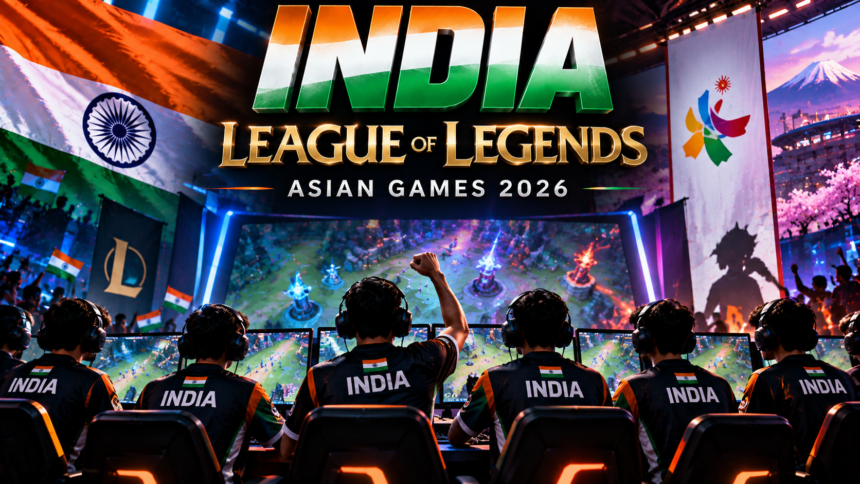

India is preparing for one of its biggest esports challenges at the Aichi-Nagoya Asian Games 2026, with a six-member League of Legends squad set to represent the country against some of Asia’s strongest teams. Led by captain Akshaj “Kat Bot” Shenoy, the Indian roster combines experienced players from the previous Asian Games with new additions who earned their place through the domestic and regional qualification process.
The squad competes domestically under the S8UL Esports banner. India earned its Asian Games berth after winning the National Esports Championships (NESC) 2026 and then progressing through the regional qualifiers. The League of Legends event will put the team against elite opposition, making it an important test of how far India’s competitive LoL scene has progressed.
Meet India’s Six League of Legends Players
India’s roster consists of Akshaj Shenoy, Aakash Shandilya, Sanindhya Malik, Mihir Ranjan, Rahul Bisht and Ahmed Shahid Israr. Each player occupies a specialised role within the five-player League of Legends lineup, with one member serving as the substitute.
Akshaj “Kat Bot” Shenoy – Mid Lane and Captain
Akshaj Shenoy is the captain of the Indian squad and plays in the mid lane. The 24-year-old is based in Kochi and is pursuing an MBA while also helping with his family’s business. His role goes beyond individual performance: as captain, he is responsible for helping the team coordinate and adapt during matches.
Shenoy was part of India’s previous Asian Games League of Legends campaign and returns with experience of competing on this stage. That continuity gives the squad a core of players who already understand the pressure of representing India at a major multi-sport event.
Sanindhya “Deadcorporal” Malik – Top Lane
Sanindhya Malik will take responsibility for India’s top lane. Outside competitive gaming, Malik works for a Government of India enterprise, illustrating the varied professional backgrounds within the national esports team.
In League of Legends, the top laner frequently operates independently during the early phases of a match before becoming crucial in team fights and objective control. Deadcorporal’s performance can therefore influence both India’s lane stability and its ability to execute larger team strategies.
Aakash “Infi” Shandilya – Jungle
Aakash Shandilya occupies the jungle position. The Week describes Shandilya as a cloud-engineering fresher, giving the Indian lineup another player balancing a conventional professional path with high-level esports competition.
The jungler is one of the most strategically important roles in League of Legends. Rather than remaining in a fixed lane, the player moves around the map, assists teammates, contests neutral objectives and creates opportunities for attacks.
For India, Infi’s coordination with Kat Bot and the side lanes could therefore become an important part of the team’s approach.
Mihir “Lotus” Ranjan – AD Carry
Mihir Ranjan will compete as India’s AD Carry. Ranjan is an IIM Ahmedabad graduate, giving the roster an unusual mix of academic and esports backgrounds.
The AD Carry is generally one of a team’s major sources of sustained damage, particularly as games progress. Lotus will consequently be an important part of India’s late-game fighting potential.
His partnership with support player Rahul “Bob” Bisht in the bottom lane will also be crucial because coordination between the ADC and support can shape the early stages of a match.
Rahul “Bob” Bisht – Support
Rahul Bisht is India’s support player. The 29-year-old is a product designer and is one of the two Asian Games debutants highlighted in the team’s profile.
Support players typically focus on vision, protecting teammates, initiating fights and enabling the team’s primary damage dealers rather than accumulating resources themselves.
Bob’s communication with Lotus and the rest of the team could therefore have a major influence on India’s ability to coordinate team fights.
Ahmed “Nero” Shahid Israr – Substitute
Ahmed Shahid Israr completes the six-player squad as its substitute. Shahid is a chemical engineering graduate and, like Bisht, is making his Asian Games debut.
Having a substitute provides additional flexibility across a tournament where teams may need to adapt their strategies or lineup depending on opponents and circumstances.
India Qualified After Strong Regional Campaign
India’s journey to Aichi-Nagoya began with victory at NESC 2026, which served as the country’s official qualification tournament. The S8UL roster then moved into the regional Asian Games qualifiers.
India was placed in Group B during qualifying and went undefeated against Jordan, Sri Lanka and Kazakhstan, finishing at the top of its group. The team subsequently entered the Split Stage, where it faced tougher competition and lost against Vietnam, Hong Kong and Saudi Arabia. Its overall performance was nevertheless sufficient to secure qualification for the Asian Games.
The qualification gave India a place among the eight nations reported to have reached the League of Legends main event.
India Drawn Against Asian Esports Heavyweights
The main tournament presents a considerably tougher challenge.
India has been drawn in Group B alongside South Korea, Chinese Taipei and Hong Kong, according to The Week. The League of Legends competition is set to begin for the group on September 29.
South Korea enters as the defending Asian Games champion and has selected a roster featuring internationally recognised professional players. Chinese Taipei is another established League of Legends nation, while Hong Kong also fields players with professional experience.
For India, the group therefore offers an opportunity to measure its progress directly against some of Asia’s established League of Legends ecosystems.
Four Players Bring Previous Asian Games Experience
One of India’s important strengths is continuity.
Four members of the current setup have previous Asian Games experience, while Bisht and Shahid are newcomers to the event. India finished fifth in League of Legends at the previous Asian Games in Hangzhou, according to the Sports Ministry-approved contingent information reported by NDTV.
That previous campaign gives part of the roster experience with the environment surrounding a multi-sport international competition, where players represent their country rather than only a professional esports organisation.
Since then, the roster has also had more time competing together, which captain Shenoy identified as an important part of the team’s development.
League of Legends Returns as an Asian Games Medal Event
League of Legends has become one of the major esports disciplines represented at the Asian Games.
Esports first appeared at the Asian Games as a demonstration event in 2018 before becoming an official medal sport at Hangzhou. It returns as a medal competition at Aichi-Nagoya, with the broader esports programme covering multiple games.
India’s overall esports contingent for the Games consists of 15 athletes, with the country represented in League of Legends, Pokémon UNITE, eFootball and Puyo Puyo Champions. The six-member LoL squad is therefore the largest single group within India’s approved esports contingent alongside Pokémon UNITE’s six-player team.
India’s League of Legends Test Begins September 29
The six players heading into India’s campaign represent a blend of esports experience and very different academic and professional backgrounds: an MBA student, an IIM Ahmedabad graduate, a cloud-engineering fresher, a government-enterprise employee, a chemical engineering graduate and a product designer.
Their route to the Asian Games has already required success at the national championships followed by qualification against international opposition. The next challenge is significantly larger.
With Akshaj “Kat Bot” Shenoy leading Sanindhya “Deadcorporal” Malik, Aakash “Infi” Shandilya, Mihir “Lotus” Ranjan, Rahul “Bob” Bisht and substitute Ahmed “Nero” Shahid Israr, India now heads toward its League of Legends matches carrying both the experience of its fifth-place finish at the previous Games and the ambition of improving on that result in Aichi-Nagoya.
About The Author