

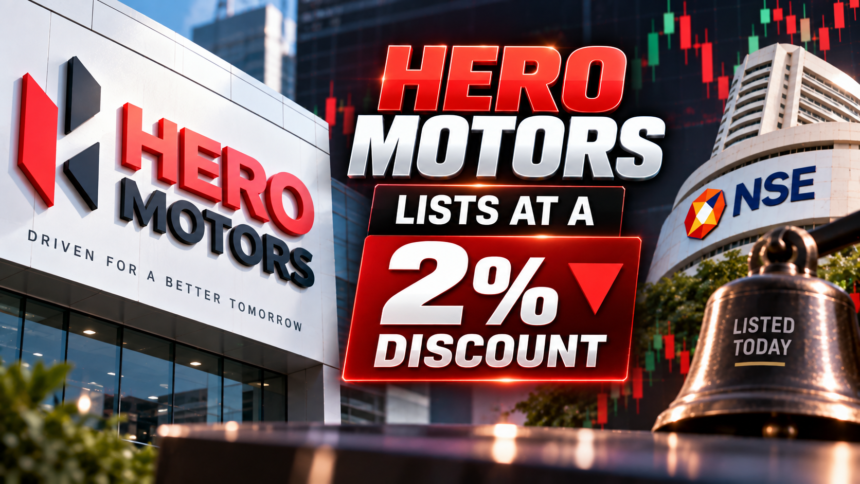

Hero Motors made a muted stock-market debut on September 23, 2026, with its shares listing at a discount to the IPO issue price despite the public offering receiving strong investor demand. The shares opened at ₹82 on the NSE, compared with the IPO issue price of ₹84, translating into a 2.38% discount. On the BSE, the stock opened at ₹82.10, down 2.26% from the issue price.
The debut came after Hero Motors’ ₹1,000-crore IPO was subscribed more than six times, highlighting the difference that can sometimes emerge between subscription demand and the actual market opening price.
Hero Motors IPO Makes a Weak Debut
Hero Motors had fixed its IPO price band at ₹79–₹84 per share, with the issue priced at the upper end at ₹84. The stock’s NSE opening at ₹82 meant investors who received shares at the IPO price initially faced a notional loss of ₹2 per share.
For the minimum lot of 178 shares, the difference between the issue price and the NSE opening price amounted to approximately ₹356 before considering taxes and other charges. The minimum application at the upper price band was ₹14,952.
The listing was broadly in line with the subdued grey-market signals seen before the debut, although grey-market premiums are unofficial and do not determine the actual exchange listing price.
₹1,000 Crore IPO Attracted Strong Demand
The weak opening came despite substantial demand during the IPO subscription period.
Hero Motors’ IPO received bids for approximately 58.97 crore shares against 8.86 crore shares offered, resulting in an overall subscription of around 6.66 times, according to exchange data reported by Business Standard.
Demand was particularly strong among non-institutional investors. The NII portion was subscribed 9.86 times, while the retail category was subscribed 8.23 times. The QIB portion was subscribed 1.49 times.
The IPO therefore generated considerable demand during the bidding period, but that did not translate into a premium opening price on the first day of trading.
How the Hero Motors IPO Was Structured
The ₹1,000-crore IPO consisted of two components.
The company raised ₹600 crore through a fresh issue, while shares worth approximately ₹400 crore were offered for sale by existing shareholders, including O P Munjal Holdings and Hero Cycles.
The fresh capital provides Hero Motors with funds for its business and expansion plans, while the OFS allows existing shareholders to sell part of their holdings.
The IPO opened on September 16 and closed on September 18. Allotment was finalised on September 21, refunds and demat credits were scheduled for September 22, and the shares began trading on September 23.
What Does Hero Motors Do?
Hero Motors is an automotive technology and components company that designs, develops, manufactures and supplies engineered powertrain solutions to automobile manufacturers.
Its products cover both electric and conventional applications across categories including two-wheelers, e-bikes, performance vehicles, off-road vehicles, electric and hybrid cars and heavy-duty vehicles.
The company operates through two principal business segments: Powertrain Solutions and Alloys & Metallics.
During FY2026, Powertrain Solutions contributed approximately 53.67% of revenue, while Alloys & Metallics accounted for around 46.33%.
Hero Motors also has an international manufacturing footprint, with six manufacturing facilities across India, the UK and Thailand as of March 31, 2026.
Global Customer Base Gives Hero Motors Wider Exposure
Hero Motors supplies components and powertrain technologies to customers across several international markets.
Its reported customer base includes names such as BMW, Ducati, Enviolo, Formula Motorsport, Hummingbird EV and HWA.
The company’s exposure to both electric and non-electric powertrain technologies gives it access to multiple parts of the automotive supply chain.
The transition toward electric vehicles could create additional opportunities for companies developing specialised powertrain components. At the same time, Hero Motors continues to operate significant conventional powertrain and alloy-related businesses, meaning its performance remains connected to broader automotive production and demand.
Shares Recover After the Initial Discount
Although Hero Motors opened below its IPO price, the stock subsequently moved sharply higher during the morning session.
Moneycontrol reported that the shares rose to around ₹95.98, representing a gain of more than 17% from the NSE opening price of ₹82.
Other market reports also showed the stock moving toward the upper circuit during the session. This created a sharp contrast between the initial listing price and the subsequent trading levels.
The early trading action illustrates why the opening price does not necessarily represent the entire first-day performance of an IPO. Market participants continued to reassess the company’s valuation after trading began.
Valuation and Customer Concentration in Focus
Following the listing, valuation became one of the areas attracting market attention.
Moneycontrol cited an assessment that Hero Motors was valued at around 74 times FY26 P/E, compared with a peer average of approximately 50.2 times. The same analysis also highlighted customer concentration, with the company’s top 10 customers contributing roughly 73–78% of revenue.
These factors are important because the company’s future performance depends not only on automotive-sector growth but also on maintaining relationships with major customers and converting its technology capabilities into sustainable earnings.
Hero Motors’ IPO Debut Marks a Mixed Start
Hero Motors’ market debut has produced a notable sequence: strong IPO subscription, a discounted opening and then a sharp recovery in early trading.
The ₹1,000-crore IPO was subscribed around 6.66 times, but the shares opened at ₹82 on the NSE, 2.38% below the ₹84 issue price.
The company’s performance in the coming quarters will now be closely watched as a listed entity, particularly its powertrain business, international operations, customer concentration, profitability and exposure to the transition toward electric mobility.
For investors, the first-day price movement is only the beginning of the company’s public-market journey. The longer-term market valuation will depend on how Hero Motors performs as an automotive technology supplier and how effectively it converts its global customer relationships and technology portfolio into sustained financial growth.
About The Author