

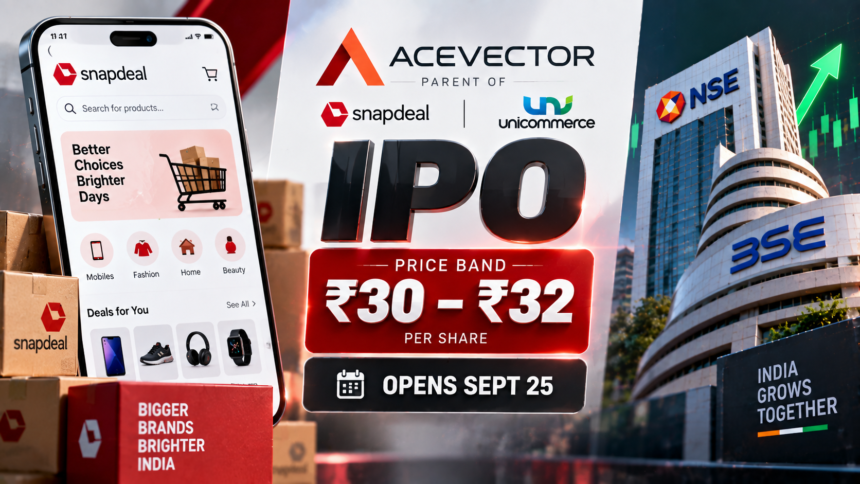
AceVector, the parent company of e-commerce platform Snapdeal and software business Unicommerce, has fixed the price band for its upcoming initial public offering (IPO) at ₹30 to ₹32 per equity share. The company is targeting a valuation of approximately ₹1,741 crore at the upper end of the price band and will open its IPO for public subscription on September 25, 2026. The issue will remain open until September 29, while anchor investors will be able to participate on September 24.

The IPO comes after AceVector reduced the size of its proposed offering compared with its earlier plans. At the upper end of the price band, the company is looking to raise ₹420 crore, making the issue one of the notable new-age technology and consumer internet offerings arriving in India’s primary market this month.
AceVector IPO: Key Details
The AceVector IPO will comprise a combination of a fresh issue and an offer for sale (OFS). The company plans to raise approximately ₹287 crore through the fresh issue, while existing shareholders will sell shares worth around ₹133 crore through the OFS.
The face value of each equity share is ₹1. Investors will be required to bid for a minimum of 468 shares, and thereafter in multiples of 468 shares. At the upper price of ₹32, the minimum application amount works out to ₹14,976, before applicable charges.
The IPO is scheduled as follows:
- Anchor bidding: September 24, 2026
- IPO opens: September 25, 2026
- IPO closes: September 29, 2026
- Expected listing: October 5, 2026
- Price band: ₹30–₹32
- Issue size: ₹420 crore
- Fresh issue: ₹287 crore
- Offer for sale: ₹133 crore
- Post-issue valuation at ₹32: approximately ₹1,741 crore
Why AceVector Reduced the IPO Size
AceVector’s latest offering is smaller than the issue outlined in its earlier filings. The company had previously planned a fresh issue of around ₹300 crore and a larger OFS component.
According to Reuters, the revised IPO will contain a fresh issue of ₹287 crore and an OFS of up to 41.56 million shares. Earlier plans had envisaged a fresh issue of ₹300 crore and an OFS of approximately 63.87 million shares. The reasons for the reduction in the offer size were not immediately clear from the company’s filing.
The reduction means the company is seeking a more modest public-market debut than initially planned. Nevertheless, the IPO provides existing investors with an opportunity to partially exit while also bringing fresh capital into AceVector.
SoftBank and Other Investors to Sell Shares
The OFS component will allow several existing investors to sell part of their holdings.
Starfish, a SoftBank-controlled entity, is among the key selling shareholders and plans to sell up to approximately 27.61 million shares. Nexus Venture Partners is also participating in the OFS.
Other selling shareholders include FIH Business Global, Kenneth Stuart Glass, Jason Ashok Kothari, Rupen Investment and Industries, Centaurus Trading and Investments, and Laurent Bernard Amouyal.
Because the OFS proceeds go to selling shareholders rather than to AceVector, the fresh issue is particularly important for understanding how much new capital will actually enter the company’s business.
Where Will AceVector Use the IPO Money?
AceVector plans to use the proceeds from the fresh issue across several areas of its business.
The company has identified marketing and business promotion, technology infrastructure and inorganic growth opportunities as key uses of the IPO proceeds.
Marketing investment is particularly relevant for Snapdeal because competition in India’s e-commerce market remains intense. Spending on customer acquisition, brand visibility and promotional activities can influence traffic and transaction volumes.
Technology infrastructure is another major area because AceVector operates digital marketplaces and technology platforms that require investment in software, systems and other infrastructure.
The company also intends to retain flexibility for potential inorganic growth, which could include acquisitions or investments that complement its existing businesses.
Snapdeal Remains the Core Consumer-Facing Business
AceVector’s most recognisable business is Snapdeal, an e-commerce marketplace focused on value-conscious consumers.
Unlike premium-focused online marketplaces, Snapdeal has positioned itself around affordable products, particularly in categories such as fashion, home and general merchandise, and beauty and personal care.
Company documents describe Snapdeal as a pure-play value marketplace using an asset-light, zero-inventory model. During the six months ended September 30, 2025, approximately 94% of Snapdeal’s net merchandise value came from lifestyle categories, while more than 83% of delivered units were priced below ₹599.
The company also reported that more than 82% of delivered units during that period came from customers in non-metro cities, highlighting Snapdeal’s focus on India’s broader value-shopping market.
Unicommerce Adds a B2B Technology Angle
AceVector is not solely dependent on Snapdeal. The group also has exposure to Unicommerce, a software business that provides technology solutions to e-commerce companies and merchants.
This gives AceVector a combination of consumer-facing e-commerce and business-to-business technology exposure.
The group has therefore been positioning itself around a broader digital-commerce ecosystem rather than simply operating a conventional online marketplace. The combination could provide multiple revenue opportunities, although the performance of each business remains dependent on competitive conditions and the overall growth of India’s digital-commerce market.
Financial Performance Remains an Important Factor
Despite operating in India’s large e-commerce market, AceVector continues to face profitability challenges.
Reuters reported that for fiscal year 2026, the company recorded revenue of approximately ₹510 crore, while its consolidated loss before exceptional items and tax stood at around ₹37.56 crore.
This makes profitability one of the important areas investors are likely to examine when evaluating the IPO.
For a technology and e-commerce company, revenue growth alone does not necessarily translate into profits. Marketing expenses, technology investment, employee costs, logistics and customer acquisition can significantly affect margins.
AceVector IPO Enters a Busy September Market
AceVector’s IPO is arriving at a particularly active period for India’s primary market, with several other public offerings also scheduled around the same time.
The company’s ₹30–₹32 price band, relatively small ₹420-crore issue size and connection with the well-known Snapdeal brand could put the offering on investors’ radar.
However, the IPO also comes with factors that require close attention, including the company’s current losses, competition in e-commerce, dependence on consumer spending and the reduction in issue size.
With the public issue opening on September 25, the next major focus will be investor demand across the retail, non-institutional and institutional categories. The eventual listing on October 5 will provide the first market-based valuation of AceVector after its transition to a publicly traded company.
About The Author