

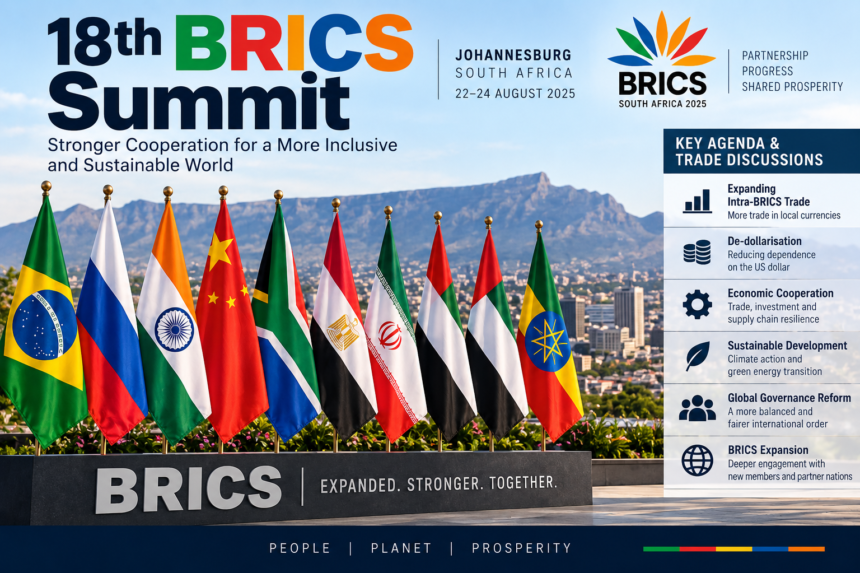
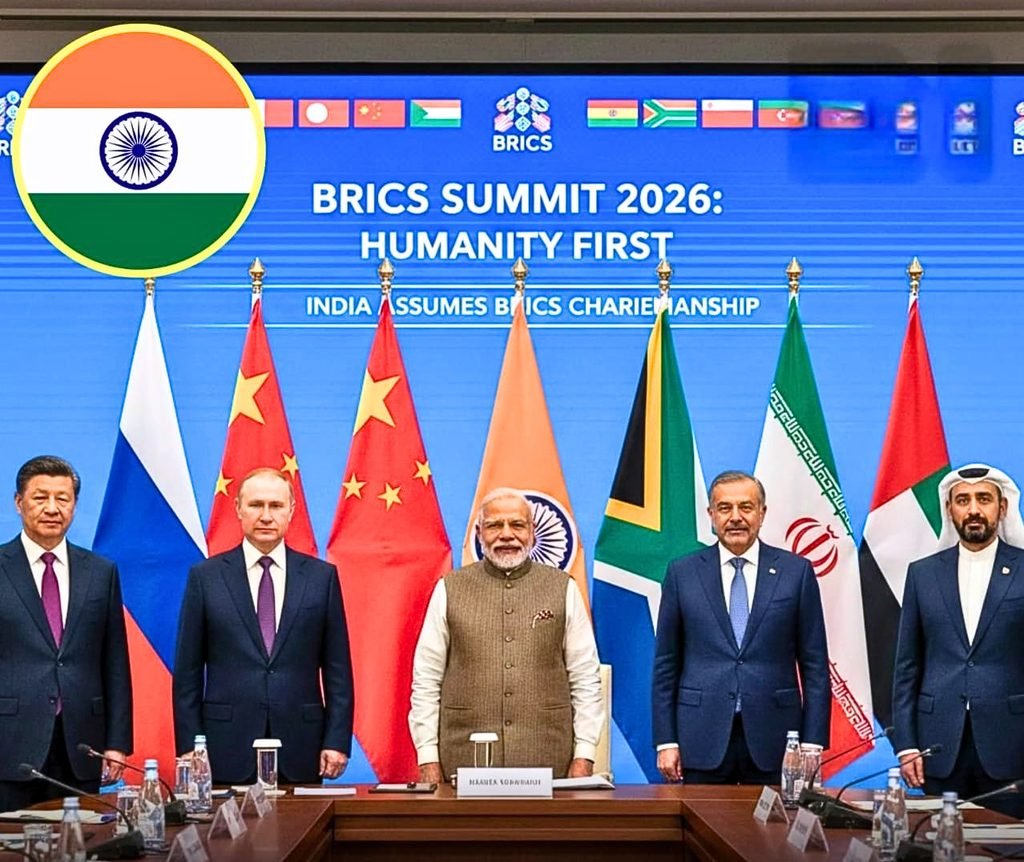
The 18th BRICS Summit is set to take place in New Delhi on September 12–13, 2026, with India hosting the grouping for the fourth time. The summit comes at a particularly important moment for the global economy, with trade tensions, geopolitical conflicts, energy disruptions and changes in global supply chains creating new challenges for emerging economies.
India’s BRICS presidency has adopted the theme “Building for Resilience, Innovation, Cooperation and Sustainability”, with a broader emphasis on a people-centric approach under the principle of “Humanity First.” The expanded BRICS now has 11 full members — Brazil, Russia, India, China, South Africa, Egypt, Ethiopia, Iran, Indonesia, Saudi Arabia and the UAE — collectively representing about 49.5% of the world’s population, 40% of global GDP and 26% of global trade.
The summit’s economic agenda is expected to focus heavily on trade, investment, local-currency settlements, supply-chain resilience, technology, MSMEs and financial cooperation, alongside broader discussions on global governance and geopolitical developments.
Trade and Investment at the Centre of the Summit
One of India’s key priorities is to increase economic activity between BRICS members.
Trade among BRICS economies has significant potential, but the bloc continues to face barriers including different regulations, payment systems, logistics challenges and uneven market access. India is therefore pushing for more practical mechanisms that can make it easier for businesses to trade and invest across member countries.
The BRICS finance track has been discussing ways to increase intra-BRICS trade using national currencies, reducing dependence on the US dollar for transactions between member economies. Finance ministers and central bank governors held meetings in Jaipur ahead of the leaders’ summit, where intra-BRICS financial mechanisms and local-currency settlement were among the key issues.
However, India has indicated that the focus should be on practical financial cooperation rather than presenting BRICS as an explicitly anti-dollar alliance. The issue is particularly sensitive because BRICS members have very different monetary systems, capital controls and exchange-rate regimes.
The aim is therefore more likely to be greater flexibility in cross-border payments than an immediate replacement of the dollar.
New Focus on Supply Chains and Global Value Chains
Supply-chain resilience has become another major priority because geopolitical conflicts and disruptions to important shipping routes have exposed vulnerabilities in global trade.
India is pushing a BRICS Logistics Supply-Chain Cooperation Framework designed to improve cooperation in transport and logistics. The framework focuses on stronger connectivity, technical cooperation, cargo and shipping services, local manufacturing and assembly ecosystems, and more sustainable logistics.
BRICS members are also working on a 2026–2030 Global Value Chains Action Plan. The initiative aims to make supply chains more resilient and productive while encouraging market opening and economic diversification.
This could become increasingly important for India as it seeks to expand manufacturing, attract investment and integrate Indian companies into global production networks.
For businesses, more efficient logistics and fewer trade bottlenecks could lower costs and make it easier for small and medium-sized companies to participate in international trade.
MSMEs and Startup Cooperation
Small businesses are another major part of India’s BRICS agenda.
India has pushed for greater cooperation on MSME finance, technology and internationalisation, recognising that smaller companies often struggle with working capital, export financing and access to overseas markets.
Under India’s chairship, BRICS adopted a workplan for the internationalisation of MSMEs. It includes the Jaipur Consensus, which calls for studying a BRICS Invoice Discounting Mechanism and developing principles for assessing credit for export-oriented MSMEs.
The idea is important because smaller exporters frequently have confirmed orders but lack sufficient working capital to fulfil them.
A more efficient invoice-financing system could allow businesses to borrow against expected export payments instead of relying heavily on traditional collateral.
The bloc is also considering a BRICS Startup Innovation Fund and a BRICS Incubator Network. The proposed network would connect startups, incubators and national agencies across member economies, while the fund would potentially provide financing for early-stage and growth-stage companies.
Technology and Digital Trade
Technology cooperation will be another important part of the summit.
India wants BRICS economies to cooperate on emerging technologies, digital infrastructure and digitally delivered services. The trade track has already adopted principles for cross-border digitally delivered services, while technology cooperation is being incorporated into wider economic initiatives.
For India, this creates an opportunity to showcase its experience with digital public infrastructure, fintech and digital payments.
UPI, Aadhaar-linked digital infrastructure and India’s rapidly expanding fintech ecosystem could provide potential models for other developing economies.
At the same time, cooperation on artificial intelligence, cybersecurity and digital infrastructure could help BRICS countries reduce technological dependence and create new markets for domestic technology companies.
The challenge will be creating compatible standards between countries with very different regulatory systems.
Food and Energy Security
Energy security will receive considerable attention because BRICS economies are major producers and consumers of energy.
The current geopolitical environment has made energy supply chains particularly vulnerable. Conflicts in the Middle East and disruptions to major shipping routes have raised concerns about oil prices, shipping costs and the reliability of energy supplies.
India and other members are therefore interested in stronger cooperation on energy security, agriculture and food supply chains.
The summit is also expected to discuss ways of improving resilience in agriculture and food systems. Climate change, extreme weather events and disruptions to fertiliser and energy supplies can have a direct impact on food prices and economic stability.
For India, maintaining affordable energy and stable food supplies is especially important because higher oil prices can increase the country’s import bill and put pressure on inflation and the rupee.
Reforming Global Economic Institutions
Beyond trade, India is using its BRICS presidency to push for a stronger voice for developing economies in international institutions.
The first major leaders’ session on September 12 is titled “Inclusive Global Governance and Strengthening Multilateralism.” The discussion is expected to cover ways of making international institutions more representative of today’s economic realities.
BRICS members have long argued that institutions such as the International Monetary Fund, World Bank and other global bodies need reforms that give emerging economies greater representation.
For India, this is also about strengthening the influence of the wider Global South rather than turning BRICS into a narrow geopolitical alliance.
Geopolitics Could Complicate Economic Cooperation
The summit is taking place against a difficult geopolitical backdrop.
The Russia-Ukraine war, tensions in West Asia, US-China rivalry and disruptions around important trade routes are all affecting the global economy. India is simultaneously maintaining relationships with Russia, China, the United States, Europe and other major economies.
Prime Minister Narendra Modi and Russian President Vladimir Putin are also holding bilateral talks in New Delhi ahead of the summit, with trade, energy, defence, nuclear cooperation, fertilisers and critical minerals among the expected subjects.
China will also be a major presence, making the summit important for India-China economic relations despite their strategic differences.
This diversity is both BRICS’ strength and its weakness. The group has enormous economic weight, but its members do not always agree on foreign policy, trade or monetary issues. Analysts therefore expect practical economic initiatives to be easier to achieve than sweeping geopolitical agreements.
What India Wants From the Summit
For India, the 18th BRICS Summit is ultimately about turning the bloc’s enormous economic size into practical cooperation.
The priorities include easier trade, stronger supply chains, better financing for MSMEs, startup cooperation, digital services, technology partnerships, local-currency payment mechanisms and greater resilience in food and energy.
The summit will conclude with the New Delhi Declaration, which is expected to outline the leaders’ common positions and future priorities.
The biggest test will be whether BRICS can move beyond declarations and create mechanisms that businesses can actually use.
If initiatives around logistics, customs, supply chains, digital trade, MSME financing and local-currency settlements progress, the expanded BRICS could become a more important economic platform for emerging markets.
For India, hosting the summit provides an opportunity to position the country not only as one of the world’s fastest-growing major economies, but also as a key bridge between emerging markets, global trade and the wider Global South.
About The Author