

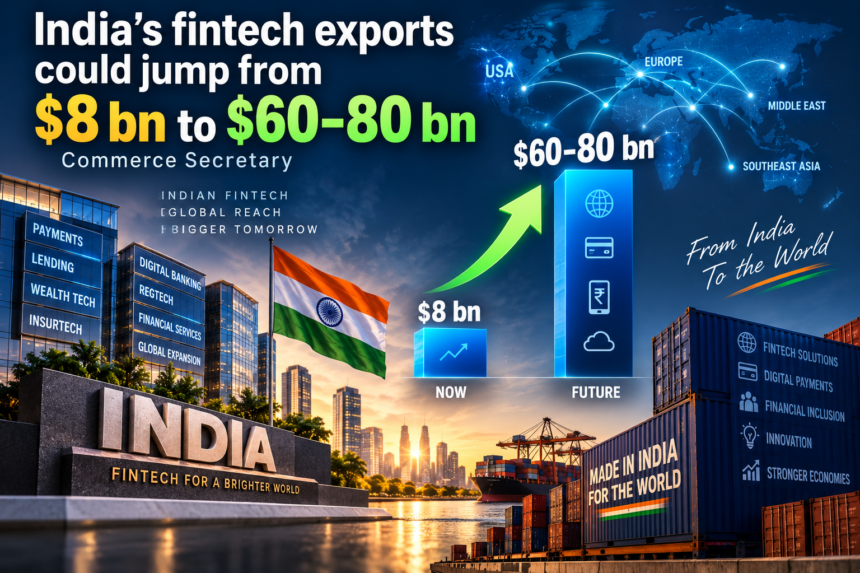

India could dramatically expand its financial-services exports from around $8 billion today to $60–80 billion by using its experience in digital payments, lending, insurance and financial technology to serve global markets, Commerce Secretary Rajesh Agrawal said at the Global Fintech Festival 2026 in Mumbai.
Agrawal argued that India now needs to diversify its services-export economy beyond traditional IT and professional services. With digital financial services increasingly able to cross borders without requiring professionals to physically relocate, fintech could become one of the country’s next major export opportunities.
The ambition is significant because global financial-services trade has already crossed $670 billion, while India’s share is only around $8 billion, or roughly 1.2–1.3%. Agrawal said capturing even 10% of the relevant global trade opportunity could potentially take India’s exports toward the $60–80 billion range.
UPI Gives India a Global Fintech Advantage
At the centre of India’s strategy is the country’s experience with digital public infrastructure, particularly the Unified Payments Interface (UPI).
UPI transformed India’s domestic payments market by allowing customers to transfer money instantly between participating banks and payment applications. According to Agrawal, India’s experience of building financial infrastructure at population scale could now be adapted for other countries, particularly emerging economies facing challenges similar to those India faced.
Many countries across Asia, Africa and Latin America still have large cash-based economies, significant informal sectors and limited access to formal financial services. Indian fintech companies could potentially work with local governments, banks and businesses to develop systems suited to those markets rather than simply selling an identical Indian product overseas.
India has already signed cooperation agreements or memoranda with 23 countries covering digital public infrastructure. UPI itself is also connected with multiple international markets, providing an early foundation for expanding India’s digital-finance footprint abroad.
Agrawal’s message to the industry was therefore straightforward: build in India, but design for the world.
Cross-Border Payments Could Become a Major Opportunity
Cross-border payments are one of the clearest areas where Indian fintech companies could expand internationally.
India receives more than $125 billion in remittances each year, but sending money internationally remains expensive because of intermediaries, currency conversions and other charges. Agrawal said that reducing the average remittance cost for Indian migrant workers from around 5–6% to 3% could leave an additional $5 billion in their hands.
The potential benefit is even larger globally. A similar reduction in remittance costs worldwide could save migrant workers approximately $30 billion, creating a substantial opportunity for companies developing cheaper and faster payment infrastructure.
India’s experience with instant digital payments could help fintech companies compete in this market by reducing the number of intermediaries involved in international transfers and making transactions more transparent.
Lending and E-Commerce Finance Could Open Another Export Market
Agrawal also highlighted digital lending as an area where Indian fintech expertise could have international applications.
Traditional lending often depends on collateral or established credit histories, which can exclude small businesses and new borrowers. Digital platforms can instead use transaction histories and other forms of financial information to assess creditworthiness.
This could be particularly valuable for India’s growing e-commerce exporters.
The Commerce Ministry is experimenting with a Niryat Credit Card aimed at helping e-commerce exporters obtain short-term financing to fulfil overseas orders. Agrawal said fintech companies could develop systems that assess an exporter based on confirmed orders and expected sales rather than requiring large amounts of collateral.
The opportunity is substantial. Global e-commerce trade is estimated at around $1 trillion, while India’s e-commerce exports are only around $5 billion, according to Agrawal. Better access to working capital could allow more Indian small businesses to participate in international e-commerce.
Insurance, Wealth Management and Trade Finance Are Also in Focus
The opportunity extends well beyond payments.
The Commerce Secretary identified insurance, wealth management, investment services and trade finance as other areas where Indian companies could develop technology-enabled services for overseas markets.
India’s large domestic market gives fintech companies an important advantage because new products can be tested at significant scale before being introduced internationally. A successful product can then be adapted to local regulations and consumer behaviour in another country.
This approach could help Indian companies move from simply exporting software to exporting complete financial technology solutions.
The government also sees GIFT City and its International Financial Services Centre as a potential gateway. Financial services that have already moved to GIFT City could eventually use the centre as a base for serving international markets.
AI, Cybersecurity and Data Protection Will Be Critical
India’s fintech expansion will not depend on technology alone. Trust could become one of the biggest requirements for exporting financial services.
Agrawal highlighted the importance of artificial intelligence, fraud detection, risk management, cybersecurity and data protection as Indian fintech companies expand internationally.
AI could help financial institutions identify suspicious transactions, assess risks and automate parts of their operations. But cross-border financial services also require strong safeguards because companies will be handling sensitive financial and personal information across different regulatory jurisdictions.
Agrawal argued that responsible technology should not be viewed as a constraint on competitiveness. Instead, strong cybersecurity, privacy protections and regulatory compliance could become an export advantage, particularly when countries decide which foreign financial technology providers they can trust.
Trade Agreements Could Help Indian Fintech Go Global
India’s expanding network of trade agreements could provide another route for fintech companies to enter foreign markets.
Agrawal said India has concluded nine free-trade agreements over the past five years, covering economies with a combined GDP of roughly $60 trillion. The government is also working to address barriers involving financial regulation, telecommunications, data flows, artificial intelligence and investment.
Such agreements could make it easier for Indian financial-service providers to deliver services overseas and establish partnerships with foreign institutions.
However, the transition from an $8 billion export industry to a $60–80 billion one would require much more than government agreements. Indian fintech firms would need to compete with established international banks, payment networks and technology companies while adapting their products to different regulatory systems and consumer preferences.
The Commerce Secretary’s target is therefore an ambitious opportunity rather than a guaranteed outcome.
Still, India’s combination of a huge domestic digital market, UPI, a mature fintech startup ecosystem, digital public infrastructure and experience with population-scale financial technology gives it a foundation few emerging economies possess.
If Indian companies can successfully turn that domestic experience into globally trusted products and partnerships, fintech could become a major new pillar of India’s services exports—potentially taking the country from $8 billion today toward the $60–80 billion opportunity envisioned by the Commerce Ministry.
About The Author