
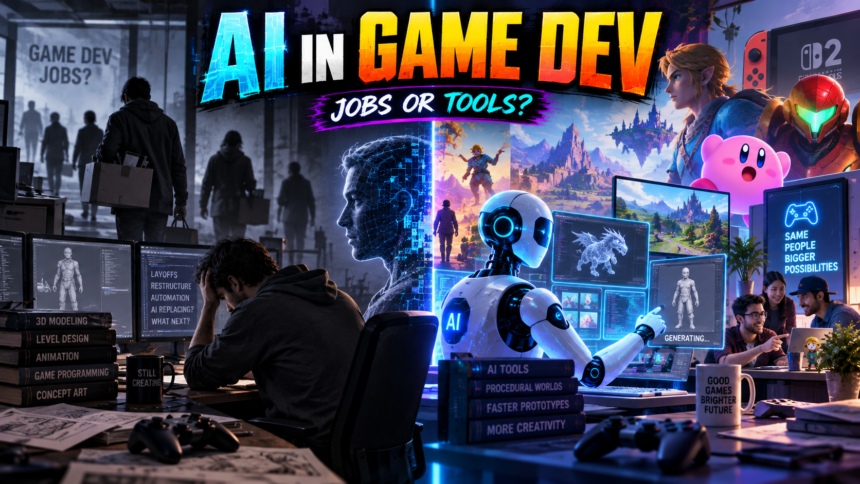
Artificial intelligence is rapidly changing how video games are designed, programmed, tested and produced, but its impact on employment is proving far more complicated than simply replacing developers with machines. For some game workers, AI is becoming a powerful productivity tool that allows small teams to accomplish work that previously required much larger studios. For others—particularly junior developers, artists and writers—the technology is contributing to a tougher job market and reducing the number of traditional entry-level opportunities.

The latest industry data shows just how divided the situation has become. The 2026 State of the Game Industry report from the Game Developers Conference (GDC) found that 36% of game-industry professionals surveyed use generative AI as part of their work. However, 52% believe generative AI is having a negative impact on the industry, up sharply from 30% the previous year.
The result is a gaming industry where AI is simultaneously creating new possibilities and increasing anxiety about employment.
Junior Developers and Creative Workers Face the Biggest Pressure
The most immediate impact appears to be concentrated in jobs involving repetitive or easily automated tasks.
Junior programmers, concept artists, writers, localisation workers and some QA roles can now use AI systems to generate first drafts, code snippets, dialogue variations, artwork concepts and testing scenarios in a fraction of the time previously required.
That does not necessarily mean an entire profession disappears overnight. Instead, studios can potentially accomplish the same amount of work with fewer people.
This is particularly concerning for newcomers trying to enter the industry. A report examining Turkey’s gaming sector found that junior developer, artist and writer opportunities have fallen sharply, with some studios using AI to allow very small teams to perform work that previously required several employees.
The problem goes beyond today’s layoffs. Entry-level jobs traditionally provided the first step toward becoming a senior developer, designer or technical artist. If those positions disappear, the industry could eventually face a shortage of experienced professionals because fewer young workers will have had the opportunity to gain the necessary experience.
A similar pattern is appearing in software engineering more broadly. Recent US hiring data shows that nearly 70% of software-development job postings were aimed at senior engineers in early 2026, compared with 55% in 2019. AI tools can handle more routine coding, increasing the value companies place on experienced workers who can supervise AI-generated output and solve complex problems.
AI Is Also Making Small Game Studios More Powerful
At the same time, it would be misleading to describe AI only as a job-cutting technology.
For independent developers, AI can dramatically lower the cost and time required to build a game. A solo developer can use AI coding assistants to create prototypes, generate placeholder assets, troubleshoot bugs, develop dialogue and experiment with gameplay mechanics without having to immediately hire a large team.
This is already changing the economics of game development.
A 2026 Gamescom developer survey found that 37% of respondents viewed smaller development teams as the industry’s biggest opportunity over the next three years. Meanwhile, 47% believed AI-assisted development would have the biggest impact on gaming during that period.
That combination is important. AI does not necessarily mean fewer games—it could mean more games being produced by smaller teams.
A two-person studio might now be able to create a prototype that previously required programmers, artists, designers and technical specialists. This could give independent developers a much lower barrier to entering the market.
But there is an obvious downside: if everyone can make games more easily, the number of games competing for players’ attention also increases. Discoverability and marketing become even more difficult.
Programmers Are Not Simply Being Replaced
Programming is one of the areas where AI’s impact is particularly visible, but the evidence suggests that many developers are using it as an assistant rather than handing over complete development to AI.
The GDC survey found that among game-industry professionals using generative AI, 47% use it for code assistance, while 35% use it for prototyping. The most common application overall was research and brainstorming, reported by 81% of AI users. ChatGPT was the most commonly used AI tool among respondents, followed by Google Gemini and Microsoft Copilot.
In practice, a programmer might ask AI to create a basic gameplay system, explain an error, write repetitive code or suggest an optimisation. The developer then reviews, modifies and integrates the result.
That distinction matters because games are unusually complicated pieces of software. A modern AAA title involves thousands of interconnected systems, including physics, animation, networking, artificial intelligence, rendering, audio and gameplay logic.
AI can produce code quickly, but it does not automatically understand the entire architecture or the creative intention behind a project.
CD Projekt Red, the studio behind The Witcher, recently reiterated that it is experimenting with AI but does not plan to rely on AI to create complete games. The company says its projects will remain predominantly human-made, particularly because of the complexity and creative requirements involved.
Artists and Writers Face a Different Kind of Disruption
The situation is more complicated for visual and narrative workers.
Generative image and text systems can produce concept variations, textures, reference material, dialogue drafts and other content extremely quickly. That makes them attractive for early-stage development, brainstorming and prototyping.
However, this has also generated some of the strongest opposition within the industry.
The GDC survey found that 64% of visual and technical artists and 63% of game designers and narrative professionals viewed generative AI negatively. Among programmers, the figure was 59%.
Part of the concern involves employment, but another major issue is creative ownership. Developers remain concerned about whether AI-generated material is trained on copyrighted work, whether generated assets can be commercially used safely and whether AI could gradually replace distinctive human artistic styles.
For this reason, many studios are adopting AI cautiously rather than allowing it to operate freely across their production pipelines.
The Jobs That May Become More Valuable
AI is unlikely to eliminate every role in game development. Instead, it is changing which skills are valuable.
Developers who can direct AI, evaluate its output and integrate it into complex production systems may become more valuable than workers who only perform repetitive tasks.
The 2026 Gamescom survey identified leadership as the most sought-after future skill, followed by technical programming, art and design, and AI literacy. It also found that 36% of developers believed AI would primarily change roles rather than reduce team sizes, while 33% expected AI to reduce team sizes.
That suggests the future game developer may increasingly be a hybrid worker: part programmer, designer or artist and part AI supervisor.
A technical artist, for example, could use AI to generate dozens of concepts but still decide which direction fits the game’s art style. A programmer could use AI to produce a prototype but remain responsible for performance, security and integration. A designer could use AI to explore hundreds of gameplay ideas while making the final creative decisions.
AI Could Shrink Teams Without Eliminating Game Development
The biggest change may therefore not be “AI replaces game developers.” It could be AI allows fewer developers to produce more content.
That distinction is critical.
If a studio previously needed 100 people to produce a game and AI allows it to achieve the same result with 70, 30 positions may disappear even if the game itself becomes more ambitious. At the same time, smaller studios may emerge because the cost of entering the market falls.
This could create a two-speed industry: large publishers operating with leaner teams and independent developers using AI to compete with much bigger studios.
There is already evidence that developers see this possibility. The GDC report found that one-third of AAA developers had experienced layoffs at their companies, while two-thirds of AAA respondents said their studios had conducted layoffs. Overall, 28% of surveyed game professionals said they had personally been laid off during the previous two years.
Those layoffs cannot all be blamed on AI. The industry has been dealing with excessive post-pandemic hiring, rising development costs, cancelled projects, market saturation and financial pressure. But AI is arriving at exactly the same time studios are searching for ways to reduce costs and increase productivity.
The Real Battle Is Over Who Controls the Tools
The future of game development is therefore unlikely to be a simple choice between humans and AI.
The bigger question is how studios choose to use AI—and who benefits from the productivity gains.
If AI allows a small team to create better games, it could open the industry to thousands of new creators. If publishers primarily use it to eliminate entry-level jobs and reduce headcount, it could make the traditional career ladder much harder to climb.
The technology is already here. The industry is now deciding how deeply it should be integrated.
For experienced developers, AI may increasingly function as a powerful new tool. For junior workers trying to get their first job, however, the situation is much more uncertain. The next few years could determine whether AI ultimately creates a broader generation of independent game creators—or leaves the industry with fewer people at the bottom and increasingly concentrated opportunities at the top.
The clearest conclusion so far is that AI is not replacing the entire game-development workforce—but it is changing the value of human labour, shrinking some tasks and potentially reshaping the traditional path into the industry.
About The Author