

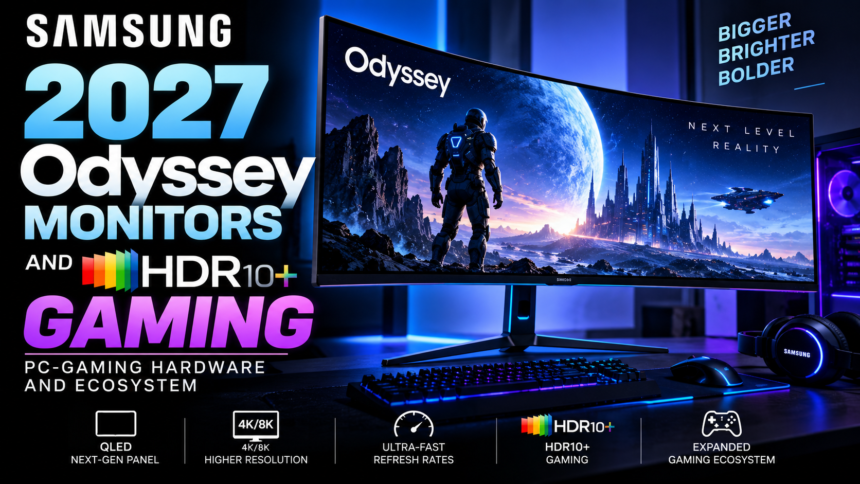
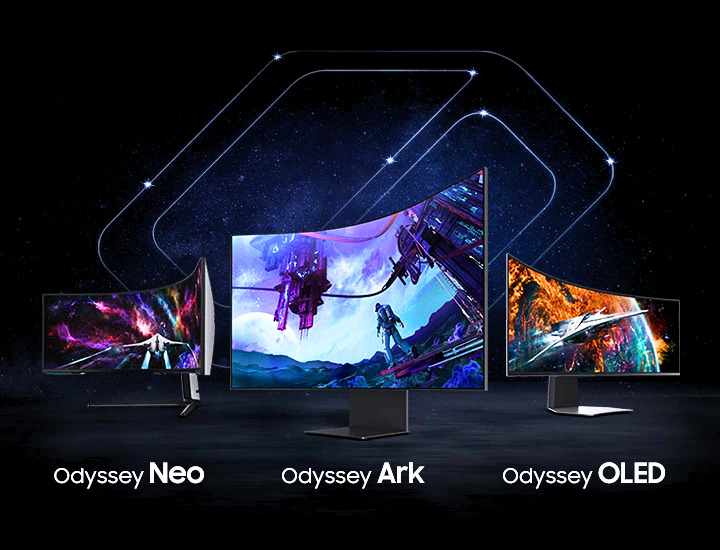
Samsung has unveiled its new 2027 Odyssey gaming monitor lineup at Gamescom 2026, bringing some of the most aggressive display specifications yet seen in gaming monitors. The new range combines extremely high refresh rates, next-generation QD-OLED panels, ultrawide screens and flexible resolution modes, while Samsung is simultaneously expanding its HDR10+ GAMING ecosystem to more major PC games.
The lineup includes four major models: the 49-inch Odyssey OLED G9, 32-inch OLED G8, 42-inch curved OLED G7 and 27-inch Odyssey G6. Samsung is targeting different types of gamers, from competitive esports players who prioritise refresh rates to players looking for cinematic visuals in RPGs and open-world games.
Odyssey G6 brings 1,100Hz to gaming monitors
The headline product is the 27-inch Odyssey G6 G60H, which Samsung describes as the world’s first gaming monitor capable of reaching a 1,100Hz refresh rate.
The number comes with an important qualification: 1,100Hz is available when the monitor is operating at HD resolution, while QHD mode reaches up to 600Hz. The monitor uses a Fast IPS panel with a 1ms response time, giving competitive players the option of prioritising either resolution or extreme refresh rate.
At 1,100Hz, each frame is displayed for less than a millisecond. That makes the G6 particularly aimed at competitive FPS players who want extremely low motion latency.
However, the benefits of moving beyond several hundred hertz will depend heavily on the game, graphics hardware and player’s ability to take advantage of the additional responsiveness. For most mainstream gamers, the 600Hz QHD mode is likely to be the more practical configuration.
OLED G9 combines ultrawide gaming with 360Hz
At the opposite end of Samsung’s lineup is the 49-inch Odyssey OLED G9 G95SJ.
The monitor combines a 5120 × 1440 Dual QHD resolution with a 360Hz refresh rate and a 0.03ms GtG response time. Samsung is using its fifth-generation QD-OLED panel with Penta Tandem technology.
The G9 also supports a Dual Mode configuration. Players can switch from the wide 5120 × 1440 experience at 360Hz to 2560 × 720 at up to 720Hz when prioritising competitive performance.
Samsung says the monitor can reach peak brightness of up to 1,300 nits under specified testing conditions. The RGB Stripe sub-pixel layout is also designed to improve text clarity and reduce colour fringing.
This makes the G9 particularly interesting for racing games, flight simulators, strategy titles and immersive open-world games where a wider field of view can be more valuable than extreme pixel density.
OLED G8 offers three different performance modes
The 32-inch Odyssey OLED G8 G80SJ takes Samsung’s flexible display approach even further.
It is a 4K QD-OLED monitor capable of running at:
- 4K at 360Hz
- QHD at 520Hz
- Full HD at 680Hz
This effectively allows gamers to choose between image quality and performance depending on the game they are playing.
For visually demanding single-player games, 4K at 360Hz provides a combination of high resolution and fast motion. Competitive players can reduce resolution to unlock higher refresh rates.
The G8 also features a 0.03ms GtG response time, VESA DisplayHDR TrueBlack 600, AMD FreeSync Premium Pro and NVIDIA G-SYNC Compatible support. Connectivity includes DisplayPort 2.1 UHBR20, HDMI, USB-C with up to 98W power delivery, USB connectivity and KVM functionality.
OLED G7 targets cinematic gaming
Samsung’s 42-inch Odyssey OLED G7 G75SJ takes a different approach.
Rather than chasing extreme refresh rates, it combines a large 4K OLED panel, 165Hz refresh rate and 1000R curvature. Samsung describes it as the world’s first 42-inch 16:9 curved OLED gaming monitor.
The large curved display is designed primarily for cinematic gaming, particularly RPGs and open-world titles. Samsung says the screen area is approximately 72% larger than its previous 32-inch model.
The G7 also has a 0.03ms response time and Samsung’s Glare Free technology, which is designed to reduce reflections from external light sources.
HDR10+ GAMING becomes a bigger part of Samsung’s strategy
The hardware announcements are only part of Samsung’s gaming push. The company is also working to expand HDR10+ GAMING support across the game ecosystem.
Samsung says it plans to expand HDR10+ GAMING to more than 20 AAA titles by the first half of 2027. One of the major partnerships highlighted at Gamescom is with Activision Blizzard for Call of Duty: Modern Warfare 4.
HDR10+ GAMING is intended to allow compatible displays and games to use dynamic HDR information to adjust brightness, contrast and colour according to the content being displayed.
The important development is that Samsung is pushing the technology further into the game-development process rather than treating HDR solely as a display feature. The company says the partnership with Activision Blizzard will bring HDR10+ GAMING into the development process for Call of Duty: Modern Warfare 4.
If Samsung can expand support across more major PC games, HDR10+ GAMING could become a more meaningful differentiator for its gaming monitors.
Samsung is also pushing glasses-free 3D
Samsung’s Gamescom strategy extends beyond conventional 2D gaming.
The company showcased its Odyssey 3D technology, which creates a glasses-free three-dimensional effect through the display. Samsung highlighted new supported games including Cyberpunk 2077 and Cronos: The New Dawn.
This is another sign that Samsung is attempting to make the Odyssey brand more than a traditional high-refresh monitor range. The company is increasingly combining display technologies, gaming software support and partnerships with developers.
What Samsung’s new lineup means for PC gaming
The 2027 Odyssey range shows how gaming monitors are splitting into increasingly specialised categories.
Competitive players are being offered extreme refresh rates with the G6, while enthusiasts can choose the ultrawide OLED G9. The OLED G8 attempts to combine high-end 4K image quality with multiple high-refresh configurations, while the G7 focuses on large-screen cinematic gaming.
The bigger question is whether gamers will actually benefit from specifications such as 1,100Hz. For esports professionals and extremely powerful gaming PCs, ultra-high refresh rates can provide measurable improvements in responsiveness. For ordinary players, however, the jump from 240Hz or 360Hz to much higher numbers may be considerably less noticeable.
HDR10+ GAMING could ultimately be just as important as the headline refresh-rate numbers. If Samsung succeeds in bringing the standard to more than 20 major games, it could give gamers a reason to consider supported displays based on image quality and game compatibility rather than refresh rate alone.
Samsung has not yet announced final pricing or exact availability for most of the 2027 Odyssey models. The company says availability will vary by market. The Odyssey G6, meanwhile, is scheduled to become available globally in the second half of 2026.
With 1,100Hz IPS, 720Hz dual-mode OLED, 360Hz 4K OLED and a rapidly expanding HDR10+ GAMING ecosystem, Samsung is clearly betting that the next generation of PC gaming displays will be defined not by one specification, but by giving players far more control over speed, resolution, HDR and immersion.
About The Author