

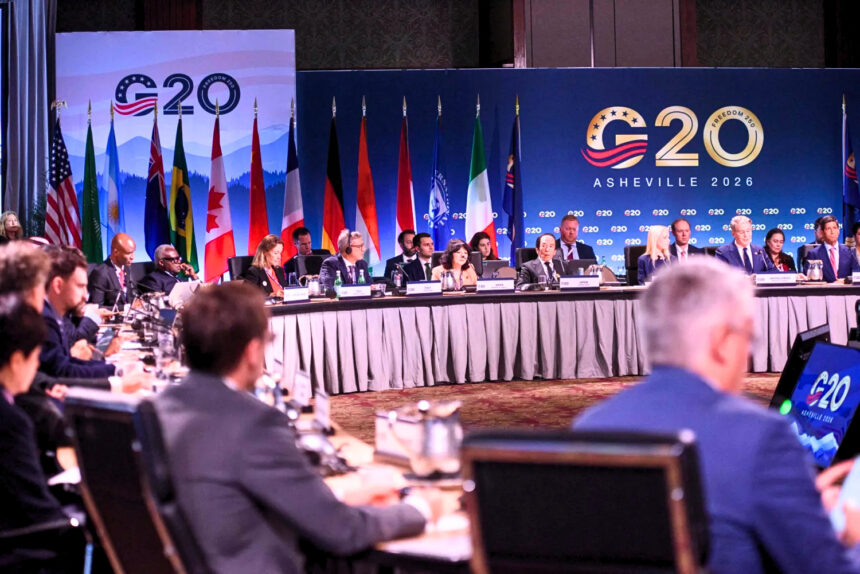
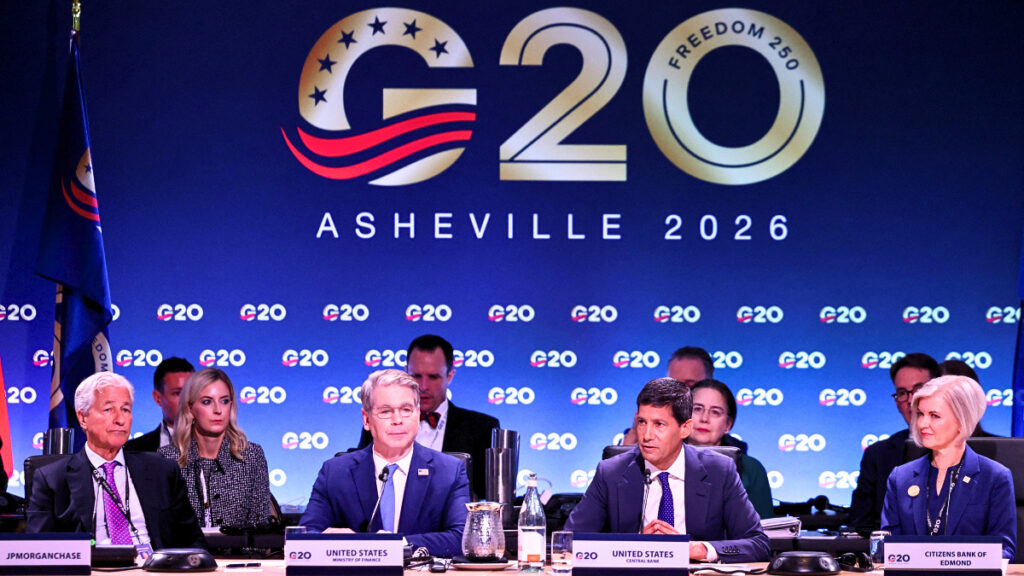
The latest G20 Finance Ministers and Central Bank Governors meeting has concluded in Asheville, North Carolina, with global economic growth, trade imbalances, sovereign debt, financial regulation and digital assets emerging as some of the biggest issues on the agenda. The two-day meeting, held on August 31 and September 1 under the US G20 presidency, brought together finance ministers and central bank governors from the world’s major economies.
The meeting comes at a challenging time for the global economy, with elevated government debt, uncertainty over trade policies, geopolitical tensions, volatile bond markets and rapid developments in artificial intelligence creating new risks for policymakers.
US puts economic growth at the centre of G20 agenda
The United States made economic growth the central theme of its 2026 G20 finance agenda. US Treasury Secretary Scott Bessent argued that the G20 should return to its original focus on economic growth, investment and financial stability.
The US presidency has identified several priorities, including productivity growth, global economic imbalances, financial literacy, sovereign debt, digital assets and financial-sector issues. The official G20 chair’s statement said the meeting also focused on private-sector participation in growth and innovation.
The emphasis on growth comes as governments worldwide face pressure to manage rising debt while maintaining investment and economic activity.
The IMF’s Managing Director Kristalina Georgieva said there was strong agreement among participants on the need to increase potential growth through structural reforms and sound fiscal and monetary policies. She also stressed the importance of international cooperation in dealing with debt challenges and global economic imbalances.
Trade imbalances become a major point of disagreement
Trade was another major issue at the meeting, particularly concerns over persistent global trade imbalances.
Bessent said that 19 finance ministers supported the need to address what the US considers unsustainable “cheap exports,” while China dissented. Washington has argued that large trade surpluses and heavily subsidised exports can distort global markets.
The disagreement highlights the wider trade tensions between the US and China.
The Trump administration has used tariffs as a major tool for addressing trade imbalances, while China has rejected the US approach and defended its trade policies.
The issue is particularly important for emerging economies, which are concerned that trade restrictions between the world’s largest economies could disrupt supply chains, investment and global growth.
India backs growth and discussions on global imbalances
India played an active role in the latest G20 discussions, with Finance Minister Nirmala Sitharaman supporting the US focus on economic growth while also calling for open discussions about global imbalances.
Sitharaman said India was broadly aligned with Washington on making growth a central priority of the G20 financial track. She also emphasized that global imbalances needed to be addressed through candid discussions among member countries.
Her participation comes as India’s economy continues to show strong momentum. India recorded 7.8% GDP growth in the first quarter of FY2026-27, with manufacturing expanding 9.2% and financial and professional services growing 12.1%, according to Sitharaman.
The strong domestic growth figures provide India with a relatively positive position as global policymakers debate the risks facing the international economy.
Sitharaman pushes trade and investment partnerships
India also used the G20 meeting to strengthen bilateral economic relationships.
Sitharaman held discussions with representatives from Russia, South Korea, Poland, Qatar, the European Union and other international institutions. Her discussions focused on trade, investment, infrastructure, technology, financial cooperation and attracting private capital.
During her meeting with European Commissioner for Economy Valdis Dombrovskis, India and the EU discussed strengthening economic and financial cooperation, ongoing trade negotiations and resilient supply chains.
The two sides also discussed cooperation involving FinTech, artificial intelligence, generative AI and critical technologies, as well as opportunities for Indian and European startups.
Sitharaman also met World Bank President Ajay Banga and discussed mobilising private capital for infrastructure and corporate financing, including support for Indian MSMEs.
Digital assets get clearer regulatory focus
Another important development was the G20’s discussion of digital assets and cryptocurrencies.
The G20 chair’s statement said digital financial innovation and digital assets could support broad-based economic growth and private-sector innovation. Members committed to advancing responsible regulatory and supervisory frameworks that support financial stability while creating clearer pathways for digital-asset innovation.
The group also highlighted the importance of addressing cross-border challenges associated with digital assets and stablecoins.
This is significant for the global cryptocurrency industry because inconsistent regulations across countries have made cross-border digital-asset activity more complicated.
The G20 also reaffirmed its work on improving cross-border payments, including efforts to expand operating hours for large-value payment systems.
AI becomes another major G20 issue
Artificial intelligence has emerged as another major economic and regulatory issue during the US presidency.
At a separate G20 Innovation Ministerial meeting in Chapel Hill, US officials pushed member countries toward a relatively hands-off approach to AI regulation. US officials argued that countries should avoid creating entirely new regulatory systems for every emerging AI technology and instead focus on genuinely novel risks.
The meeting brought together major technology figures and policymakers, with discussions involving the economic impact of AI, regulation and the infrastructure needed to support increasingly powerful AI systems.
China also agreed to the so-called “Carolina Principles”, according to US officials, although details of the document were not immediately released publicly.
The debate demonstrates the growing importance of AI in global economic policy. Governments are trying to balance technological innovation with concerns over safety, competition, employment and regulation.
Russia’s return creates diplomatic tensions
The participation of Russian Finance Minister Anton Siluanov became one of the most controversial aspects of the Asheville meeting.
Siluanov attended the US-hosted G20 finance meeting in person for the first time since Russia’s full-scale invasion of Ukraine. His presence prompted criticism from several European countries and other Western participants.
Siluanov also held bilateral discussions with US Treasury Secretary Scott Bessent.
Despite the controversy, the United States argued that Russia’s participation did not prevent the finance ministers from conducting their discussions. The meeting ended with a chair’s statement that received broad support, although China did not fully back it.
The episode highlights the difficulty of achieving consensus within the G20 at a time when geopolitical divisions between major economies remain deep.
Rising debt and global bond-market pressure
Sovereign debt was another major concern for the G20.
Governments are facing increasingly difficult choices as debt levels remain elevated while borrowing costs have risen in several major economies. The IMF stressed that sound fiscal policies and structural reforms are needed to strengthen economic resilience and reduce vulnerabilities.
The discussions occurred against the backdrop of a significant global bond-market selloff. Rising government bond yields have increased borrowing costs for countries, businesses and consumers, adding another challenge for policymakers attempting to support growth.
This makes the G20’s focus on productivity and private investment particularly important. Policymakers want stronger economic growth without relying excessively on additional government borrowing.
What the latest G20 meeting means for India
For India, the meeting provided an opportunity to highlight the country’s strong economic performance and attract additional investment.
Sitharaman used the gathering to promote India as an important destination for manufacturing, infrastructure, technology and private capital. India also discussed deeper economic relationships with major partners, including the EU, Russia, South Korea, Qatar and the United States.
The discussions around digital payments and financial technology are also relevant to India, given the country’s experience with digital public infrastructure and the rapid expansion of digital payments.
Meanwhile, stronger cooperation on supply chains and critical technologies could create opportunities for India as companies seek to diversify manufacturing and reduce dependence on concentrated production networks.
The road to the G20 leaders’ summit
The Asheville meeting was not the final major G20 event of the year. It forms part of the broader US-led G20 process ahead of the G20 Leaders’ Summit in Miami in December 2026.
The issues discussed by finance ministers and central bankers are expected to remain central to the leaders’ meeting, particularly economic growth, trade, debt, financial regulation, digital assets and technology.
However, the latest meeting also demonstrated how difficult consensus could be. Disagreements over trade, Russia, China and geopolitical issues continue to divide G20 members.
For now, the biggest takeaway is that economic growth and investment have been placed at the centre of the US G20 presidency, while India is using the platform to strengthen trade and investment partnerships and highlight its economic resilience.
With global debt rising, bond markets under pressure and AI rapidly transforming the economy, the G20 faces a difficult task: maintaining global growth while preventing trade conflicts, financial instability and geopolitical divisions from undermining the international economy. The decisions and disagreements emerging from Asheville will therefore be closely watched ahead of the December leaders’ summit in Miami.
About The Author