

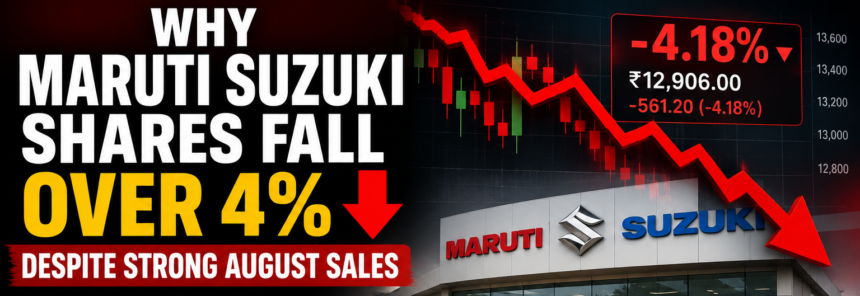

Maruti Suzuki shares came under heavy selling pressure on September 1, 2026, falling more than 4% after the country’s largest passenger-vehicle maker released its August sales figures. The decline came despite the company reporting 21.3% year-on-year growth in total sales, highlighting that investors were focusing more on the monthly slowdown, weaker exports and the stock’s technical setup than on the headline annual growth.
The stock fell as much as 5.13% to ₹12,851 during Tuesday’s session, while the Nifty 50 was also trading lower. By the afternoon, Maruti remained among the biggest losers on the benchmark index.
August sales rise 21%, but fall sharply from July
Maruti Suzuki reported total sales of 219,220 vehicles in August, compared with 180,683 units in August 2025. That represents a strong 21.32% annual increase.
However, the more immediate concern for investors was the sequential performance. Total sales fell from a record 241,421 units in July to 219,220 units in August, representing a decline of about 9.2% month-on-month.
This monthly decline appears to have been a major reason behind the negative market reaction. Investors often compare monthly auto sales not only with the previous year but also with the preceding month to assess momentum.
Exports fall 7.4%
Another concern was Maruti’s export performance.
The company exported 33,844 vehicles in August, down 7.37% from 36,538 units a year earlier. Business Standard reported that the weaker export number was a key factor behind the stock’s decline.
The fall in exports contrasts with the strong domestic market performance. Maruti’s domestic passenger-vehicle sales excluding light commercial vehicles and OEM sales increased 34.8% year-on-year to 176,971 units.
Therefore, the August numbers present a mixed picture: domestic demand remained strong, but exports weakened and overall sales declined sequentially.
Domestic passenger-vehicle demand remains strong
The domestic numbers themselves were encouraging.
Utility-vehicle sales increased 46.3% year-on-year to 79,045 units, helped by demand for models including the Brezza, Ertiga, e Vitara, Fronx, Grand Vitara, Invicto, Jimny, Victoris and XL6.
Passenger cars in the Mini and Compact/Mid-Size categories also performed strongly, with combined sales reaching 85,965 units, compared with 66,450 units in August 2025.
The figures suggest that India’s domestic automobile market continues to benefit from stronger consumer demand, particularly in SUVs and other utility vehicles.
GST changes provide a positive backdrop
The broader outlook for Maruti’s domestic business has also improved following changes to India’s GST structure.
Maruti Suzuki Chairman RC Bhargava recently said GST 2.0 has provided significant momentum to the automobile industry and expects India’s car market to reach approximately 6.3 million units by 2031. He also expects the small-car segment to grow faster following the GST changes.
Maruti has responded to this expected demand by planning significant investment. The company has announced a ₹77,500 crore capital expenditure programme over five years, aimed at expanding capacity and supporting future growth.
Therefore, the latest share-price decline does not necessarily indicate that investors have turned negative on Maruti’s long-term domestic prospects.
Technical indicators add to the pressure
Technical factors also appear to have amplified the selling.
Business Standard reported that Maruti’s share price had broken below a rising trendline and was trading below its 9-day, 20-day and 50-day moving averages. The stock’s MACD had also moved into negative territory following a bearish crossover.
SBI Securities similarly pointed to a deterioration in the technical structure. The brokerage said the stock had fallen below important moving averages, while the RSI had moved below 30, indicating strong bearish momentum.
Analysts identified the ₹13,200–₹13,300 region as an immediate resistance zone. On the downside, ₹12,800–₹12,750 was identified as an important support area.
Earlier margin concerns remain in the background
The latest selling also comes after concerns over Maruti’s profitability.
In July, Maruti reported an 11% year-on-year decline in Q1 FY27 consolidated net profit to ₹3,352 crore, despite strong sales volumes. Higher input costs linked to the West Asia crisis put pressure on margins.
Nomura had also said in August that Maruti could need additional price increases to protect margins from persistent input-cost pressure. The brokerage estimated that the company’s cumulative FY27 price increases remained below the level needed to fully offset cost pressures.
With crude oil prices again above $90 amid heightened Middle East tensions, investors remain sensitive to the possibility of further cost pressures for automakers and the wider economy.
Is the fall a sign of weakening demand?
The August numbers do not suggest a collapse in Maruti’s domestic demand. In fact, domestic passenger-vehicle sales grew strongly and utility vehicles recorded particularly high growth.
The concern is more about sales momentum, exports, margins and valuation.
Maruti’s total sales fell considerably from July’s record level, while exports declined year-on-year. At the same time, the stock has already been under pressure for much of 2026, leaving investors focused on whether earnings growth can justify the company’s valuation.
The company’s cumulative April-August FY27 sales, however, reached 1.14 million units, up 28.6% from 889,070 units in the same period a year earlier. Domestic passenger-vehicle volumes rose 35.6% during the period.
What investors will watch next
Investors are likely to focus on three things in the coming months: domestic demand, export recovery and profit margins.
Strong domestic sales following the GST changes could support Maruti’s earnings outlook. However, persistent input-cost inflation, higher crude prices and weaker exports could limit the benefits of higher volumes.
The stock’s technical performance will also remain important. A sustained recovery above the ₹13,200–₹13,300 resistance zone could improve sentiment, while a decisive break below ₹12,750 could increase selling pressure, according to technical analysts cited by Business Standard.
For now, Maruti’s sharp fall appears to be driven by a combination of a month-on-month sales decline, weaker exports, technical selling and existing concerns over margins, rather than a sudden collapse in domestic demand.
The contrasting numbers tell the story: August total sales were up more than 21% year-on-year, but down about 9% from July, while domestic passenger-vehicle sales remained exceptionally strong. Investors will now watch whether Maruti can convert that domestic demand into sustained earnings growth while controlling costs and rebuilding export momentum.
About The Author