


Media stocks came under heavy selling pressure on Monday, August 31, with the Nifty Media index plunging as much as 4.5% during intraday trading. The decline was significantly sharper than the broader market, where the Nifty 50 was down around 0.69% at one point. Zee Entertainment Enterprises (ZEEL) emerged as the biggest casualty, falling as much as 14%, while Network18 Media & Investments also declined sharply.
The selloff came amid fresh uncertainty surrounding the insolvency proceedings involving Subhash Chandra, founder of the Zee Group. At the same time, analysts are warning about structural challenges facing traditional television advertising as companies increasingly shift their marketing budgets toward digital platforms.
Zee Entertainment shares plunge 14%
Zee Entertainment was at the centre of Monday’s media-sector selloff. The stock fell 14% to ₹86.90 on the NSE during intraday trading, accompanied by exceptionally heavy volumes. Around 68.01 million ZEEL shares changed hands across the NSE and BSE, highlighting the intensity of the selling.
The immediate trigger was renewed uncertainty surrounding a repayment plan approved by the National Company Law Tribunal (NCLT) for Subhash Chandra.
According to reports cited by Business Standard, Canara Bank and Union Bank of India are challenging the NCLT’s approval of the repayment plan. The plan reportedly provides creditors with only around ₹6.5 crore against admitted claims of approximately ₹22,006.57 crore, representing a nearly 99.97% haircut for lenders.
The development has increased investor concerns around the wider financial and governance implications surrounding the Zee Group founder’s insolvency proceedings.
Network18 also comes under pressure
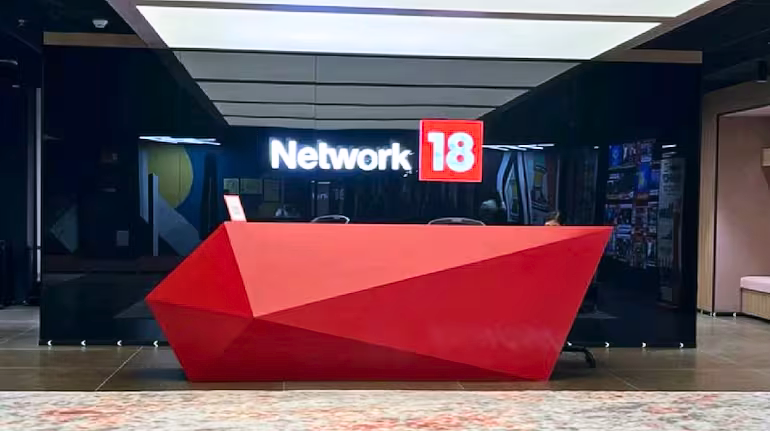
Network18 Media & Investments was another major loser in the sector. Its shares fell around 5% to ₹27.40, coming close to the stock’s 52-week low of ₹27.38 recorded on March 30.
Network18 has had a difficult year in the stock market. The company operates across broadcasting, digital content, print and related media businesses, but its shares have fallen approximately 36% so far in 2026, according to the report. That compares with a 6.8% rise in the Nifty Media index over the same period.
The decline shows that investors have remained cautious about the company’s outlook despite the broader media index having gained earlier in the year.
Sun TV hits a fresh 52-week low
Selling was not limited to Zee and Network18.
Sun TV Network dropped around 3.3% during Monday’s trading session and touched a fresh 52-week low of ₹458.60. The stock is now down approximately 21% during 2026.
Other media companies also declined, with Saregama India falling around 4% and Prime Focus losing about 3% during intraday trading.
The broad-based decline suggests that investors were not simply reacting to the Zee-related developments but were also reassessing the outlook for India’s media industry.
Television advertising faces a structural challenge
Beyond the company-specific concerns, analysts are increasingly worried about the future of traditional television advertising.
According to JM Financial Institutional Securities, television advertising is undergoing a structural decline as advertisers shift more of their budgets toward digital platforms. Companies are increasingly allocating spending to digital advertising, performance marketing, influencers and localised campaigns.
This shift is particularly important for broadcasters because advertising remains a major source of revenue.
While overall advertising and promotion spending by sectors such as FMCG, banking, automobiles and consumer durables remains healthy, an increasing portion of that money is moving away from traditional television toward digital channels.
Digital growth has not yet fully offset TV weakness
Broadcasters are responding to the changing advertising landscape by investing heavily in digital platforms.
However, JM Financial believes the digital businesses of many broadcasters are still relatively small compared with their traditional television operations. This means strong digital growth may not immediately compensate for weaker television advertising revenue.
That creates a difficult transition period for media companies.
They must continue investing in digital content and platforms while dealing with pressure on their traditional television businesses. Until digital operations reach sufficient scale, overall advertising growth could remain muted.
Why investors are becoming cautious
Monday’s selloff reflects two different concerns coming together.
The first is company-specific uncertainty, particularly around Zee Entertainment and developments related to Subhash Chandra’s repayment plan. The second is a broader structural shift in the media industry, as advertisers increasingly move their budgets toward digital platforms.
For investors, this combination creates uncertainty about both short-term sentiment and longer-term earnings growth.
Zee’s sharp decline was particularly significant because of the heavy trading volume, while Network18’s continued weakness highlights the broader pressure facing some major media companies.
What could happen next?
The immediate focus for investors will likely remain on developments surrounding the repayment plan and any further legal action by creditors.
At the sector level, investors will also be watching advertising trends closely. If television continues losing advertising market share to digital platforms, traditional broadcasters could face continued pressure on revenue growth and profitability.
However, companies that successfully build large digital audiences and convert them into advertising and subscription revenue could eventually benefit from the industry’s transformation.
For now, Monday’s market action shows that investors remain cautious. The 4.5% intraday decline in the Nifty Media index, combined with Zee Entertainment’s 14% plunge and Network18’s continued weakness, highlights the challenges confronting India’s media industry.
The coming sessions will be important for determining whether the selloff remains concentrated in a few stocks or develops into a broader reassessment of India’s media sector.
Source: Business Standard.
About The Author