

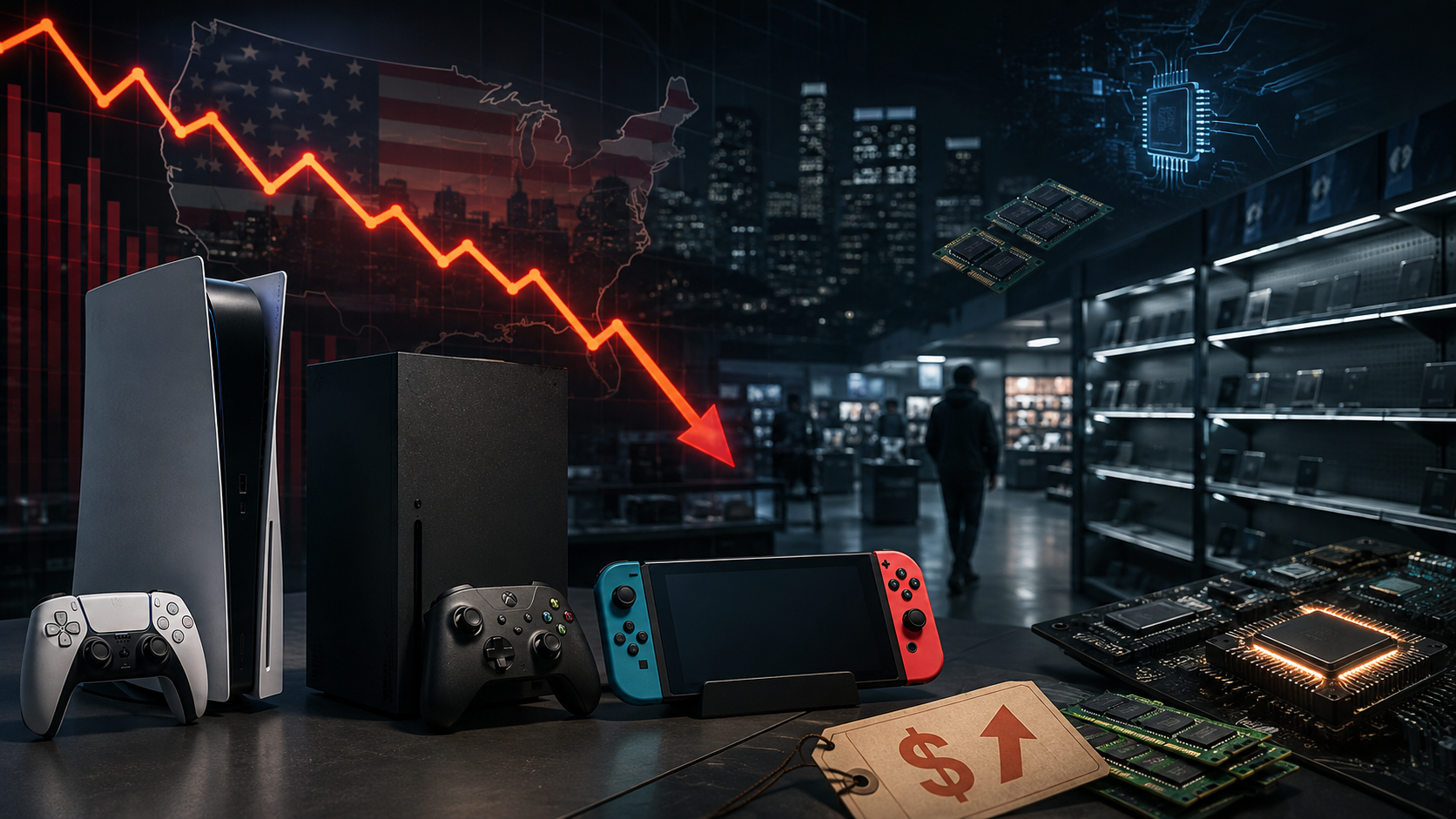

US game-hardware sales are hitting post-pandemic lows mainly because consoles have become much more expensive just as consumers have fewer reasons to buy new ones immediately. In July, US hardware spending fell 29% year over year to $282 million—the weakest July since 2020—while unit sales fell 39%.
What is driving the drop
- Higher console prices are reducing demand
The average selling price of a new game-hardware unit rose 16% year over year to $542. Circana says higher prices for PlayStation 5 and Xbox Series hardware have significantly slowed their sales rates. - Memory and component costs are rising
A RAM and component crunch has lifted manufacturers’ costs. AI data centres are competing for memory, storage and processors—the same supply chain categories used for consoles and gaming PCs—leaving companies with higher input costs. - Tariff costs have been passed on
Higher import and supply-chain costs, including those associated with US tariff policy, have added to manufacturers’ costs and helped push retail prices upward rather than downward over a console’s lifecycle. - The Switch 2 comparison is unusually difficult
July 2025 benefited from Nintendo Switch 2’s record-setting June launch. Comparing July 2026 sales with that launch-period demand makes this year’s decline look especially severe. - Hardware is available—but buyers are waiting
The 2020 low reflected supply shortages and empty shelves. In 2026, consoles are generally available; the issue is that many people are unwilling to upgrade at current prices. Eurogamer described the effect as high prices producing a result similar to a shortage.
Pricing illustrates the problem
| Hardware example | Earlier price | Current / upcoming price |
|---|---|---|
| PS5 Digital Edition | $400 at its 2020 launch | $600 after the April 2026 hike |
| Nintendo Switch 2 | — | $500 from September 1, 2026 |
| Average new US game-hardware unit | — | $542 in July, up 16% YoY |
Why 2025 was a hard comparison
July 2026 was compared with July 2025, which followed the record-setting June 2025 launch of Nintendo Switch 2. A major new-console launch creates unusually high sales momentum, so the year-on-year decline looks particularly sharp.
But the issue is not just statistical. Every major platform sold fewer units than a year earlier:
- PS5 unit sales fell 6%.
- Xbox Series unit sales fell 18%.
- Switch 2 unit sales fell 51%.
Despite the recent decline, Switch 2 remained 11% ahead of the original Switch’s time-aligned sales pace after 14 months, showing that its long-term position was still relatively strong.ign
Buyers have alternatives
Players are increasingly deciding that a new $500–$800 console is not essential:
- Subscriptions offer large libraries for a monthly fee, and subscription spending was the only major category that grew in July.
- Backlogs and live-service games give users plenty to play on existing devices.
- Cross-generation releases reduce the urgency to upgrade, because many major titles remain playable on older consoles or PC.
- Digital distribution makes it easier for publishers to sell updates, downloadable content and subscriptions without a new console purchase.
The physical side is also collapsing: new physical software revenue was only $85 million in July. Nintendo accounted for 63% of year-to-date physical-game spending and PlayStation 32%, indicating physical buying is increasingly concentrated in Nintendo’s ecosystem.ign+1
Why this differs from 2020
July 2020 hardware spending was similarly low because consoles were hard to obtain amid pandemic shortages and logistics disruption. July 2026 is more troubling for the industry because hardware is generally available—consumers simply face much higher prices and are holding back.
What the numbers mean
This is not simply a collapse in gaming interest. Subscription spending was the only major video-game category that grew in July, up 6% year over year, suggesting consumers may be shifting toward Game Pass-style access and existing hardware rather than spending hundreds of dollars on a new console.
About The Author