Nobel Prize in Economics 2025 Awarded for Innovation-Led Growth.In one of the most significant recognitions in the field of economics, the Royal Swedish Academy of Sciences has awarded the 2025 Sveriges Riksbank Prize in Economic Sciences in Memory of Alfred Nobel jointly to Joel Mokyr, Philippe Aghion, and Peter Howitt. The trio received the honor “for having explained innovation-driven growth” — a concept that has redefined how economists and policymakers understand long-run prosperity, entrepreneurship, and technological evolution.
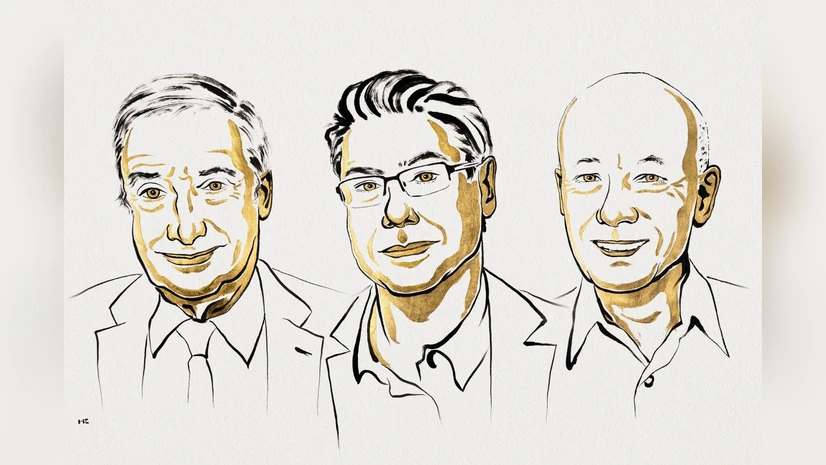
The Essence of the Award of Nobel Prize in Economics 2025
The Nobel Committee’s decision highlights the importance of innovation and creative destruction as the engines of economic development. Their work explains how sustained growth over centuries is not an accident but a result of human creativity, competition, and the continuous process of new ideas replacing old ones.
The Theoretical Foundations: How Innovation Drives Growth
Throughout history, economic progress was fragile and uneven. The laureates’ work shows why the last two centuries have been different — because societies learned to institutionalize innovation. According to Aghion, Howitt, and Mokyr, innovation must be recursive, meaning that new ideas build on previous ones. This process depends on knowledge-sharing, risk-taking, and competitive ecosystems. When these conditions are absent, economies stagnate.
Their combined insights also connect historical context with modern theory. Mokyr demonstrates that technological progress requires cultural openness and supportive institutions, while Aghion and Howitt mathematically modeled how “creative destruction” — the replacement of outdated firms and technologies with new ones — leads to continuous advancement.
Technology advances rapidly and affects us all, with new products and production methods replacing old ones in a never-ending cycle. This is the basis for sustained economic growth, which results in a better standard of living, health and quality of life for people around the… pic.twitter.com/Ggxoy3csA7
— The Nobel Prize (@NobelPrize) October 13, 2025
Breaking Down the Contributions
- Joel Mokyr, born in 1946 in the Netherlands and currently a professor at Northwestern University, bridges history and economics by explaining how cultural attitudes, institutions, and learning environments foster or hinder technological change. His research shows that innovation thrives not only on invention but also on the environment that allows new ideas to spread.
- Philippe Aghion, a French economist born in 1956 and associated with Collège de France and London School of Economics, has developed groundbreaking models in endogenous growth theory, emphasizing how competition stimulates innovation and how policy shapes the balance between stability and disruption.
- Peter Howitt, a Canadian economist born in 1946 and currently at Brown University, collaborates closely with Aghion to explore how entry and exit of firms, market competition, and technological transitions create the foundation for sustained growth.
Key Takeaways from Their Research
1. Innovation Must Be Continuous — True progress happens when societies continuously reinvent themselves through new ideas and technologies.
2. Creative Destruction Is Essential — New firms and inventions push the frontier forward by replacing older, less efficient ones.
3. Institutions Shape Innovation — Cultures that encourage curiosity, risk-taking, and openness achieve faster progress.
4. Competition Drives Productivity — Monopolies hinder innovation; open markets stimulate it.
5. Policy Matters — Economic systems must be designed to support learning, experimentation, and entrepreneurship.
Policy Implications for a Changing World
The 2025 Nobel Prize arrives at a critical moment when global growth is slowing, inequality is widening, and AI and automation are transforming labor markets. The laureates’ message is clear: societies must protect competition, nurture innovation, and prevent institutional stagnation.
Trade and openness, central to Aghion’s research, remain vital for spreading ideas and achieving economies of scale. Mokyr’s work adds that rigid systems and bureaucratic inertia can become serious barriers to innovation. Meanwhile, Howitt’s studies emphasize that growth requires a dynamic churn — policies should support startups, reskilling, and innovation-friendly ecosystems rather than favor incumbents.
For policymakers, the takeaway is profound: growth is not automatic. It depends on laws that protect creativity, systems that reward risk-taking, and education that fuels curiosity. Nations that neglect these elements risk falling behind in the global innovation race.
A Vision for the Future
As economies transition into the era of artificial intelligence and advanced automation, the work of Mokyr, Aghion, and Howitt serves as both a roadmap and a warning. Their research shows that prosperity depends not merely on technology but on the institutions, competition, and human capital that make innovation sustainable.
In honoring these three thinkers, the 2025 Nobel Committee recognizes that the story of economic growth is, above all, the story of human creativity — an ongoing journey of discovery, reinvention, and courage to embrace the new.
Checkout More Content:
About The Author
