
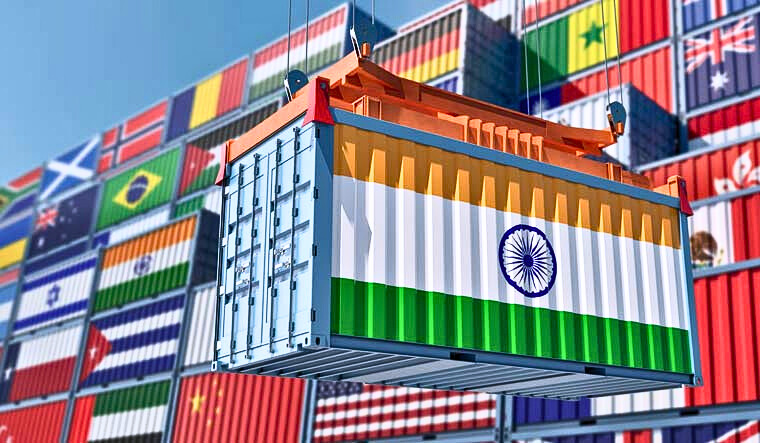
The government has notified the first set of guidelines under the Export Promotion Mission (EPM), launching a Market Access Support (MAS) scheme that puts MSMEs and first‑time exporters at the centre of India’s new export push.
Market Access Support under ₹25,060‑crore EPM
MAS is a key component of the six‑year Export Promotion Mission, which has an overall outlay of ₹25,060 crore aimed at boosting India’s export competitiveness through unified, data‑driven interventions. Within this, around ₹4,531 crore has been earmarked specifically for market access support over FY26–31, with flexibility to reallocate funds based on scheme uptake.
The scheme focuses on MSMEs, first‑time exporters and firms in priority sectors, providing financial backing for participation in international fairs, exhibitions, buyer–seller meets and trade delegations to new and emerging markets. Officials said the aim is to strengthen buyer connect and expand India’s presence in global value chains through structured, outcome‑oriented market access interventions rather than ad‑hoc support.
Strong MSME bias and cost‑sharing structure
DGFT chief Ajay Bhadoo underlined that the MAS will have a clear MSME bias to ensure diversification in products, markets and beneficiaries, with at least 35% MSME participation mandated for supported events. Cost‑sharing for eligible activities is set at 60% government and 40% private, rising to 80% government support for priority sectors with higher MSME participation, making global outreach more affordable for smaller firms.
Firms can receive support for up to three buyer–seller meets per year, while MSMEs will be allowed up to four, widening their exposure to overseas buyers. Small exporters with export turnover up to ₹75 lakh in the preceding year will also get partial airfare reimbursement to encourage first‑time and low‑scale exporters to explore foreign markets.
Trace sub‑scheme for compliance and ‘product passport’
A notable innovation under MAS is the ‘Trace’ sub‑component, which will partially reimburse costs related to testing, certifications, and even litigative expenses required to meet destination‑market standards. Bhadoo explained that many markets now demand a dynamic “product passport”, with evolving requirements such as REACH rules in the EU or eco‑tax norms, and Trace is meant to help Indian products comply fully with these frameworks.
The government also plans to use the EPM to clear arrears of about ₹330 crore pending under the earlier Market Access Initiative (MAI), signalling continuity and smoother transition for exporters shifting to the new regime. Guidelines for all 11 components of the EPM are targeted to be issued by January 31, creating a comprehensive playbook for exporters and implementing agencies.
Data‑driven monitoring and exporter performance index
To sharpen targeting and accountability, the commerce department is working on an index that will track exporter performance using Importer Exporter Codes (IECs) over a rolling five‑year period. While there will not be a rigid ‘hard linkage’ between support and performance, officials indicated there will be consequences for IEC holders in case of persistent compliance gaps or misuse.
The entire process — from event listing and proposal submission to approvals, participant onboarding, fund release and monitoring — will be handled through a dedicated digital portal to ensure transparency and ease of access. A forward‑looking three‑to‑five‑year calendar of key market access events will also be prepared and approved in advance so exporters and agencies can plan early and ensure continuity of market‑development efforts.
Not a direct response to US tariffs
On concerns that the EPM and MAS may be reactionary measures to recent US tariff hikes, Bhadoo clarified that these interventions are not designed as a direct response to any one country’s actions. Instead, the mission seeks to address long‑term structural “disabilities” in areas like trade finance, compliance costs and branding, especially for MSMEs and labour‑intensive sectors.
Officials emphasised that the EPM will operate in a “sandbox mode”, allowing fungibility of funds and mid‑course adjustments based on how tools like factoring or specific support components are picked up by the market. Taken together, the notified MAS guidelines mark the first operational step in translating the ₹25,060‑crore Export Promotion Mission from policy announcement into on‑ground support for India’s next generation of exporters.
Checkout More Content:
About The Author