
5 Study Techniques That Actually Work: A Science-Backed Guide to Study Smarter
Studying is something we all must do—whether you’re preparing for board exams, university tests, competitive exams, or learning new skills for personal growth. But the truth is, many traditional study habits don’t actually help us retain information. Rereading notes, highlighting entire textbooks, or cramming the night before an exam might feel productive, but research shows they’re some of the least effective techniques.
So what does work?
Science gives us clear answers. Here are five proven study techniques that actually boost memory, understanding, and long-term retention.
1. Active Recall — The Brain’s Best Friend

Active recall is widely considered the one out of most powerful study techniques ever discovered. It works by forcing your brain to retrieve information rather than passively reading it. Every time you recall a fact or concept, your brain strengthens that neural pathway—just like working out muscles.
How to Use Active Recall:
- After reading a chapter, close the book and explain what you remember.
- Create flashcards and quiz yourself.
- Try to write down everything you know about a topic without looking at your notes.
- Teach the concept to someone else (or pretend to).
Why it works:
When the brain practices retrieving information, it becomes far better at remembering it during exams or real-life situations.
2. Spaced Repetition — Study Less, Remember More

If active recall is the engine, spaced repetition is the fuel.
Instead of studying the same topic repeatedly in one day, spaced repetition involves reviewing material at increasing intervals—like after 1 day, 3 days, 7 days, and 14 days.
This method is backed by the “forgetting curve,” a concept by psychologist Hermann Ebbinghaus, which shows that we forget information quickly unless we review it periodically.
Tips for Spaced Repetition:
- Use apps like Anki or Quizlet.
- Break your study schedule into short, spaced sessions.
- Revisit older topics weekly while learning new ones.
Why it works:
Your brain moves information from short-term memory to long-term memory, making it stick for weeks, months, or even years.\
3. The Feynman Technique — Learn by Teaching

Named after the Nobel Prize–winning physicist Richard Feynman, this technique transforms complex ideas into simple explanations. If you can’t explain something in simple language, you don’t fully understand it yet.
How to Practice the Feynman Technique:
- Choose a topic you want to understand.
- Write an explanation as if teaching a 10-year-old.
- Identify gaps in your understanding.
- Return to the source material to fill those gaps.
- Simplify the explanation again.
Why it works:
Teaching forces your brain to organize information clearly, filter out unnecessary details, and reinforce the core concepts.
4. The Pomodoro Technique — Beat Procrastination
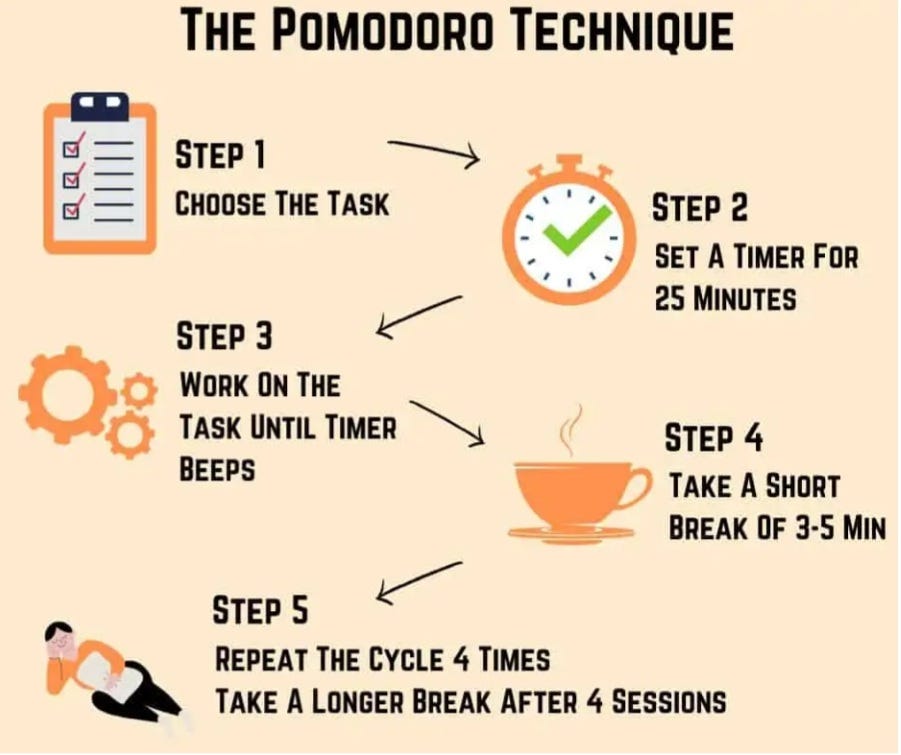
Procrastination is the biggest enemy of effective studying. The Pomodoro Technique is a simple time-management method that helps you stay focused without burning out.
How it works:
- Study for 25 minutes (one “Pomodoro”).
- Take a 5-minute break.
- Repeat this cycle 4 times.
- After 4 cycles, take a longer break (15–20 minutes).
Why the Pomodoro Technique Works:
- Short bursts increase focus and reduce mental fatigue.
- Breaks prevent burnout.
- It trains your brain to work with time, not against it.
- It helps overcome the pressure of long study sessions.
Pro tip:
Use a timer and keep distractions away—your phone should be on silent or in another room.
5. Interleaving — Mix Subjects to Boost Learning

Most students study one subject for hours before moving to another. This is called “blocking,” and while it feels organized, it’s less effective.
Interleaving means mixing different subjects or types of problems during your study time. For example, study math, then science, then English, rather than doing 3 hours of math alone.
How to Use Interleaving:
- Combine similar topics: physics + math, or biology + chemistry.
- Mix question types: theory questions + numerical problems.
- Rotate subjects every 30–45 minutes.
Why it works:
Interleaving trains your brain to switch between ideas, making it better at problem-solving and applying knowledge in new situations. It improves memory and helps you understand patterns rather than just memorizing them.
Final Thoughts: Study Smart, Not Hard
You don’t need to double your study hours to score better—you need to study smarter. These five study techniques are backed by cognitive science and used by top students worldwide. When combined, they help you learn faster, remember longer, and perform better in exams.
Quick Summary:
- Active Recall: Quiz yourself instead of rereading.
- Spaced Repetition: Review material at intervals.
- Feynman Technique: Teach concepts in simple terms.
- Pomodoro Method: Study in focused 25-minute sessions.
- Interleaving: Mix subjects or question types.
Start applying them today, and you’ll see a dramatic improvement in your productivity, confidence, and performance.
Checkout More Content:
About The Author
